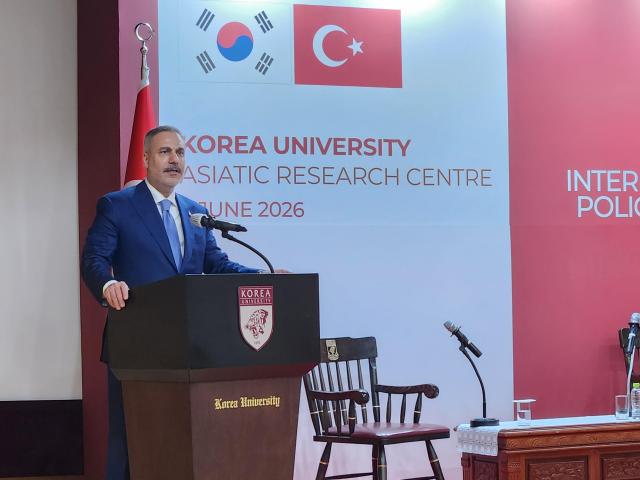
SEOUL, June 04 (AJP) - South Korea and Türkiye must leverage their diplomatic influence to address a deepening crisis in global governance and stabilize a fragmented international order, Turkish Foreign Minister Hakan Fidan said Thursday. Speaking at the 143rd International Policy Forum at Korea University in Seoul, Hakan Fidan warned that the current international system is unsustainable and requires coordinated intervention by capable middle powers.
The diplomat highlighted a profound paradox in modern global cooperation. He noted that while the international community has established an unprecedented number of institutions and treaties over the past 80 years, the sense of shared global purpose has never been more severely fractured.
He cautioned against viewing contemporary instability purely as a security crisis. Relying on familiar tactics like military deployments, deterrence, and containment fails to address the root issue, which he described as a fundamental breakdown requiring a visionary response.
The escalating conflict involving Iran in the Gulf serves as a prime example of this instability, carrying severe consequences for global economic and strategic stability. Ankara is currently utilizing its diplomatic channels to halt the active conflict and prevent secondary regional spillover. Working alongside Indonesia, the Turkish government is closely coordinating with Pakistan, which is performing the primary mediating role in ongoing negotiations between the United States and Iran.
A similar systemic failure is evident in Ukraine, now a grinding war of attrition in its fifth year where a ceasefire remains elusive due to incompatible territorial claims. The threat of the conflict expanding into a broader war between Russia and Europe remains high following a recent intermediate-range missile strike near the borders of the European Union and NATO, an act described as an unacceptable escalation.
Ukrainian forces have maintained a mid-range strike campaign against Russian ground lines of communication, successfully disrupting logistics across the theater. As the war continues indefinitely, European leaders face immense pressure to provide Kyiv with a credible and speedy path to European Union membership to help secure a future peace deal.
The situation in Gaza represents the absolute peak of this systemic breakdown, with the top Turkish envoy characterizing the international community's failure to intervene in the ongoing genocide as an acute crisis of legitimacy. He warned that a system unable to prevent atrocities or uphold its founding principles is bound to fail. Nations that long benefited from the current framework are now facing crises at their own borders, he added.
As power shifts fluidly across a growing number of theaters, no single actor can manage these global challenges alone. This dynamic elevates the role of capable middle powers like South Korea and Türkiye. Their distinct societies and backgrounds allow them to construct a resilient consensus beyond the narrow interests of singular power blocs.
Achieving concrete diplomatic outcomes relies on regional ownership and global institutional reform. Regions must manage their own risks to prevent exporting instability to the rest of the world, as peace cannot be imposed from the outside.
The minister also criticized the United Nations Security Council, arguing its veto architecture reflects a long-receded distribution of power that fails to represent current realities. Reaffirming the statement that the world is bigger than five, he demanded structural changes to establish fairness, inclusiveness, and shared responsibility.
The foreign minister assumed his current Cabinet position in 2023 following a 13-year tenure as director of Türkiye's National Intelligence Organization. His extensive administrative and academic background includes serving on the Board of Governors of the International Atomic Energy Agency and holding a doctorate in international relations from Bilkent University.
Addressing the historical ties between Seoul and Ankara, he grounded his call for reform in the military cooperation seen during the war. He noted that when the concept of collective security was put to the ultimate test on the Korean Peninsula, South Korea and Türkiye stood shoulder to shoulder.
Copyright ⓒ Aju Press All rights reserved.