
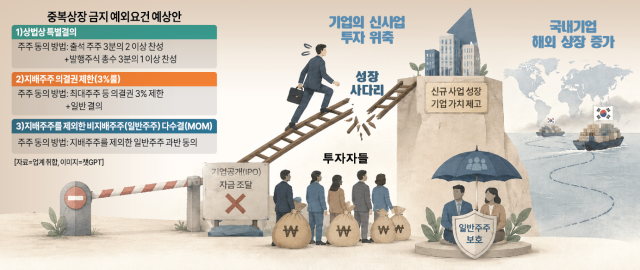
Concerns are rising that the administration of Lee Jae-myung will hinder domestic companies' ability to secure funding for future growth by implementing guidelines that generally prohibit dual listings for subsidiaries and affiliates, allowing exceptions only in specific cases. There are also worries that detailed regulations favoring minority shareholders could infringe on the rights of controlling shareholders.
According to sources in the securities industry, the Korea Exchange is expected to announce a draft of the dual listing ban guidelines and detailed regulations soon. Following a period for public comment and approval from the Financial Services Commission's Securities and Futures Commission, the guidelines are anticipated to take effect in July. This move aims to clarify the government's March announcement regarding the prohibition of dual listings for parent companies with exceptions.
Conglomerates such as SK Group, HD Hyundai Group, and LS Group, which were preparing for initial public offerings (IPOs) of their affiliates, are now in a state of emergency. They have halted all IPO plans and are cautiously awaiting the government's announcement. Financial investors are increasingly pressuring these companies to retrieve their investments amid fears of postponed or canceled IPOs.
The dual listing ban is a key policy initiative of the Lee Jae-myung administration aimed at modernizing the domestic capital market and protecting minority shareholders. The goal is to prevent the dilution of shareholder rights for parent company investors due to additional listings following corporate spin-offs. In the past, complaints arose from minority shareholders of LG Energy Solution and Kakao affiliates after their listings, prompting the government to establish preventive measures.
Jo Dong-geun, a professor of economics at Myongji University, stated, "It is appropriate to fundamentally prohibit dual listings that involve spinning off specific business segments for re-listing to protect minority investors. Allowing such practices in the past was a policy mistake, and there is a need for stricter regulations through amendments to capital market laws."
However, there are significant concerns about the potential negative impact on the IPO market. Following the government's announcement, only one company, K-Bank, has gone public on the KOSPI this year, a sharp decline from four companies in the same period last year. LS E6 Solutions had planned an IPO this year but withdrew its plans amid the dual listing controversy.
Experts worry that domestic companies may seek to avoid the dual listing ban by delisting from the KOSPI and pursuing overseas listings instead. Wang Soo-bong, a professor at Ajou University, warned, "If the dual listing ban is implemented, we may see cases where parent companies pursue overseas listings to minimize capital burdens. This would be a loss for the country, and it is questionable whether these companies would receive proper valuations abroad."
Predictions indicate that securing new funding for business growth will also become more challenging. Previously, companies could attract investments from financial investors by using equity as collateral for new business development and then repay them during an IPO. However, with the dual listing ban, this growth strategy will no longer be viable.
Consequently, companies will need to rely on profits from their core businesses or issue corporate bonds, which carry significant interest burdens. This raises the risk of both core and new businesses suffering, likely deterring companies from pursuing new ventures.
One alternative suggested is for parent companies to attract direct investments from financial investors through third-party allocations of new shares. However, accurately valuing new businesses may prove difficult, and there could be backlash from minority investors due to share dilution.
An academic source, who requested anonymity, noted, "With the dual listing ban blocking affiliate IPOs and increasing financial burdens making bond issuance difficult, the easiest option for companies will be capital increases. Considering domestic investors' negative perception of equity offerings, there is a risk that the parent company's value could decline compared to before the implementation of the regulations."
In the investment banking sector, there are concerns that global financial investors may increasingly bypass South Korea due to uncertainties surrounding capital recovery. This could lead to significant capital inflows into overseas markets where listings are relatively unrestricted, potentially disadvantaging South Korean companies during their growth stages.
* This article has been translated by AI.
Copyright ⓒ Aju Press All rights reserved.