
Throughout the history of human civilization, great cultures have always developed on two pillars: material civilization and spiritual civilization. While material civilization has enriched human life, spiritual civilization has provided answers to fundamental questions about existence, societal purpose, and national direction.
The roads and legions of Rome built an empire, but it was the law and philosophy that defined Rome's identity. Similarly, China was supported not only by the Yellow and Yangtze Rivers but also by the spiritual culture created by Confucianism, Taoism, and Buddhism. India is remembered more for the philosophical legacies of the Vedas, Upanishads, and Bhagavad Gita than for its vast territory.
Today, humanity is undergoing another significant civilizational transformation. Artificial intelligence is learning human language, robots are replacing human labor, and algorithms are encroaching on human judgment. However, as technology advances, humanity faces even more fundamental questions.
Who are we?
Where do we come from?
Where are we going?
And what should we live for?
Religion, philosophy, and sacred texts have sought to answer these questions. The Korean people have also addressed these inquiries in their unique way over the centuries. The Cheonbu-gyeong explains the order of the universe, the Samil Sin-go discusses the heaven within humanity, and the Chamjeon Gyeong teaches how humans should live. The Daejonggyo movement aimed to carry on this tradition of spiritual culture into modernity.
Understanding Daejonggyo merely as a religion may overly diminish its historical significance. It emerged as a spiritual movement to preserve the national spirit during a time of losing sovereignty, served as an important ideological foundation for the independence movement, and sought to modernize the unique Korean ideal of Hongik Ingan through cultural efforts.
The revival of Daejonggyo by Na Cheol in 1909 was not coincidental. The Korean Empire was on the brink of collapse, and the nation's fate hung by a thread. Japan was exerting military pressure on Korea, and national self-esteem was crumbling. Na Cheol viewed this crisis not merely as a political one but as a crisis of national spirit. He believed that while territory could be seized by force, the national spirit could not be taken away. Thus, he reinterpreted Dangun not as a mythical figure but as a symbol of Korean spiritual history.
Following this, Daejonggyo became more than just a religious organization; it became a spiritual stronghold for the independence movement, particularly in Manchuria and the northern Gando region. Daejonggyo established schools, educated youth, and taught national identity. It posed the question, "Who are we?" to a people who had lost their country, seeking answers in the spirit of Dangun and Hongik Ingan.
Seoil, who succeeded Na Cheol, further developed this movement. He was deeply involved in the Declaration of Independence and the activities of the Northern Military Government, dedicating himself to training independence fighters and promoting national education. General Kim Jwa-jin, a hero of the Battle of Cheongsanri, also grew in this spiritual environment. The independence fighters' ability to endure the harsh winters of Manchuria was not solely due to weaponry; they were driven by a sense of mission and spiritual conviction to reclaim their nation.
Yoon Se-bok, another key figure in Daejonggyo, dedicated his life to both the independence movement and the revival of national culture. He believed that political independence alone was insufficient; true national revival required both spiritual independence and cultural self-reliance. This perspective later influenced historical studies and research on national culture.
At this juncture, we recall Dasuk Yoo Yeong-mo. He was not a thinker confined to a specific religion but explored Christianity, Buddhism, Confucianism, Taoism, and the traditional spirit of the Korean people. His lifelong pursuit was the heaven that resides within humanity. He viewed awakening human nature and restoring inner spirituality as crucial tasks in life.
One of Dasuk's frequently emphasized ideas was that while truth is singular, the paths to it are many. This resonates with the Cheonbu-gyeong's concept of 'ilsi musil.' The cosmic order that begins from one and returns to one, the divinity within humanity, and the Daejonggyo teaching of living to benefit the world share significant commonalities with Dasuk's thoughts. While Yoon Se-bok spoke of the spirit of the nation, Dasuk spoke of the spirit of humanity. Yet both sought to find fundamental values that make humans truly human.
Even after the establishment of the Republic of Korea, the spirit of Daejonggyo continued in various forms. The first Minister of Education, Ahn Ho-sang, played a crucial role in institutionalizing Hongik Ingan as the educational philosophy of South Korea. The spirit of Hongik Ingan, as outlined in the current Education Basic Act, is not merely rhetoric; it is the result of the core values of the spiritual culture accumulated by the Korean people over time being formalized into national educational philosophy.
Hongik Ingan is not just a nationalistic slogan. This spirit of broadly benefiting humanity encompasses universal values of human dignity, community ethics, freedom, and responsibility. In this sense, Hongik Ingan can be connected to the sustainability that today’s global civil society seeks.
Recently, the Hongshan culture relics discovered in the Liaoning region of China and Inner Mongolia have sparked new interest in the study of ancient civilizations in Northeast Asia. Some researchers believe that Hongshan culture may provide important clues for studying the ancient culture of the Korean people. However, the direct connection between Hongshan culture and the Cheonbu-gyeong or Samil Sin-go remains an area that requires careful academic scrutiny. What is clear is the need for more vigorous efforts to explore the roots of our ancient history and the origins of Northeast Asian civilization.
History is a discipline that illuminates the past but also prepares for the future. Just as a tree that loses its roots cannot survive long, a nation that loses its history and spirit cannot endure. While South Korea has achieved industrialization, democratization, and informatization, it is now time to contemplate the advancement of spiritual culture.
Today, Daejonggyo faces new challenges. It must not remain confined to commemorating the past. There is a need to reinterpret the spirits of the Cheonbu-gyeong, Samil Sin-go, and Chamjeon Gyeong in contemporary language and connect them to modern society. Especially in the AI era, understanding why we use technology is becoming more important than how we use it.
Artificial intelligence can mimic human intelligence, but whether it can replace human conscience remains uncertain. Technology is a powerful tool, but it does not set its own purpose. Ultimately, humans must determine the direction.
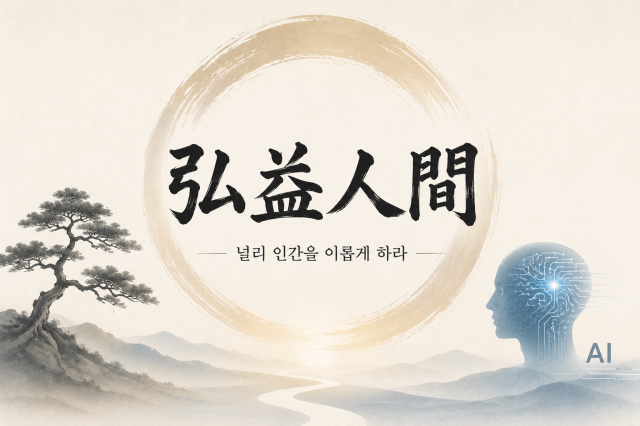
One of the values that can guide this direction is Hongik Ingan. Creating a society where humans and AI together benefit humanity, rather than one where AI dominates humans, could be a new interpretation of Hongik Ingan in the 21st century.
The future tasks of Daejonggyo lie here: to restore the soul of the nation, explore the roots of history and culture, and provide future generations with a direction for a dignified human life. This is not a return to the past but a creation of the future.
The Cheonbu-gyeong speaks of the order of the universe, the Samil Sin-go discusses the heaven within humanity, and the Chamjeon Gyeong teaches a life that benefits the world. Ultimately, all these teachings converge into one phrase: Hongik Ingan.
As we delve deeper into the AI era, humanity needs deeper philosophy rather than more technology. The questions our ancestors posed thousands of years ago remain relevant today.
What is the universe?
Who is humanity?
How should we live?
The answers ultimately converge into one: Illuminate yourself and benefit the world. Hongik Ingan.
This may be the oldest future left by the Korean people and one of the most precious spiritual legacies that South Korea can contribute to the world.
※ This article was written using generative AI and has been reviewed by an editor.
* This article has been translated by AI.
Copyright ⓒ Aju Press All rights reserved.