
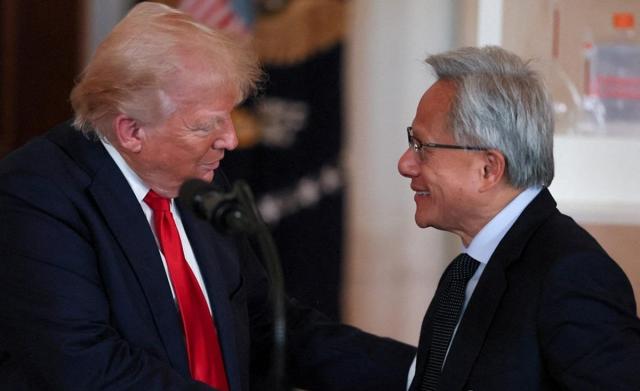
During a summit between U.S. President Donald Trump and Chinese President Xi Jinping, Taiwan emerged as the most discussed and sensitive topic. Trump himself revealed that Xi asked whether the U.S. would defend Taiwan, indicating that Taiwan was at the forefront of Xi's concerns, despite discussions on tariffs, trade, and supply chains.
China has long referred to the Taiwan issue as a "core interest," but its obsession has intensified recently, primarily because Taiwan has become the heart of the global artificial intelligence (AI) industry.
Until a few years ago, the Taiwan issue was mainly interpreted through the lenses of history, nationalism, and territorial sovereignty. While these factors remain significant, under Xi's regime, the "great rejuvenation of the Chinese nation" is not merely a slogan for economic growth; it is a political project aimed at achieving unification with Taiwan by 2049, the centenary of the founding of the People's Republic of China. For the Chinese Communist Party, Taiwan is not just an island but a symbol tied to its legitimacy. However, Taiwan now also represents a strategic asset in the realm of AI supremacy.
Today, the global AI industry cannot function without Taiwan. NVIDIA's AI semiconductors, as well as servers from Apple and Meta, and Tesla's autonomous driving systems, all rely on advanced processes from Taiwan's TSMC. No matter how well U.S. tech companies design their products, they depend on Taiwan for production, making Taiwan the focal point of the world's cutting-edge semiconductor supply chain.
Interestingly, the situation is similar for China. Amid U.S. semiconductor sanctions, China has been advocating for an "AI ecosystem without NVIDIA," yet many AI semiconductors developed by Chinese companies still rely on TSMC's production lines. Even the AI vehicle chips showcased by Chinese semiconductor firms at the Beijing International Auto Show were noted to be produced using TSMC's 4-nanometer process.
Ultimately, both the U.S. and China, as well as the entire global AI industry, are dependent on Taiwan. This is why Xi cannot abandon Taiwan. While Taiwan was once a political symbol, it has now become a strategic asset for future industries. Semiconductors are no longer just components; they are critical infrastructure that influences military power, economic strength, and AI competitiveness. For Xi, Taiwan is a territory that "must be unified" and a technological hub that "cannot be surrendered to the U.S."
Another crucial aspect is the Chinese leadership's perception of time. While U.S. policies can shift dramatically with elections, China operates on a 10- to 20-year timeline. There is a strong belief within China that "time is on China's side." In fact, economic ties between China and Taiwan have deepened significantly, with cross-strait trade volumes increasing substantially over the past decade and industrial connections strengthening.
Xi's regime is also solidifying its long-term governance structure. China has entered a new five-year plan, and discussions suggest that Xi's leadership could continue beyond 2027. This indicates that Taiwan strategy is not a short-term event but a long-term project.
The challenge is that as the AI era progresses, Taiwan's strategic value will only increase. Just as past struggles over oil shook the Middle East, future competition over semiconductors is likely to disrupt East Asia, with Taiwan at its center.
In 1954, Mao Zedong stated, "The most important issue in U.S.-China relations is the Taiwan issue, and it is a long-term problem." Nearly 70 years later, that statement remains largely true. The difference now is that while Taiwan was once a geopolitical issue of the Cold War, it has become a key engine of the global economy in the AI era.
This is why Xi cannot relinquish Taiwan—not just for territorial reasons, but because the future world order hinges on that island.
* This article has been translated by AI.
Copyright ⓒ Aju Press All rights reserved.