
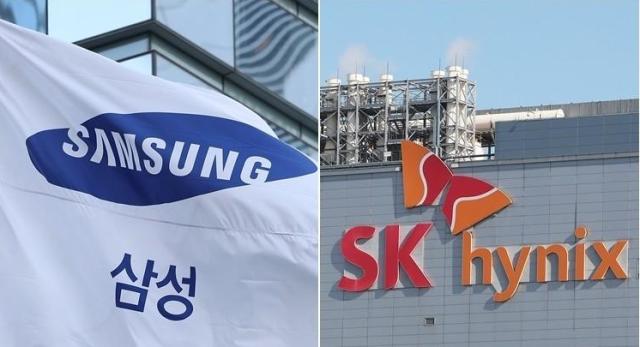
The decline in U.S. semiconductor stocks has dealt a significant blow to the South Korean market. Following Broadcom's disappointing revenue forecast for AI semiconductors, investor sentiment weakened, leading to substantial drops for both Samsung Electronics and SK Hynix.
On June 5, the Korea Exchange reported that Samsung Electronics closed at 329,000 won, down 6.40% from the previous trading day. The stock opened at 333,500 won and fell to as low as 325,000 won during the day, before recovering slightly by the close.
SK Hynix also saw a significant decline, finishing at 2,070,000 won, down 9.92% from the previous session. The stock opened at 2,142,000 won and dropped to 2,070,000 won during trading.
The sharp decline in major semiconductor stocks is attributed to the recent correction in U.S. semiconductor shares. On the previous night, New York stocks saw Broadcom drop by 12.59%, Micron Technology by 7.74%, SanDisk by 3.92%, and Western Digital by 3.13%.
Broadcom's forecast for third-quarter AI semiconductor revenue was set at $16 billion, falling short of market expectations of $17.2 billion, which significantly dampened investor sentiment.
Analysts believe this correction is more a result of weakened investor sentiment and profit-taking rather than a fundamental deterioration. Lee Kyung-min, a researcher at Daishin Securities, stated, "Broadcom's guidance of $16 billion for third-quarter AI revenue was below the expected $17.2 billion, leading to a decline in investor sentiment for the semiconductor sector. This prompted profit-taking in domestic semiconductor stocks, resulting in an overall downturn."
He added, "Additionally, a decrease in risk appetite and global liquidity outflows, such as the SpaceX IPO, contributed to panic selling, causing the sector to decline collectively."
* This article has been translated by AI.
Copyright ⓒ Aju Press All rights reserved.