
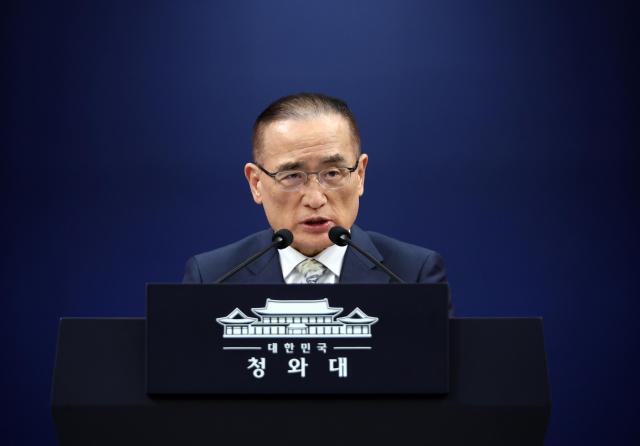
A senior presidential official told reporters that South Korea and the U.S. held productive discussions on nuclear-powered submarines, uranium enrichment and spent fuel reprocessing.
“Representatives from various sectors came and discussed enrichment and reprocessing issues as well as nuclear submarine issues,” the official said. “We have not set a specific deadline, but we want to move forward quickly.”
The official stressed that South Korea’s plan to build nuclear-powered submarines at home remains largely unchanged, while noting that new agreements are needed for enrichment and reprocessing, as well as to prevent proliferation.
The official said discussions on enrichment and reprocessing have only recently begun in earnest, adding that they are based on South Korea’s nonproliferation commitment and trust in that pledge. “We must keep that commitment, and on that basis, we will seek further coordination and cooperation with the U.S.,” the official said.
Asked about coordination with Washington over the timeline for the transfer of wartime operational control (OPCON), the official said differences between the allies are not as large as many believe.
“Contrary to what many of you may think, South Korea and the U.S. do not have major differences over OPCON,” the official said.
The official said efforts to meet the conditions for the transfer have continued for more than a decade, adding that there had been an assessment several years ago that more than 90 percent of the conditions had been met.
The official also said the gap over timing is limited.
“There is not a big difference over the timing either. There is a gap of about a year, or a little more than a year, and I do not see that as impossible to narrow,” the official said.
South Korea has been seeking to regain wartime operational control by 2028, while U.S. Forces Korea Commander Gen. Xavier Brunson presented the first quarter of 2029 as the target timeline during a House Armed Services Committee hearing in April.
The official said Seoul and Washington will continue coordinating the final stage of conditions and timing, while ensuring that the allies’ combined defense capabilities are not weakened.

Copyright ⓒ Aju Press All rights reserved.
