
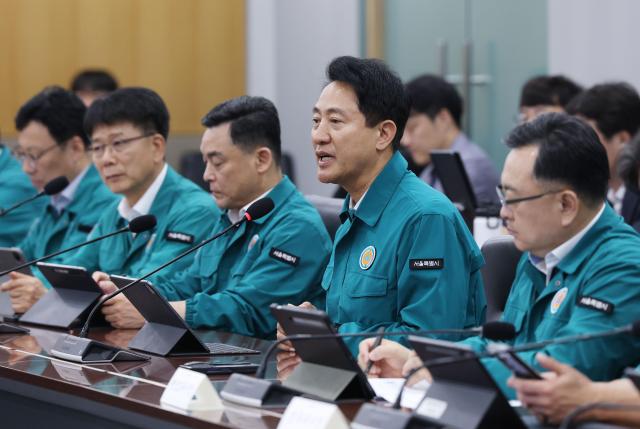
In the June 3 local elections, Oh Se-hoon of the People Power Party secured his fifth term as Seoul mayor, demonstrating his political strength. However, the next four years are expected to be challenging as the Seoul City Council has shifted power back to the Democratic Party, placing Oh's administration under significant scrutiny from the outset.
According to the National Election Commission, the Democratic Party has won 81 of the 118 seats in the Seoul City Council, while the People Power Party holds only 37 seats. This majority allows the Democratic Party to potentially override the mayor's veto power, as they have surpassed the two-thirds majority required to do so under local government law.
Political analysts suggest that this shift indicates that "half of Seoul's power has returned to the Democratic Party." Even if Mayor Oh attempts to lead the city, he will likely struggle to enact ordinances, budget allocations, and major policies without cooperation from the Democratic-controlled council.
The city has a history of conflict under a divided government.
Oh previously clashed with a Democratic majority in the city council after the 2010 local elections, notably over the issue of free school meals. The council pushed for universal free meals, while Oh advocated for selective welfare. This standoff culminated in a referendum, which resulted in low voter turnout and led to Oh's resignation as mayor. This incident is often cited as a prime example of how political disputes can engulf city governance.
After returning to the mayor's office in the April 2021 by-election, Oh faced a similar situation. At that time, the Democratic Party held 99 of 110 seats in the council. Oh sought to restructure various projects initiated during the tenure of former Mayor Park Won-soon, but encountered significant resistance from the council.
A notable point of contention was TBS (Traffic Broadcasting System). Disputes over financial support and allegations of bias led to prolonged conflicts between the city and the council, which were only resolved after the People Power Party gained a majority in the 2022 local elections and moved to halt funding.
Given the Democratic Party's acquisition of 81 seats, significant challenges are anticipated for Oh's administration.
The TBS issue is likely to resurface, with speculation that the Democratic-controlled council may revisit funding discussions under the pretext of restoring public broadcasting functions. TBS has become a politically charged topic between Oh's administration and the Democratic Party.
Budgetary conflicts also seem inevitable.
Oh's key initiatives, including the Great Han River Project, Han River Bus, Seoul Run, Guaranteed Income, and Automatic Transportation policies, may face budget cuts or adjustments during the council's review process. If the Democratic Party prioritizes "people's livelihood" and demands a reassessment of these projects, the pace of implementation could be adversely affected.
However, some analysts believe that there are factors that differentiate the current situation from those in 2010 and 2021.
Oh's political stature has changed significantly. As a five-term mayor and a potential candidate for the next presidential election, he carries more political weight than before. His extensive administrative experience may lead him to pursue a more pragmatic approach, balancing direct confrontations with negotiations and compromises on specific policies.
The Democratic Party also faces its own challenges. If they are perceived as obstructing city governance, they could face backlash from voters. Seoul residents tend to prioritize practical solutions to issues like transportation, housing, and livelihoods over ideological conflicts. Unconditional opposition or political strife could ultimately lead to voter fatigue.
Historically, the politics of Seoul have demonstrated the costs of failed cooperation. When the city and council clash, the consequences are often borne by the citizens, resulting in project delays, budget disputes, and administrative gaps that lead to everyday inconveniences.
A political insider remarked, "If the Democratic council focuses solely on securing political dominance rather than serving as a check, Seoul's governance could descend into extreme conflict. Conversely, Mayor Oh must also demonstrate leadership through collaboration and persuasion rather than unilateral actions."
The success or failure of Seoul's governance over the next four years will depend not on numbers but on political acumen. Whether the Democratic Party's 81 seats will serve as a balance of power or become a source of contention will be determined in the evolving relationship between the city and the council.
* This article has been translated by AI.
Copyright ⓒ Aju Press All rights reserved.