
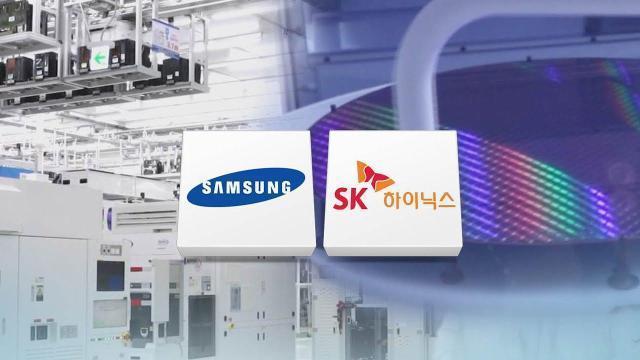
Samsung Electronics and SK Hynix are projected to maintain their record performance in the second quarter. After both companies exceeded market expectations with their operating profits in the first quarter, there are predictions that they could rank among the top global profit earners for the year, and this positive trend is expected to continue into the second quarter.
According to industry reports on June 7, analysts predict that the combined operating profit for Samsung Electronics and SK Hynix in the second quarter could exceed 150 trillion won. When annualized based on first-quarter results, Samsung is expected to rank among the top two globally, while SK Hynix is projected to be around fifth place, with second-quarter forecasts indicating even higher expectations.
Samsung's semiconductor division is expected to drive the company's overall performance in the second quarter. Market analysts believe Samsung's operating profit could rise to the high 80 trillion won range. This increase is attributed to the significant impact of rising prices for general DRAM and NAND, along with expanded sales of HBM, leading to a greater share of profits from the device solutions segment.
Samsung is benefiting greatly from its world-leading memory production capacity, particularly as demand for general DRAM recovers. The expansion of AI servers is not only affecting HBM but also boosting demand for general server DRAM and high-capacity NAND, shifting the memory market to a supplier-dominated landscape.
SK Hynix is also likely to achieve record results in the second quarter. With its leading position in the HBM market and rising prices for general memory, forecasts suggest that its operating profit margin could exceed that of the first quarter. Some analysts even speculate that the second-quarter operating margin could approach 80%.
Both companies attribute their performance improvements to the simultaneous strength of HBM and general memory. While the AI memory boom was primarily centered around HBM until last year, the expansion of inference-based AI services this year has rapidly increased demand for server DRAM and NAND. As the focus shifts from AI training to inference, the types of memory required by data centers are also diversifying.
Major server clients are moving to secure supplies of general DRAM and high-capacity NAND ahead of potential shortages in the third quarter, and this pre-order trend is believed to have influenced price negotiations in the second quarter.
Exchange rates are also playing a favorable role in performance. Since memory semiconductors are predominantly settled in dollars, a high won-dollar exchange rate increases revenue and profits when converted to won. Additionally, given the semiconductor industry's high fixed costs, revenue increases during price upturns quickly translate into profits.
The key question is whether the supplier-dominated trend will continue in the second half of the year. SK Hynix is expanding its long-term production capacity through investments in its Cheongju M15X and Yongin clusters, as well as advanced packaging in the U.S. Samsung is also aiming to regain leadership in the next-generation AI memory market with HBM4 and HBM4E.
An industry insider noted, "While the first quarter confirmed the semiconductor supercycle in numerical terms, the second quarter will demonstrate that this trend is not just a temporary rebound. Prices for HBM, general DRAM, and NAND are moving together, suggesting that annual operating profit forecasts for this year may continue to be revised upward."
* This article has been translated by AI.
Copyright ⓒ Aju Press All rights reserved.