
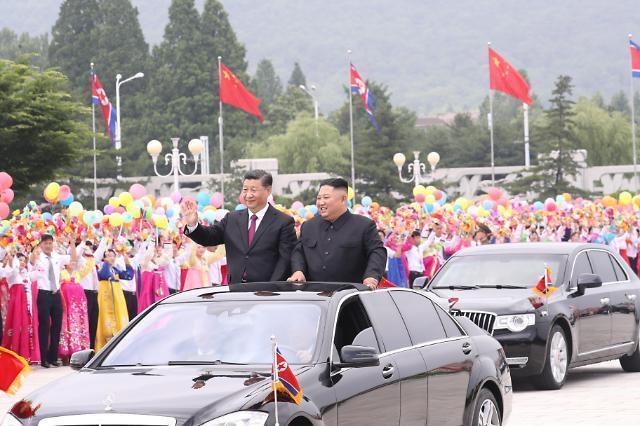
Chinese President Xi Jinping has chosen North Korea as his first overseas destination this year. He will make a state visit to the country from June 8 for a two-day meeting with North Korean leader Kim Jong-un.
This marks Xi's first visit to North Korea in nearly seven years, following Kim's trip to China in September last year for the Victory Day celebrations.
Given the diplomatic significance of selecting North Korea as his first foreign stop this year, China is expected to reaffirm its traditional friendly relations with North Korea while enhancing strategic cooperation in economic, diplomatic, and security areas. This move is also seen as an effort to assert China's influence in the Korean Peninsula and Northeast Asia.
Wang Yajun, the Chinese ambassador to North Korea, stated in an article for the People's Daily on June 6 that "the two leaders will hold an important historical meeting and outline a new chapter in China-North Korea relations for a new era."
China to Showcase Influence Over North Korea Amid Strengthened China-North Korea-Russia Cooperation
This year marks the 65th anniversary of the China-North Korea Mutual Aid and Cooperation Treaty, and China is likely to focus on further strengthening its ties with North Korea. This treaty includes a clause for automatic military intervention if one party is attacked, symbolizing the China-North Korea alliance.
However, concerns have arisen within China regarding a potential decline in influence over North Korea as the latter rapidly expands military and economic cooperation with Russia. Amid U.S.-China competition and the growing closeness between North Korea and Russia, analysts suggest that China will seek to reinforce its relationship with North Korea to maintain its influence while also strengthening the trilateral cooperation framework with North Korea and Russia against the U.S.-led international order.
As China-North Korea-Russia cooperation progresses, there is growing interest in China's potential access to the East Sea through the Tumen River.
The issue of utilizing the Tumen River as a maritime route to the East Sea has been a significant concern for China. The northeastern region of China has been unable to directly access the East Sea due to geographical barriers posed by Russia's Primorsky Krai and North Korea. However, during recent China-Russia summits, it was indicated that discussions regarding the Tumen River's maritime access would involve North Korea.
In addition to Tumen River cooperation, economic development collaboration, including the utilization of North Korea's Rason Economic Zone and the expansion of material and human exchanges between the two countries, is expected to be a focal point of the upcoming summit.
Sing Liqi, a professor at Fudan University's Institute of International Studies, predicted in the Hong Kong Ming Pao that Xi's visit to North Korea would enhance cooperation in various social and economic fields. He noted that North Korea is currently at a crucial stage of economic development, and cooperation between the two countries presents significant investment opportunities for China, indicating substantial potential for collaboration.
North Korea Showcases Nuclear Capabilities Amid Potential for U.S.-North Korea Dialogue
Issues surrounding North Korea's nuclear program and the Korean Peninsula will also be key topics at the summit. Following a series of recent summits involving the U.S., China, and Russia, Xi's immediate visit to Pyongyang is likely to emphasize China's role as a key mediator in the Korean Peninsula issues.
As North Korea continues to reject denuclearization and block dialogue with the U.S., attention is focused on whether China can facilitate a resumption of talks between North Korea and the U.S.
Recently, North Korea has been asserting its nuclear capabilities and justifying its possession of nuclear weapons. Reuters reported that "ahead of Xi's visit to North Korea, the country is justifying the acceleration of its nuclear arsenal to strengthen its negotiating position."
Consequently, some analysts believe that the likelihood of the two leaders finding a breakthrough on denuclearization is low. This year, statements from the China-South Korea, China-Russia, and U.S.-China summits have notably omitted references to denuclearization on the Korean Peninsula, indicating a subtle shift in the principle of 'no tolerance for North Korea's nuclear program.'
Voice of America (VOA) cited experts who noted that "amid the growing closeness between North Korea and Russia, China is shifting towards a less critical stance on North Korea," and that considering China's reluctance to interfere in North Korean internal affairs, discussions on denuclearization with Kim may be challenging.
Chinese expert Deng Yiwun recently wrote in Foreign Policy that "if China continues to maintain distance, it risks pushing North Korea further towards Russia and ultimately losing its dominant position on the Korean Peninsula," adding that China will likely use Xi's visit as an opportunity to present economic and security incentives to draw North Korea back into a China-led orbit.
A diplomatic source in Beijing remarked that "Xi's visit to North Korea demonstrates China's leadership in international diplomatic order through the recent series of U.S.-China and China-Russia summits, while also sending a message that it will manage the security concerns (North Korea's nuclear issue) in its own backyard."
* This article has been translated by AI.
Copyright ⓒ Aju Press All rights reserved.