
On June 5, the status board at Hana Bank's dealing room in Jung-gu, Seoul, displays the KOSPI and other indices. [Photo=Yonhap News]
The won-dollar exchange rate has surged to its highest level since the financial crisis due to geopolitical risks stemming from the Middle East. As U.S.-Iran peace negotiations stall, international oil prices have skyrocketed, exacerbating the downward pressure on the won amid foreign capital outflows.
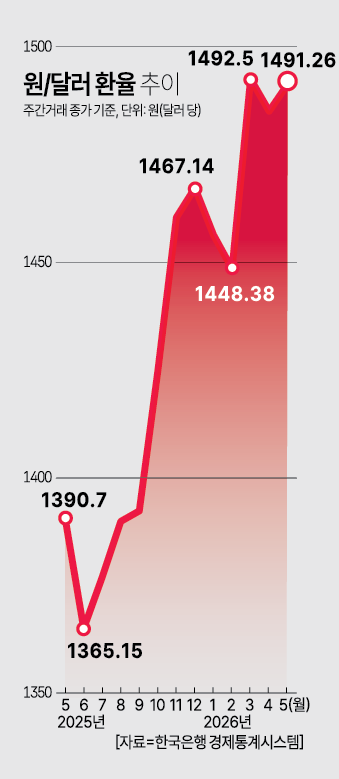
According to the Bank of Korea's economic statistics system, the average exchange rate for the won against the U.S. dollar last month was recorded at 1491.26 won.
The exchange rate fell to 1439.0 won during trading on June 6, buoyed by optimism surrounding U.S.-Iran peace talks. However, as negotiations prolonged and military tensions in the region escalated, the rate reversed course. On May 22, it peaked at 1519.5 won, reflecting a significant fluctuation of around 80 won within the month.
The primary driver of the rising exchange rate is identified as geopolitical instability in the Middle East. Concerns over prolonged conflict and rising international oil prices are placing additional burdens on South Korea's economy, which is heavily reliant on energy imports, thereby increasing downward pressure on the won. This situation has been compounded by foreign investors selling off domestic stocks and increased demand for dollars.
The upward trend in the exchange rate has continued into June. On June 6, during overnight trading, the rate reached 1561.5 won, marking the highest level since March 6, 2009, during the global financial crisis (with an intraday high of 1597.0 won).
Consequently, the average exchange rate for the second quarter has also risen to its highest level since the financial crisis. From the beginning of the second quarter until June 5, the average exchange rate was recorded at 1490.98 won, the highest level in nearly 28 years since the first quarter of 1998 (1596.88 won).
On an annual basis, the exchange rate is trending towards record highs. So far this year, the average exchange rate stands at 1477.06 won, significantly exceeding last year's average of 1420.97 won. In fact, at airport currency exchange counters, the cash purchase rate for dollars has already surpassed 1600 won. As of June 6, Hana Bank's airport branch reported a cash selling rate of 1624.0 won for dollars.
Market analysts believe that the progress of U.S.-Iran peace negotiations will significantly influence the exchange rate this week. Additionally, the U.S. Consumer Price Index (CPI) for May and the European Central Bank's (ECB) monetary policy meeting outcomes are also viewed as key variables.
The U.S. CPI, set to be released on June 10, is expected to show an annual increase of around 4%. With international oil prices exceeding $90 per barrel, persistent inflationary pressures could diminish expectations for interest rate cuts by the Federal Reserve, leading to a stronger dollar and increased exchange rate pressures.
Experts agree that for exchange rate stability, a resolution to the Middle East situation and a decline in international oil prices are prerequisites. While factors such as foreign capital flows and increased overseas investments are important, the direction of the exchange rate is likely to be heavily influenced by oil prices and geopolitical risks.
Park Sang-hyun, a researcher at iM Securities, stated, "If peace negotiations are concluded soon, international oil prices could drop to the mid-$70s to low $80s per barrel. A decline in oil prices would alleviate inflation concerns and increase downward pressure on interest rates, potentially leading to a weaker dollar."
He added, "If the Iranian risk is resolved, the exchange rate could quickly drop below 1450 won. While foreign stock sell-offs and supply-demand uncertainties remain, fundamental factors such as economic improvement could offset these concerns significantly."
According to the Bank of Korea's economic statistics system, the average exchange rate for the won against the U.S. dollar last month was recorded at 1491.26 won.
The exchange rate fell to 1439.0 won during trading on June 6, buoyed by optimism surrounding U.S.-Iran peace talks. However, as negotiations prolonged and military tensions in the region escalated, the rate reversed course. On May 22, it peaked at 1519.5 won, reflecting a significant fluctuation of around 80 won within the month.
The primary driver of the rising exchange rate is identified as geopolitical instability in the Middle East. Concerns over prolonged conflict and rising international oil prices are placing additional burdens on South Korea's economy, which is heavily reliant on energy imports, thereby increasing downward pressure on the won. This situation has been compounded by foreign investors selling off domestic stocks and increased demand for dollars.
The upward trend in the exchange rate has continued into June. On June 6, during overnight trading, the rate reached 1561.5 won, marking the highest level since March 6, 2009, during the global financial crisis (with an intraday high of 1597.0 won).
Consequently, the average exchange rate for the second quarter has also risen to its highest level since the financial crisis. From the beginning of the second quarter until June 5, the average exchange rate was recorded at 1490.98 won, the highest level in nearly 28 years since the first quarter of 1998 (1596.88 won).
On an annual basis, the exchange rate is trending towards record highs. So far this year, the average exchange rate stands at 1477.06 won, significantly exceeding last year's average of 1420.97 won. In fact, at airport currency exchange counters, the cash purchase rate for dollars has already surpassed 1600 won. As of June 6, Hana Bank's airport branch reported a cash selling rate of 1624.0 won for dollars.
Market analysts believe that the progress of U.S.-Iran peace negotiations will significantly influence the exchange rate this week. Additionally, the U.S. Consumer Price Index (CPI) for May and the European Central Bank's (ECB) monetary policy meeting outcomes are also viewed as key variables.
The U.S. CPI, set to be released on June 10, is expected to show an annual increase of around 4%. With international oil prices exceeding $90 per barrel, persistent inflationary pressures could diminish expectations for interest rate cuts by the Federal Reserve, leading to a stronger dollar and increased exchange rate pressures.
Experts agree that for exchange rate stability, a resolution to the Middle East situation and a decline in international oil prices are prerequisites. While factors such as foreign capital flows and increased overseas investments are important, the direction of the exchange rate is likely to be heavily influenced by oil prices and geopolitical risks.
Park Sang-hyun, a researcher at iM Securities, stated, "If peace negotiations are concluded soon, international oil prices could drop to the mid-$70s to low $80s per barrel. A decline in oil prices would alleviate inflation concerns and increase downward pressure on interest rates, potentially leading to a weaker dollar."
He added, "If the Iranian risk is resolved, the exchange rate could quickly drop below 1450 won. While foreign stock sell-offs and supply-demand uncertainties remain, fundamental factors such as economic improvement could offset these concerns significantly."
* This article has been translated by AI.
Copyright ⓒ Aju Press All rights reserved.