
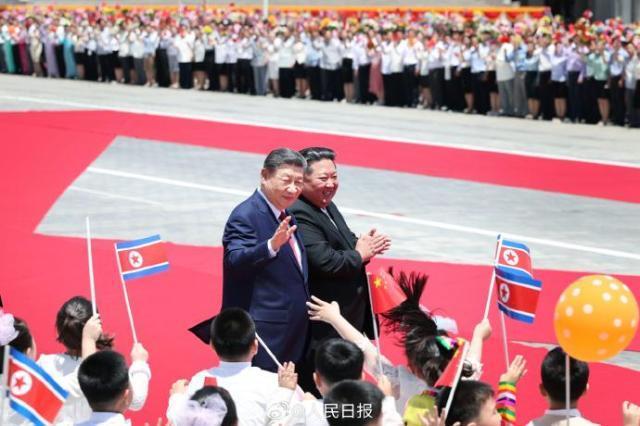
The Washington Post reported that "Kim and Xi presented a united front against the Western-led international order." The two leaders emphasized their "unbreakable bond" and highlighted the restoration of their traditional friendship. Reuters also noted that "Xi reaffirmed support for North Korea and pledged to strengthen strategic cooperation."
A key focus of the summit was China's reaffirmation of its influence over North Korea. The New York Times analyzed that "Xi emphasized close strategic communication and the enhancement of exchanges in all areas with Kim," suggesting an intention to balance against Russia's growing influence in North Korea. CNN remarked that while North Korea's ties with Russia have strengthened, Xi made it clear that China remains North Korea's most important economic lifeline and diplomatic partner.
For Kim, restoring relations with China is crucial. Although North Korea has been increasing military and economic cooperation with Russia since the Ukraine war, it remains heavily dependent on China for economic support and trade. The Wall Street Journal suggested that "Kim aims to secure economic advantages that China can provide without relinquishing nuclear weapons."
Analysts also noted that China appears to be trying to manage its relationship with North Korea to counterbalance its closeness with Russia. The BBC stated, "China views North Korea as a neighbor it cannot fully control or afford to lose," adding that Xi's visit is more about securing influence than merely showcasing friendship. The Financial Times reported expert assessments indicating that "China seeks to prevent North Korea from becoming overly aligned with Russia."
The absence of public discussion regarding denuclearization was also noteworthy. The New York Times pointed out that there was no mention of North Korea's nuclear program in the announcements following the summit, contrasting with previous meetings where such cooperation was highlighted. Bloomberg also noted that while Xi mentioned expanding cooperation in various fields, he avoided public comments on North Korea's nuclear program.
This trend could heighten security concerns on the Korean Peninsula. The New York Times suggested that if Kim successfully balances relations between China and Russia, he may feel less constrained in developing nuclear weapons. This could further unsettle U.S. allies in the region, who are already worried about China's military rise and the U.S. commitment to defense.
The summit signifies more than just a restoration of North Korea-China relations. North Korea seeks to leverage both Russia and China to expand its military and economic interests, while China aims to revive its traditional influence over North Korea. With denuclearization pressures not at the forefront, the strengthening ties among North Korea, China, and Russia may further entangle the Korean Peninsula issues with U.S.-China competition, the Ukraine war, and Northeast Asian security dynamics.
* This article has been translated by AI.
Copyright ⓒ Aju Press All rights reserved.