
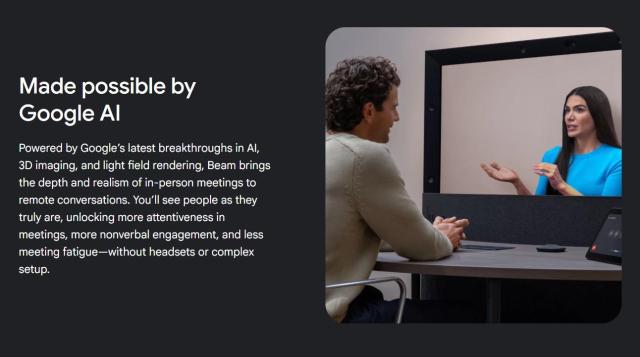
Google is accelerating the commercialization of its AI-based 3D remote conferencing solution, 'Google Beam,' which creates the illusion of having participants present without the need for glasses or headsets. The key component, an optical sensor, will be supplied by the South Korean company Namuga.
On June 9, Namuga confirmed that it has completed the proof of concept for the Google Beam supply chain and will begin supplying related components by the end of this year. An industry source stated, "The vendor selection has been completed, and the contract has been finalized." A Namuga representative added, "We cannot confirm details about this project, but we are currently in discussions with global companies regarding supply."
Google Beam is an AI-driven platform designed for immersive video conferencing. Unlike traditional video calls that present flat images, Google Beam utilizes multiple cameras and sensors to recognize users' faces and movements in real-time, reconstructing them into 3D video.
The platform's ability to create a natural sense of presence and depth without requiring glasses or headsets is a key feature. First unveiled at last year's annual developer conference, the technology was showcased at this year's CES as Google aims to penetrate the enterprise market.
To collect spatial information such as users' facial contours, distances, and movements in real-time, high-precision 3D sensors and image sensors are essential. Notably, advanced sensors are crucial for implementing volumetric video modeling, which analyzes video data from multiple angles to create real-time 3D visuals, as well as monocular depth estimation, which generates spatial awareness from a single camera feed.
According to market research firm VirtuMarket Research, the global 3D telepresence market is projected to grow from $1.78 billion in 2024 to $6.2 billion by 2030, with an annual growth rate of 19.5%. The expansion of generative AI is expected to drive this market growth.
* This article has been translated by AI.
Copyright ⓒ Aju Press All rights reserved.