
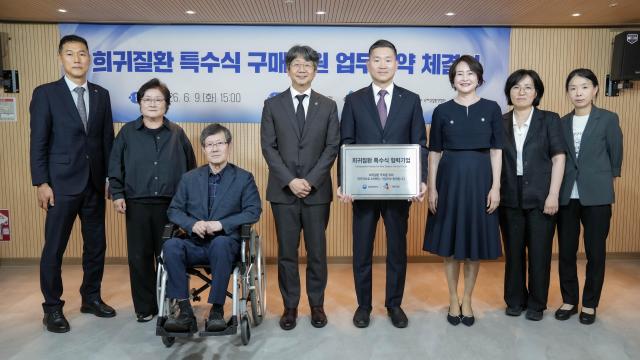
CJ CheilJedang is expanding its special food support for patients with rare metabolic disorders, such as phenylketonuria (PKU), to include adults.
On June 9, CJ CheilJedang announced it signed a memorandum of understanding (MOU) with the Korea Disease Control Agency and the Korea Rare and Intractable Disease Association to establish a support system for purchasing special foods for rare disease patients.
The agreement aims to create a public-private partnership that ensures patients requiring lifelong special diets can reliably access low-protein HaeBban rice even after reaching adulthood.
PKU is a rare disorder caused by a deficiency in an enzyme that breaks down phenylalanine, an amino acid found in protein. It occurs in approximately one in every 60,000 newborns, and without proper dietary management, it can lead to neurological and mental health issues. Patients must limit their phenylalanine intake for life, making it difficult to consume regular rice.
Previously, patients under 19 years old could receive government support for special foods, but adults were excluded from this assistance, forcing them to purchase remaining stock individually or rely on expensive foreign products.
Under the new agreement, patients aged 19 and older will be able to apply for special foods quarterly through an online platform called the “Rare Disease Helpline.” This support system is set to begin operations on July 1.
HaeBban low-protein rice has a protein content reduced to one-tenth that of regular HaeBban. The production process, which removes the protein from the rice, takes over 24 hours, making the production time more than ten times longer and the manufacturing cost more than double that of standard products.
CJ CheilJedang began developing HaeBban low-protein rice in March 2009, following a suggestion from an employee with a child suffering from a congenital metabolic disorder. After investing 800 million won and conducting seven months of research, the company established its own technology and manufacturing facilities, launching the product in October of the same year. Although the product is not highly profitable, the company has continued production as part of its social contribution efforts for patients with rare diseases. To date, the cumulative production has reached approximately 2.9 million units.
Kim Chan-ho, head of CJ CheilJedang's Strategic Support Division, stated, "This agreement lays the foundation for a stable supply of HaeBban low-protein rice to patients aged 19 and older. We will continue to do our best to ensure smooth production and supply."
* This article has been translated by AI.
Copyright ⓒ Aju Press All rights reserved.