
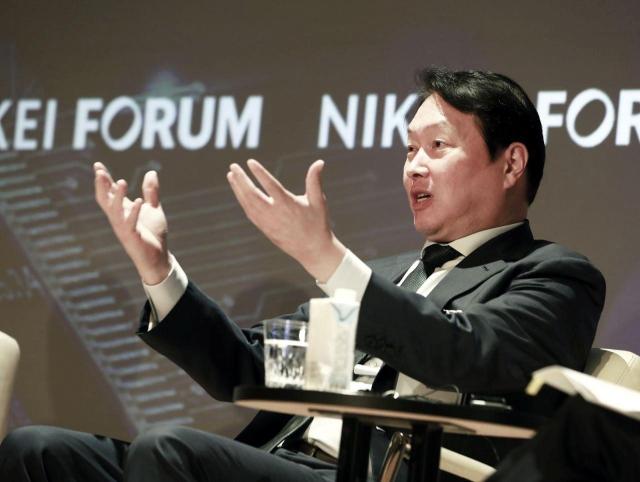
Choi Tae-won, Chairman of SK Group and Director of the Choi Jong-hyun Academy, reiterated the necessity of economic cooperation between South Korea and Japan to survive in a rapidly changing global order. He made these remarks during the special session on Korea-Japan economic cooperation at the Nikkei Forum held at the Imperial Hotel in Tokyo on June 9, where he discussed strategies with political and business leaders from both countries.
The event, hosted by the influential Japanese economic daily Nihon Keizai Shimbun (Nikkei) and organized by SK and the Choi Jong-hyun Academy, gathered over 300 attendees under the theme of “Multifaceted Economic Cooperation Supporting Strong Korea-Japan Relations.”
The Nikkei Forum, which began in 1995 to explore coexistence and development in the Asian community under the theme “The Future of Asia,” introduced the special session for the first time this year to align with Choi's vision for Korea-Japan economic cooperation.
Former Japanese Prime Minister Fumio Kishida and former National Assembly Speaker Kim Jin-pyo emphasized the importance of friendly cooperation between the two nations in their keynote speeches. Choi engaged in discussions with Masakazu Tokura, advisor at Sumitomo Chemical and former chairman of Keidanren (Japan Business Federation), and Masahiko Kato, president of Mizuho Bank, on the theme of “Korea-Japan Directions Amid Complex International Circumstances.”
Choi highlighted that the Korea-Japan economic partnership could serve as a stepping stone for both nations to become “rule makers” in creating a new international order. He specifically identified energy, artificial intelligence (AI), and addressing low birth rates as concrete areas for collaboration between the two countries.
Regarding energy, he proposed joint development of energy resources outside the Middle East, collaborative research on advanced materials and alternative batteries, and leading the formation of international standards in future energy sectors, including small modular reactors (SMRs).
In the AI sector, he noted the need for Korea and Japan to secure economies of scale and negotiating power amid the technological hegemony of the U.S. and China. He suggested that data sharing, joint infrastructure development, and standardization of norms could enhance their independent competitiveness and reduce reliance on specific countries.
Finally, Choi urged that spontaneous Korea-Japan cooperation occurring in various sectors should not be swayed by external factors such as regulatory and standard differences, short-term political situations, or uncertainties. He proposed the establishment of a “Big Tent” permanent platform where both governments could consolidate cooperation agendas across various sectors, including businesses, academia, and youth.
Choi emphasized, “Let’s create a permanent platform where the governments of both countries can gather diverse cooperation agendas and proactively discuss the challenges of advancing Korea-Japan cooperation. We can then work on refining related systems to address the obstacles to collaboration.”
Choi's repeated emphasis on Korea-Japan economic cooperation is rooted in the intensifying U.S.-China technological rivalry and the restructuring of global supply chains. As competition in strategic industries such as semiconductors, AI, and energy unfolds in a manner that promotes national block formation, he believes that Korea and Japan should enhance their negotiating power and market influence through collaboration rather than responding individually.
* This article has been translated by AI.
Copyright ⓒ Aju Press All rights reserved.