
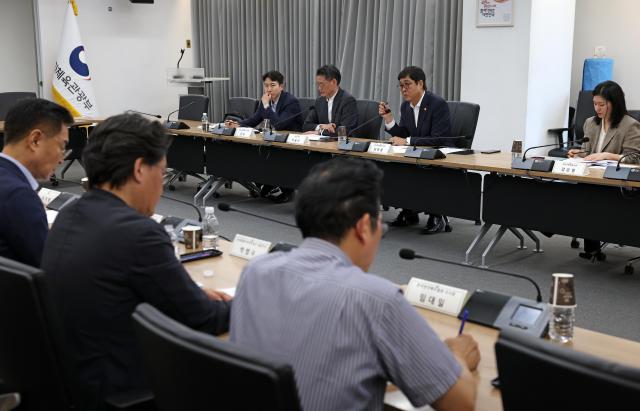
"There are no suitable works to perform. The economic challenges in the theater industry are driving talented writers away," said industry experts during the 3rd meeting of the Theater Subcommittee of the Cultural Arts Policy Advisory Committee, held on June 9 at the National Museum of Modern and Contemporary Art in Seoul.
The subcommittee, which operates under the Ministry of Culture, Sports and Tourism, consists of creators, producers, actors, and association representatives who convey the voices of the field.
Actor Lee Gi-young emphasized the need to break the cycle of relying on classic works due to the lack of new plays. "Finding new works is incredibly difficult," he stated, adding that even when performances occur, securing payment for writers is challenging, leading many talented individuals to leave the theater scene. He urged for the activation of playwriting competitions to allow selected works to be performed, criticizing the continued focus on classics that are often outdated and unengaging.
There were also calls for the simultaneous promotion of production company competitions alongside playwriting contests. Committee member Kim Soo-ro suggested that publicly recruiting teams to produce selected works from competitions could open new avenues for production.
Voices advocating for a redefined role for public theaters, such as the National Theater Company, were also heard. Park Jeong-mi, CEO of Park Company, argued that public theaters should avoid the same production methods as private companies, which often focus on foreign classics and star marketing. She stressed the importance of using public theater productions to inspire new ideas and discover talented staff and actors.
Participants also highlighted the necessity of integrated policies that connect support for creation, production, theaters, and audiences, ensuring that new initiatives do not overlap with existing support programs.
Concerns were raised about the outflow of talented individuals to countries like Japan and Singapore. Lee Gi-young noted that Japan has committed to funding 50% of film production costs, up to 15 billion won, warning that the trend of talent leaving the content industry for overseas opportunities is accelerating. He mentioned that current drama projects are collaborating with the Singapore government for support, which could lead to the loss of outstanding directors to foreign markets.
The Ministry of Culture plans to foster excellent works that can be performed for extended periods to broaden the audience base for theater. Additionally, preparations are underway for the 2027 ASSITEJ World Congress, which will be held in South Korea for the first time in 25 years. This prestigious international event in the field of children's and youth theater was confirmed to be hosted by South Korea during the 2024 congress in Cuba.
Furthermore, from July 24 to August 1, 2027, the International Performing Arts Festival will feature 35 domestic and international productions in Suwon, with the Ministry supporting the event in collaboration with the ASSITEJ Korean headquarters and Suwon City.
Minister Choi Hwi-young acknowledged that the biggest burden for the theater industry is venue rental fees. He stated that efforts are being made to expand theater infrastructure and prioritize support for these fees, aiming to encourage more active use of the Arko stage by private entities.
* This article has been translated by AI.
Copyright ⓒ Aju Press All rights reserved.