Voters Rally at Polling Station Amid Claims of Election Fraud
by Eun-mi. WonPosted : June 10, 2026, 10:45Updated : June 10, 2026, 10:45
"We have bread. Please take some bread."
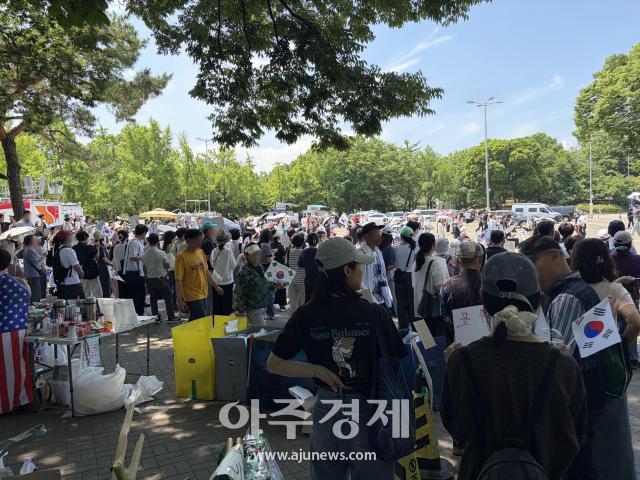
On the morning of June 9, in front of the handball stadium at Olympic Park in Songpa-gu, Seoul, a volunteer handed out bread and water to passersby from a tent set up in the shade of a tree. Nearby, ice water and coffee were stacked up. The volunteer said, "You can take water. We have plenty of snacks and drinks."
The site, which had attracted tens of thousands over the weekend, was relatively quiet on a weekday morning. However, citizens holding Korean flags maintained their positions at various entrances. Mats were laid out along the entrances, and participants shielded themselves from the heat with umbrellas or fans.
A loudspeaker repeatedly announced slogans such as "Election fraud! Re-election! Same-day voting! Manual counting!"
Participants holding U.S. and Korean flags chant slogans for re-election and against election fraud in front of the handball stadium at Olympic Park in Songpa-gu, Seoul, on June 9. [Photo by Won Eun-mi]
The protests have continued for five days since the shortage of ballots during the local elections on June 3. Participants have been demanding an investigation into the ballot shortage and a re-election while guarding the area around the counting station.
As the clock passed 10 a.m., the atmosphere at the site began to change. Participants who had been sparse at the entrance started to gather. Around 10:30 a.m., the crowd grew, and by 11 a.m., when a reporter arrived, it felt like the number of people had nearly doubled. Police were also seen deploying additional personnel or rotating shifts.
Participants were cautious about referring to themselves as "protesters."
A 70-year-old resident of Songpa-gu, holding a Korean flag, waved his hands when asked if he was participating in a protest.
"This is not a protest. We are gathering voluntarily to shout for national sovereignty and voting rights," he explained.
He added, "I am 70 years old, and I came out because I couldn't just sit back while young students are out here."
The crowd was not solely composed of older individuals. Young professionals in their 20s, job seekers, middle-aged participants, and families were all present. Young people were seen carrying boxes of water in the shade, while older participants waved Korean flags at the entrance.
A 20-something worker from Gyeonggi Province arrived at the site right after finishing a night shift.
He stated, "I believe this is a matter of basic rights being violated, regardless of political ideology. If something is wrong, it should be corrected, and we should move forward, which is why I participated."
Kim Min-jung, 26, who came to the site for the first time with her younger brother, shared a similar sentiment.
"I’m not particularly interested in politics, but I think this situation calls for a nationwide re-election," she said. "I saw online that there were claims of the protest being distorted or divided, but being here, I see that the slogans are unified and everything is proceeding peacefully."
However, the atmosphere at the site had clearly changed compared to the early days of the protest.
Immediately after the ballot shortage incident, the most common phrase heard was 'violation of voting rights.' While participants still mentioned the issue of voting rights, the terms 'election fraud' and 're-election' were more frequently heard from loudspeakers and signs.
Signs reading 'Election Fraud Re-election' were set up around the entrance, and some participants waved U.S. flags. Voices calling for "manual counting" could be heard from various spots.
However, there were also voices cautioning against this trend.
A participant in their 30s remarked, "Don’t the media create a far-right frame? We are gathering here as pure individuals to prevent that frame from being imposed. We are shouting for election fraud and same-day voting, regardless of political intent."
In fact, some participants were seen discussing the use of Korean flags over U.S. flags, expressing concern that the protest might be perceived as aligned with a specific political faction or existing conservative groups.
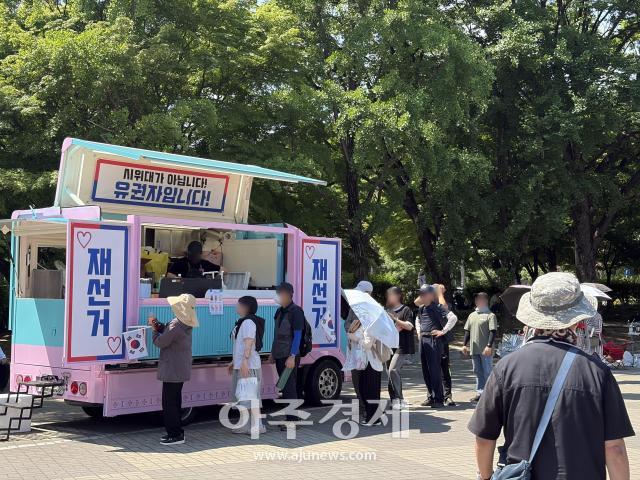
Participants at the rally line up at a coffee truck for drinks on June 9. [Photo by Won Eun-mi]
As the protest continued into its fifth day, the site had transformed into a long-term encampment.
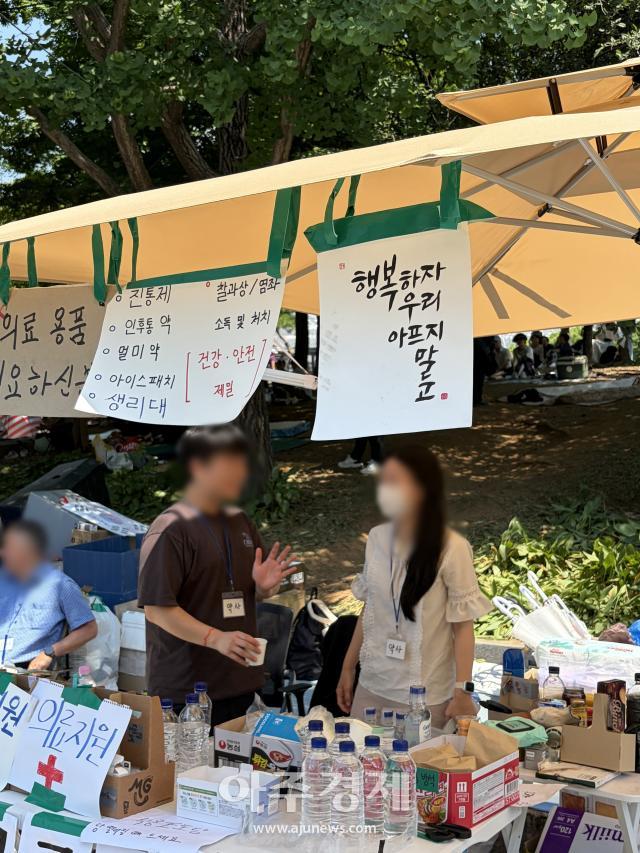
The medical support area was stocked with various medicines, ice packs, band-aids, and sanitary products. Volunteers wearing name tags identifying them as doctors or pharmacists welcomed participants. A recycling bin was set up in one area, with signs instructing people to separate plastic and general waste.
A coffee truck and a storage area for supplies were also established. Boxes of water and snacks were piled up under a notice stating, "We are voluntarily serving items sent from across the country."
One volunteer noted, "Some people bring items directly, while others send them through delivery services like Coupang. Many support anonymously."
He explained, "On weekends, there were really 20,000 to 30,000 people, but on weekday mornings, it’s less crowded because workers are at their jobs and students are at school. In the evening, people come back after work, and the parking lot fills up again."
Participants were often seen sharing food and water with each other. Some citizens brought their dogs, and families participated as well. Some sat on mats, checking their phones while others stood guard at the entrance, chanting slogans.
The medical support area at the rally, where pharmacists organize various medicines and ice packs. [Photo by Won Eun-mi]
Tension was also present.
In the morning, one participant told a citizen holding a loudspeaker to "walk properly," to which the other replied, "My legs hurt, and I can’t wear my shoes properly." The exchange escalated, but fortunately, nearby participants calmed the situation with chants.
As noon approached, the shaded areas began to fill up. The number of people gathered at the entrance increased. Participants holding Korean flags moved closer to the loudspeaker.
The same slogans were repeated, but the perspectives of those present varied slightly.
Some spoke of violations of voting rights, while others called for re-elections. Some participants raised allegations of election fraud, while others urged not to politicize the issue.
However, one thing remained consistent: most participants introduced themselves as "voters" rather than political factions.
What began as a protest against the violation of voting rights has evolved over time, incorporating new slogans and faces, but at least the term they used to define themselves remained 'voters.'