
Humanity has long pursued wealth. Nations seek prosperity, businesses aim for growth, and individuals dream of a prosperous life. However, a closer look at history reveals an intriguing truth: having a lot of money does not guarantee happiness, nor does great power ensure peace. Many people come to realize later in life that while money can be an important condition for living, it is not the purpose of life. As the AI revolution reshapes human civilization, we are once again confronted with the question, "What is true wealth?"
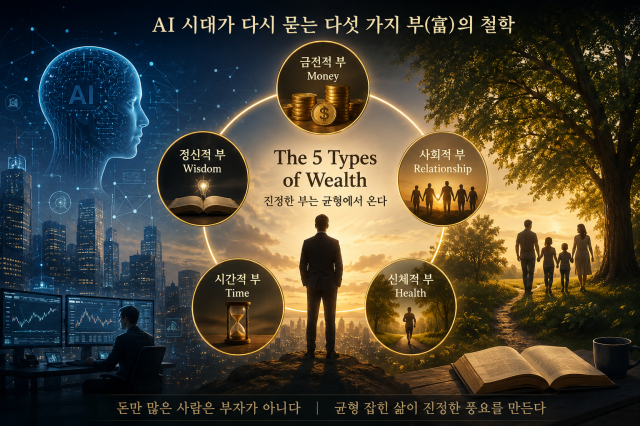
Recently, Saheel Bloom's book, The 5 Types of Wealth, has sparked significant global interest by offering intriguing answers to this question. He categorizes life’s wealth into five types: monetary wealth, social wealth, spiritual wealth, physical wealth, and temporal wealth. While the expression is modern, the essence is not new. Great texts from both Eastern and Western traditions have conveyed the same message for thousands of years: what humans should pursue is not mere material wealth but a balanced life, and true abundance comes from the depth of existence rather than the quantity of possessions.
Confucius stated, "The noble person thinks of righteousness, while the petty person thinks of profit." This does not mean one should not earn money; it suggests that there are values more important than money. Wealth devoid of righteousness does not last, and success without humanity ultimately leads to emptiness. Today, while we are developing one of the world's strongest economies and advanced technologies, we also face some of the lowest birth rates and serious issues of loneliness, depression, and social disconnection. This may be a consequence of prioritizing monetary wealth while neglecting other forms of wealth.
Monetary wealth is undoubtedly important. Without money, it is difficult to maintain a dignified life, protect one’s family, or prepare for the future. However, the essence of money lies not in consumption but in freedom. The true nature of wealth is not the ability to buy everything one desires but the ability to refuse what one does not want. Economic freedom means having choices in life, not just numbers in a bank account. Those who regret the most in old age are often not those who failed to earn more money but those who spent their valuable time chasing it.
Laozi said, "He who knows contentment is rich." This short statement offers profound insight into today’s capitalist society. The world is filled with endless competition for bigger houses, better cars, higher positions, and more assets. Yet, human desires grow larger the more they are satisfied. Thus, Laozi found the path to wealth not in acquiring more but in knowing sufficiency. A true wealthy person is not one who possesses everything but one who understands what they truly need.
Social wealth is also an indispensable asset for humans. People cannot live in isolation. No matter how advanced AI becomes or how robots take over human jobs, they cannot replace love, friendship, trust, and solidarity. Ultimately, humans grow and find comfort in relationships. Harvard University’s adult development study, ongoing for over 80 years, shows that the quality of human relationships is the most crucial factor for a happy life. The difference between successful and happy people lies here. Success can be achieved alone, but happiness requires connection with others.
Buddhism teaches that "finding good friends is not half of life but all of life." Humans discover themselves through relationships. Family, friends, colleagues, and communities are not just social connections; they are the spiritual foundation that supports each other on life’s long journey. No matter how much wealth one possesses, if there is no one to genuinely trust and rely on, it is difficult to claim a life of abundance.
Spiritual wealth is becoming increasingly important in the age of AI. In the past, the problem was a lack of information. Today, the issue is an overload of information. Thousands of news stories, videos, messages, and data continuously stimulate the human brain every day. However, having more information does not equate to wisdom. What is crucial is the ability to discern what to accept and what to discard. Spiritual wealth is inner peace and an unwavering center. It is the strength to remain calm in crises and the resilience to rise again after failures.
The Doctrine of the Mean states, "Joy, anger, sorrow, and pleasure are in a state yet to be revealed, and when they are revealed in moderation, it is harmony." Balance and harmony signify the equilibrium of the human spirit. In the age of AI, true competitiveness lies not in the quantity of knowledge but in the depth of the spirit. While machines can perform calculations, they cannot replace human insight and wisdom.
Physical wealth is the foundation of all wealth. Health is often likened to air; we do not appreciate its value until it is lost. When health is compromised, money loses its meaning, honor becomes insignificant, and maintaining relationships becomes challenging. This is why global companies recognize employee health as a matter of competitiveness rather than just welfare. A healthy body fosters a healthy mind, and a healthy mind generates creativity and productivity.
The Huangdi Neijing states, "Preserving vital energy prevents illness." Eastern medicine has long emphasized the importance of prevention. The body is like a ship that sails through the long journey of life. If the ship is damaged, it cannot reach its destination; similarly, if health is lost, all other forms of wealth cannot be preserved.
Lastly, temporal wealth may be the greatest wealth of all. Money can be lost and earned again, health can be somewhat restored, and relationships can be rebuilt with effort. However, time is the exception. No power in the world can relive yesterday. Time is the raw material of all wealth and the source of all life. Money requires time to be earned, health requires time to be maintained, and love requires time to deepen.
The Book of Ecclesiastes states, "To everything, there is a season, and a time for every purpose under heaven." Humans cannot own time, but they can choose how to use it. Ultimately, the quality of life is determined by how one uses time. The greatest blessing that the age of AI may bring is time itself, as artificial intelligence takes over repetitive tasks, potentially giving humans more time. However, if that time is used for more consumption and competition, civilization may advance, but humanity will not find happiness.
In the end, the essence of the five types of wealth is balance. One should not lose health in pursuit of monetary wealth, nor should one sacrifice family for success. One should not lose oneself for relationships, nor should one abandon the meaning of life for work. Life is not a game of maximizing one aspect but rather an art of achieving harmony among different values.
The age of AI holds the potential for unprecedented abundance for humanity. Yet, it also poses more fundamental questions: It is not about how much one can possess, but why one lives. It is not about how quickly one can succeed, but what one succeeds for. It is not about how much information one can acquire, but what wisdom one leaves behind.
Having only money does not make one wealthy. True wealth comes when one has a healthy body, a peaceful mind, deep relationships with loved ones, the ability to choose how to spend time, and the spiritual maturity to discover the meaning of life.
Confucius spoke of ren, Laozi of zuo, the Buddha of the Middle Way, and the Bible of love; ultimately, they all convey the same truth in different languages: humans are not born to possess but to live for meaning.
Even in an era where AI can calculate faster and process more information than humans, the decision of what constitutes a good life will remain solely in the hands of humanity. And the answer will lie not in money, but in balance.
* This article has been translated by AI.
Copyright ⓒ Aju Press All rights reserved.