
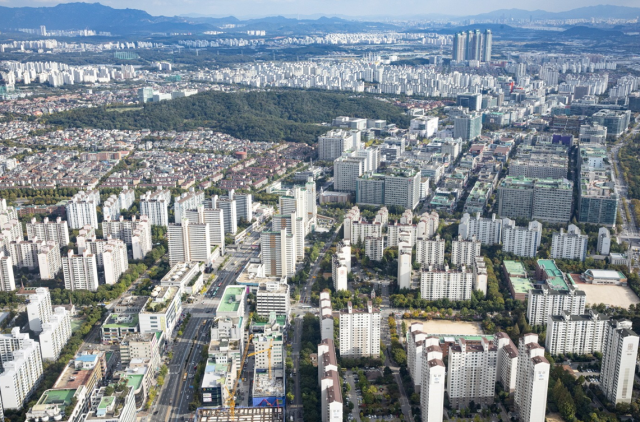
The redevelopment project for first-generation new towns is gaining momentum, but the atmosphere on the ground is less optimistic than expected. As the government accelerates follow-up procedures for leading districts like Bundang and Ilsan, residents express more concern about relocation and additional cost-sharing burdens than about rising property values.
According to the construction industry on June 10, the Ministry of Land, Infrastructure and Transport recently designated eight out of 15 leading districts in first-generation new towns as special maintenance zones. The designated areas include Seongnam's Bundang Yangji Village, Saetbyeol Village, and the Hyundae Woosung complex, as well as Anyang's Pyeongchon Dream Village Geumho and Dream Village Woosung, and Gunpo's Sanbon Xi Baihap and Hanyang Baekdu.
The government and local authorities are focusing on expediting the first-generation new town projects based on a special law for aging planned cities, which includes streamlining maintenance plans and permitting processes. Previously, the limit on the number of designated maintenance project units was expanded from 26,000 to a maximum of 70,000 units. By region, the proposed units include 24,800 in Ilsan, 22,200 in Jungdong, 12,000 in Bundang, 7,200 in Pyeongchon, and 3,400 in Sanbon.
Market sentiment is leaning towards increased expectations for redevelopment. There is hope that aging complexes will be replaced with new apartments, and that regulatory support such as increased floor area ratios, relaxed safety inspections, and integrated reviews will enhance property values. However, the designation of leading districts and special maintenance zones does not guarantee immediate redevelopment. Numerous steps remain, including the establishment of special maintenance plans, designation of project implementers, selection of construction companies, approval of project implementation plans, management disposition approvals, and the processes of relocation, demolition, and construction commencement.
The biggest variable is relocation. The first-generation new towns are large planned communities, nearing 300,000 households. A surge in relocation demand during a specific period could disrupt the nearby rental and leasing markets. In areas like Bundang and Pyeongchon, strong demand for school districts and living environments may lead residents to prefer relocating within their existing neighborhoods. Concerns have been raised that the availability of nearby rental housing and new supply could determine the success of the projects.
Additional cost-sharing is also a source of conflict. With rising construction and financing costs, the feasibility of redevelopment projects has decreased compared to the past. Even within the same first-generation new towns, the burden on cooperative members can vary significantly based on existing floor area ratios, location, complex size, and general sale prices. This is particularly concerning in complexes with a high proportion of elderly residents, where proposed additional cost-sharing in the tens of millions of won may make it difficult to secure resident agreement.
There are still uncertainties regarding the timeline. The government initially aimed for construction to begin in 2027 and occupancy by 2030, but the actual pace of progress will inevitably vary based on resident agreement, project feasibility, and local government permitting situations. Within the designated leading districts, there are concerns that differences in resident opinions regarding integrated maintenance methods, cost-sharing calculations, and relocation timing could widen.
An industry insider stated, "Redevelopment of first-generation new towns is not just a project that ends with the designation of leading districts; it involves addressing the relocation of hundreds of thousands of households and the associated cost burdens. If we only emphasize expectations for rising property values, conflicts among residents could escalate during the process, so we need to present concrete relocation plans and manageable cost-sharing structures first."
A resident from a first-generation new town remarked, "In Bundang, additional cost-sharing is being discussed at up to 700 million won. How many households can afford that? Even if construction starts immediately, I'm worried because there are no clear relocation plans."
On the other hand, there are voices expressing concern about project delays. Choi Woo-sik, president of the Bundang Redevelopment Association, emphasized, "While it is necessary to proactively manage relocation demand, we must not let relocation plans hinder redevelopment, as this is within the private sector's domain."
* This article has been translated by AI.
Copyright ⓒ Aju Press All rights reserved.