
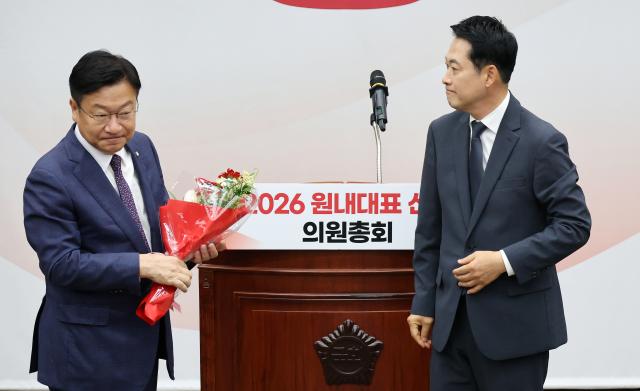
Jung Jeom-sik, the new floor leader of the People Power Party, receives a bouquet from Representative Jang Dong-hyuk after being elected on June 10 at the National Assembly. [Photo: Yonhap News]
Jung Jeom-sik was elected as the new floor leader of the People Power Party on June 10, facing significant challenges including resolving factional conflicts, forming committees, reforming the election commission, and countering the dominant ruling party. Immediately after his election, Jung stated, "I will gather the opinions of party members to harness our collective wisdom."
In his campaign, Jung emphasized the need for "integrative leadership" to mend factional disputes and unify the party. He asserted, "I believe there are no pro-Yoon (supporters of President Yoon Suk-yeol) factions within the party," while promising to communicate with members from other factions to ease tensions. He added, "There can be no division or conflict. There is only one People Power Party that reflects the will of the people," and pledged to pursue more aggressive reforms, stating that he would appoint individuals regardless of factional affiliations.
Jung secured his position by receiving 55 out of 103 votes in the runoff, highlighting the importance of party unity as his top priority. Concerns arose that his election could signal a shift towards a "pro-Yoon party," prompting Jung to stress the need for unity.
In addition to internal unity, establishing a relationship with the major opposition party, the Democratic Party, is also a critical task for the new floor leader. He must address immediate issues such as committee formation for the second half of the National Assembly and the investigation into the shortage of ballots for the June 3 local elections, working with Democratic Party floor leader Han Byung-do.
The 22nd National Assembly elected its leadership on June 5, marking the start of its second half. The negotiations for committee assignments will focus on the Legislative and Judiciary Committee. The People Power Party argues that, given its status as the second-largest party, it should hold the chairmanship of this committee to ensure checks and balances, while the Democratic Party aims to secure both the National Assembly Speaker and the Judiciary Committee chair under the banner of a "working National Assembly."
The parties must also reconcile their differences regarding the investigation into the ballot shortage. According to the requests for a national investigation submitted by both parties, the Democratic Party insists on basing the composition of the investigative committee on the number of seats held by negotiating and non-negotiating parties, while the People Power Party advocates for equal representation. Furthermore, the People Power Party has excluded the Democratic Party's recommendation rights in the special prosecutor bill they proposed the day before, indicating that negotiations will be challenging.
Jung stated, "With the strength of a strong united front, I will successfully conclude the negotiations for committee formation," and emphasized the need for thorough investigations and accountability regarding the ballot shortage through national investigations and special prosecutors.
In his campaign, Jung emphasized the need for "integrative leadership" to mend factional disputes and unify the party. He asserted, "I believe there are no pro-Yoon (supporters of President Yoon Suk-yeol) factions within the party," while promising to communicate with members from other factions to ease tensions. He added, "There can be no division or conflict. There is only one People Power Party that reflects the will of the people," and pledged to pursue more aggressive reforms, stating that he would appoint individuals regardless of factional affiliations.
Jung secured his position by receiving 55 out of 103 votes in the runoff, highlighting the importance of party unity as his top priority. Concerns arose that his election could signal a shift towards a "pro-Yoon party," prompting Jung to stress the need for unity.
In addition to internal unity, establishing a relationship with the major opposition party, the Democratic Party, is also a critical task for the new floor leader. He must address immediate issues such as committee formation for the second half of the National Assembly and the investigation into the shortage of ballots for the June 3 local elections, working with Democratic Party floor leader Han Byung-do.
The 22nd National Assembly elected its leadership on June 5, marking the start of its second half. The negotiations for committee assignments will focus on the Legislative and Judiciary Committee. The People Power Party argues that, given its status as the second-largest party, it should hold the chairmanship of this committee to ensure checks and balances, while the Democratic Party aims to secure both the National Assembly Speaker and the Judiciary Committee chair under the banner of a "working National Assembly."
The parties must also reconcile their differences regarding the investigation into the ballot shortage. According to the requests for a national investigation submitted by both parties, the Democratic Party insists on basing the composition of the investigative committee on the number of seats held by negotiating and non-negotiating parties, while the People Power Party advocates for equal representation. Furthermore, the People Power Party has excluded the Democratic Party's recommendation rights in the special prosecutor bill they proposed the day before, indicating that negotiations will be challenging.
Jung stated, "With the strength of a strong united front, I will successfully conclude the negotiations for committee formation," and emphasized the need for thorough investigations and accountability regarding the ballot shortage through national investigations and special prosecutors.
* This article has been translated by AI.
Copyright ⓒ Aju Press All rights reserved.