
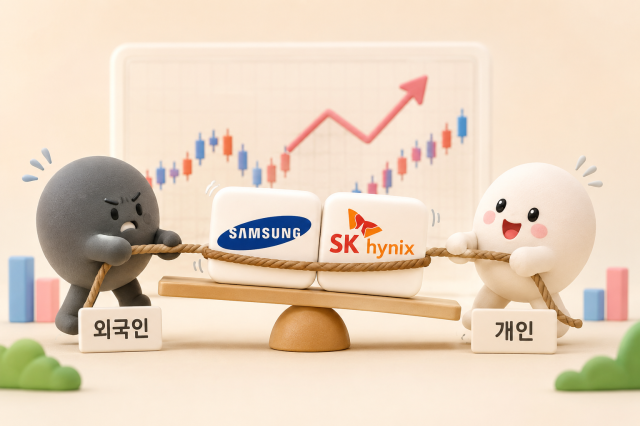
Investor sentiment surrounding South Korea's leading semiconductor stocks is diverging sharply. Over the past month, foreign investors have aggressively sold shares of Samsung Electronics and SK Hynix, while individual investors have significantly increased their holdings in these companies. During a 23-day streak of net selling, foreign investors offloaded more than 58 trillion won in these two stocks, while individuals purchased a net total of 45 trillion won.
According to the Korea Exchange, foreign investors have maintained a net selling position on the KOSPI market since May 6, continuing this trend for 23 consecutive trading days. The total amount of net selling during this period reached 74.4 trillion won. Foreign investors sold 29.4 trillion won in SK Hynix and 29.1 trillion won in Samsung Electronics, marking these as the most heavily sold stocks. They sold SK Hynix on all but one trading day and Samsung Electronics on all but four.
In contrast, individual investors have actively bought shares of SK Hynix and Samsung Electronics during the same period, absorbing the foreign selling. Individuals purchased a net 23.3 trillion won in SK Hynix and 21.8 trillion won in Samsung Electronics, making these stocks their top buys.
As foreign selling continues, the foreign ownership percentage in these companies has decreased. The foreign ownership ratio for SK Hynix fell from 53.22% on May 6 to 51.09% on the latest trading day, while Samsung Electronics dropped from 49.37% to 47.70%. Conversely, the overall foreign ownership ratio in the KOSPI increased from 38.90% to 39.97% during the same timeframe.
Lee Kyung-min, a researcher at Daishin Securities, noted, "The increase in foreign ownership in the KOSPI suggests that the recent net selling by foreign investors can be viewed as a rebalancing effort following a surge in leading stocks."
Additionally, analysts suggest that the potential for a worsening supply-demand imbalance leading to panic selling is low. Lee Jae-won, a researcher at Yuanta Securities, stated, "Even on the day of the index's sharp decline on June 8, the amount of net selling by foreign investors was not substantial. Concerns about a panic selling cycle can be alleviated, as this appears to be a portfolio adjustment by foreign investors reducing their holdings in high-performing stocks like SK Hynix and Samsung Electronics."
Looking ahead, the direction of foreign investment is expected to be determined during the second-quarter earnings season, which is anticipated to gain momentum after July. Lee Jae-won added, "Once the second-quarter results are confirmed, foreign investor sentiment towards the semiconductor sector could improve again."
* This article has been translated by AI.
Copyright ⓒ Aju Press All rights reserved.