
With the explosive growth of the artificial intelligence (AI) industry, there is a heightened societal interest in the semiconductor sector, a key component of the nation's advanced strategic industries.
A recent survey conducted by JinHakSa revealed that high school students ranked semiconductors as the top major that remains exceptionally stable even in the AI era. As the 2027 college admissions process approaches, a clear trend toward early admission centered around programs partnered with global companies like Samsung Electronics and SK Hynix is emerging, prompting students to develop tailored admission strategies.
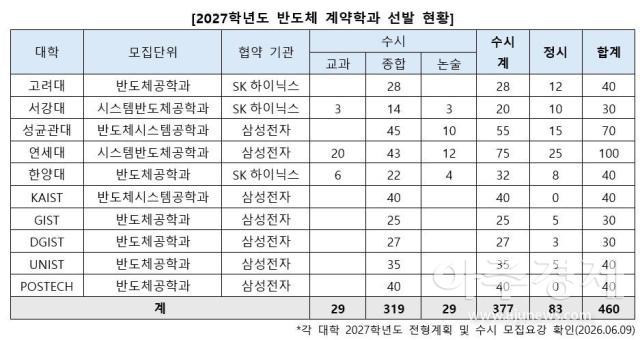
On June 10, JinHakSa analyzed the 2027 college admission plan, reporting that a total of 460 students will be selected for semiconductor contract programs at major universities in South Korea.
This marks a decrease of 60 students compared to the previous year. While other universities maintained their selection numbers and methods, the significant reduction in the admissions quota for KAIST's semiconductor systems engineering program—from 100 to 40 students—was a major factor in this decline.
A recent survey conducted by JinHakSa revealed that high school students ranked semiconductors as the top major that remains exceptionally stable even in the AI era. As the 2027 college admissions process approaches, a clear trend toward early admission centered around programs partnered with global companies like Samsung Electronics and SK Hynix is emerging, prompting students to develop tailored admission strategies.
On June 10, JinHakSa analyzed the 2027 college admission plan, reporting that a total of 460 students will be selected for semiconductor contract programs at major universities in South Korea.
This marks a decrease of 60 students compared to the previous year. While other universities maintained their selection numbers and methods, the significant reduction in the admissions quota for KAIST's semiconductor systems engineering program—from 100 to 40 students—was a major factor in this decline.
Although the overall admissions quota, which had been steadily increasing due to government policies promoting advanced programs, has temporarily stabilized, the demand for practical talent from companies continues to elevate the status of these programs to unprecedented levels.
A key point for the 2027 semiconductor contract programs is that 377 out of the 460 total admissions, or 82.0%, will be through early admission. In contrast, only 83 students (18.0%) will be admitted through regular admission based solely on standardized test scores, creating a significant barrier for students focused solely on the college entrance exam.
Among the 377 students admitted early, 319, or 84.6%, will be selected through the comprehensive student record evaluation (holistic admissions), while only 29 students (7.7%) will be admitted through subject-specific evaluations and another 29 (7.7%) through essay evaluations.
This trend is reflected in the admissions guidelines of individual universities. At Sungkyunkwan University's semiconductor systems engineering program, which is partnered with Samsung Electronics, 45 out of 55 early admissions will be through holistic evaluation. Similarly, Yonsei University's system semiconductor engineering program, in partnership with SK Hynix, will select 43 out of 75 students through holistic evaluation.
Notably, specialized science and engineering universities like KAIST and POSTECH select all their students through early admission, further raising the bar for regular admissions in semiconductor contract programs. Given the strong indicators of job guarantees and scholarship benefits, the holistic evaluation structure emphasizes assessing students' suitability for the major beyond just quantitative academic performance.
Admission experts agree that to gain acceptance into these highly competitive semiconductor contract programs, students must demonstrate their academic capabilities in math and science throughout their high school careers.
Woo Hyun-cheol, head of the admission strategy research institute at JinHakSa, stated, "While the regular admission rate at top universities hovers around 40%, semiconductor contract programs exhibit a different structure. Even excluding specialized science and engineering universities like KAIST, five universities have an early admission rate of 75%, with over 70% selected through holistic evaluation."
He added, "This indicates that semiconductor contract programs prefer a selection method that evaluates students comprehensively, considering their academic and research capabilities, as well as their interest and potential in the field. It will be crucial for students to effectively showcase their mathematical and scientific inquiry skills in their student records."
A key point for the 2027 semiconductor contract programs is that 377 out of the 460 total admissions, or 82.0%, will be through early admission. In contrast, only 83 students (18.0%) will be admitted through regular admission based solely on standardized test scores, creating a significant barrier for students focused solely on the college entrance exam.
Among the 377 students admitted early, 319, or 84.6%, will be selected through the comprehensive student record evaluation (holistic admissions), while only 29 students (7.7%) will be admitted through subject-specific evaluations and another 29 (7.7%) through essay evaluations.
This trend is reflected in the admissions guidelines of individual universities. At Sungkyunkwan University's semiconductor systems engineering program, which is partnered with Samsung Electronics, 45 out of 55 early admissions will be through holistic evaluation. Similarly, Yonsei University's system semiconductor engineering program, in partnership with SK Hynix, will select 43 out of 75 students through holistic evaluation.
Notably, specialized science and engineering universities like KAIST and POSTECH select all their students through early admission, further raising the bar for regular admissions in semiconductor contract programs. Given the strong indicators of job guarantees and scholarship benefits, the holistic evaluation structure emphasizes assessing students' suitability for the major beyond just quantitative academic performance.
Admission experts agree that to gain acceptance into these highly competitive semiconductor contract programs, students must demonstrate their academic capabilities in math and science throughout their high school careers.
Woo Hyun-cheol, head of the admission strategy research institute at JinHakSa, stated, "While the regular admission rate at top universities hovers around 40%, semiconductor contract programs exhibit a different structure. Even excluding specialized science and engineering universities like KAIST, five universities have an early admission rate of 75%, with over 70% selected through holistic evaluation."
He added, "This indicates that semiconductor contract programs prefer a selection method that evaluates students comprehensively, considering their academic and research capabilities, as well as their interest and potential in the field. It will be crucial for students to effectively showcase their mathematical and scientific inquiry skills in their student records."
* This article has been translated by AI.
Copyright ⓒ Aju Press All rights reserved.