
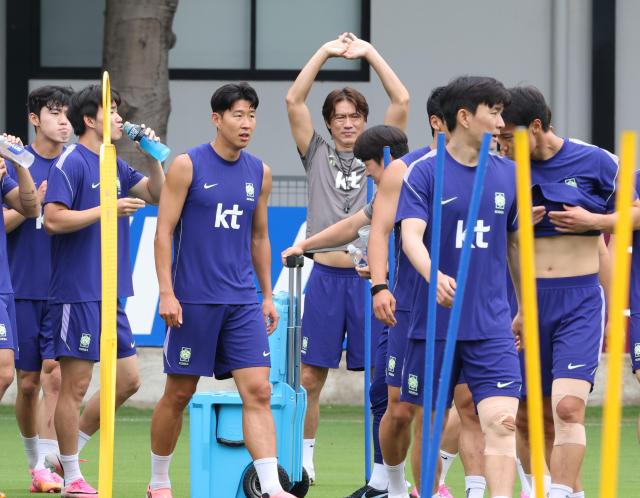
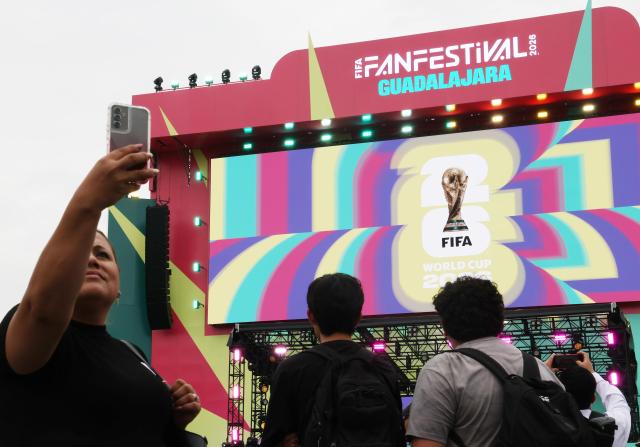
This year's World Cup will only be broadcast by KBS and JTBC, reducing the traditional viewing options that included KBS, SBS, and MBC. The broadcasting industry is closely watching the performance of JTBC, which has secured exclusive rights to the World Cup. The outcome could influence negotiations for broadcast rights extending to the 2032 Olympics and future World Cups.
According to industry sources on June 10, JTBC has acquired domestic broadcast rights for the 2026 North American World Cup, the 2028 Los Angeles Summer Olympics, the 2030 FIFA World Cup, the 2030 Alpine Winter Olympics, and the 2032 Brisbane Summer Olympics.
Industry analysts suggest that JTBC's strategy involves recovering its investment through reselling broadcast rights. However, the initial results have not met expectations. The 2026 Milan-Cortina Winter Olympics, which JTBC broadcasted exclusively in February, recorded a disappointing opening ceremony viewership of just 1.8%, leading some to label it a major failure. This has sparked controversy over the monopoly on broadcast rights.
There are speculations that JTBC's decision to significantly reduce the resale price from an initial 35 billion won to about 14 billion won during the North American World Cup negotiations was influenced by the poor performance of the Winter Olympics.
JTBC announced that the broadcast rights fee for the North American World Cup is $125 million (approximately 187 billion won), which is about 20% higher than the $103 million fee for the 2022 Qatar World Cup. KBS accepted JTBC's resale price of around 14 billion won to join the joint broadcast, while SBS and MBC did not. Reports suggest that Naver invested over 30 billion won to secure exclusive online broadcast rights.
Given that the revenue from reselling rights falls short of the broadcast rights fee, JTBC's profitability largely depends on the performance of Hong Myung-bo's team. The Korea Broadcast Advertising Corporation (KOBACO) plans to sell advertisements for all matches at the start of the tournament and will sell additional ads based on the Korean team's performance.
A KOBACO official stated, "If our national team advances to the Round of 32, additional advertising sales will occur," adding, "The scale of advertising revenue can vary significantly based on the team's performance."
Advertising rates are also a variable. The official noted, "There is no guarantee that advertising rates will increase simply because of exclusive World Cup coverage. If market reactions fall short of expectations, we may have to lower prices to sell ads." They further emphasized that numerous factors, including match results, viewership ratings, and economic conditions, make it difficult to predict revenue at this time.
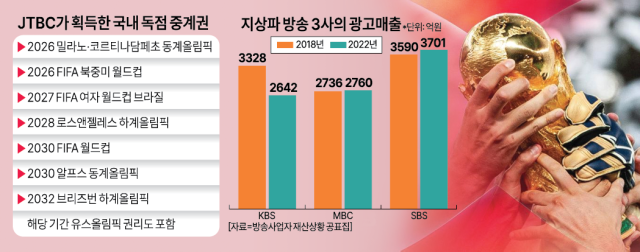
There are opinions that it is premature to assess JTBC's profitability based solely on this year's Winter Olympics and World Cup. An advertising industry insider remarked, "Since JTBC has secured broadcast rights for the World Cup and Olympics through 2032, it is unclear how far back we should assess losses. Profitability should be evaluated in terms of the overall portfolio rather than individual events."
In the National Assembly, a bill is being discussed to mandate terrestrial broadcasting of national interest events like the World Cup and Olympics. The proposed amendment, introduced by lawmakers including Kim Hyun, stipulates that significant national interest events must be broadcast live by at least one nationwide terrestrial broadcaster.
The key issue is whether the law will apply retroactively. A Ministry of Culture, Sports and Tourism official stated, "The scope and timing of the law's application are critical issues," adding, "We need to monitor the National Assembly's discussions."
In this regard, an official from Kim Hyun's office noted, "The Science, Technology, Information, Broadcasting and Communications Committee has passed a provision allowing for retroactive application to the Legislation and Judiciary Committee," and added, "The core of the amendment is to ensure that at least one terrestrial broadcaster is required to cover these events, even if negotiations among broadcasters are contentious."
* This article has been translated by AI.
Copyright ⓒ Aju Press All rights reserved.