
The shipbuilding industry's supercycle is bringing renewed energy to South Korea's shipbuilding equipment sector. However, industry players are focused on finding the next growth drivers rather than resting on current successes. Given that shipbuilding is a cyclical industry and competition from China is intensifying, there is a consensus that failing to secure future markets will make it difficult to endure the next downturn.
The Korea Marine Equipment Association (KOMEA) is eyeing the U.S. naval maintenance, repair, and overhaul (MRO) market as a next-generation growth area. As South Korean shipyards ramp up their efforts to penetrate the U.S. market, the potential for equipment manufacturers to join them is increasing.
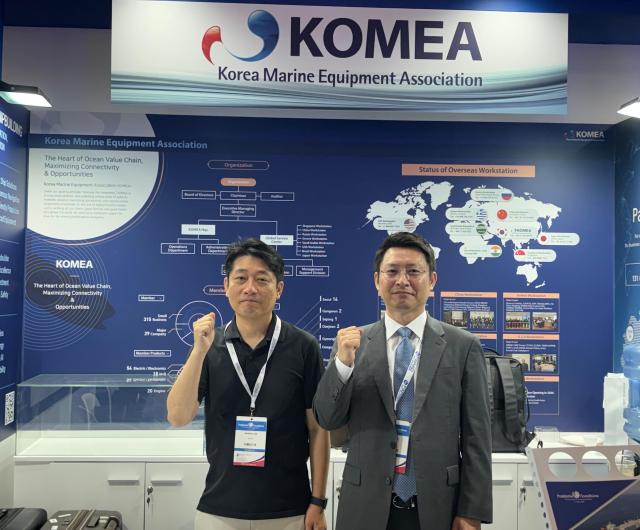
On June 5, during the world's largest maritime exhibition, Posidonia 2026, held in Athens, KOMEA's Lee Hang-gil and Son Jin-po discussed the current state and future strategies of South Korea's shipbuilding equipment industry.
K-Shipbuilding Equipment Can Play a Key Role in U.S. MRO Market
Lee emphasized that the U.S. MRO market is not solely an opportunity for shipyards. He noted, "When shipyards expand overseas, it is common for their partner suppliers to move alongside them. The U.S. market can also serve as a stage for domestic equipment manufacturers to enter together."
In fact, the U.S. shipbuilding industry relies heavily on imports for a significant portion of its key equipment. It is reported that the Philippines' shipyards source over 90% of the equipment needed for ship construction from abroad. Industry experts believe that even as the U.S. shipbuilding industry begins to recover, establishing a domestic supply chain for equipment will be challenging in the short term.
As South Korean shipyards expand their U.S. operations, they are also looking forward to the participation of key partners. The role of domestic equipment manufacturers is essential for establishing local production bases and ensuring reliable delivery timelines.
Lee stated, "Recently, South Korean shipyards that have begun expanding overseas are actively encouraging major equipment manufacturers to enter the local market. Domestic manufacturers have already accumulated various technologies and achievements in the fields of military vessels, special ships, and defense, and they will be competitive in the MRO market as well."
However, the potential for growth comes with significant challenges. Son noted, "Unlike large corporations, small and medium-sized equipment manufacturers must be cautious about establishing local production facilities. They need stable volumes that can ensure profitability relative to their investments."
In light of these practical constraints, KOMEA is stepping up to support small and medium enterprises. Established in the 1980s, KOMEA is a leading cooperative representing over 350 member companies in South Korea's marine equipment sector. The association provides export support, policy advocacy, and overseas marketing initiatives, currently operating nine overseas branches worldwide. Recently, it has been actively working to help domestic small shipbuilding equipment companies establish a foothold in the U.S. market through various support programs for naval MRO and equipment exports.
Operating the Korean pavilion at Posidonia is one of KOMEA's key support initiatives. This year marks the 20th anniversary of KOMEA's operation of the Korean pavilion, which serves as a bridge connecting domestic equipment manufacturers with overseas shipowners and shipyards. This year, various domestic companies, including those specializing in LNG fuel supply systems, cryogenic valves, and hull cleaning robots, met with international buyers through the Korean pavilion.
Son explained, "Greece is a market where shipowners from around the world gather in large numbers. Our role is to support small equipment manufacturers by providing local networks and market information that would be difficult for them to establish independently."
Despite Boom, K-Shipbuilding Equipment Must Prepare for Next Cycle
Even amid the shipbuilding boom, the shipbuilding equipment industry faces deep concerns. While increased orders have led to more work, the competition from China is intensifying, and the burdens of raw material costs and labor expenses are growing.
Son remarked, "In the past, there was a perception that Chinese products were cheap but of lower quality. However, the situation has changed. Domestic manufacturers now have to compete against European technology and China's low-price offensive."
Moreover, in the environmentally friendly equipment sector, which is considered a strength of South Korean shipyards, competition from China is becoming fiercer, making it difficult to guarantee an advantage. Lee noted, "Recently, the number of shipyards in China constructing LNG carriers has significantly increased, intensifying competition in the related equipment market. Since shipbuilding is ultimately a cyclical industry, failing to prepare for the next cycle during a boom could jeopardize survival itself."
KOMEA emphasizes the need for a joint response from both the public and private sectors to secure future markets. Lee stated, "While Japan and China have been able to create synergies through joint marketing and service network establishment, domestic companies still often approach the market individually. We need to create a structure where shipyards, equipment manufacturers, and related institutions work together."
He also highlighted the necessity for government support, explaining that as South Korean shipyards expand overseas, incentive programs are needed to encourage the simultaneous entry of equipment manufacturers.
Korea is a Global Shipbuilding Power, but Support for Korean Pavilion is Lacking
KOMEA also expressed disappointment regarding the operational conditions of the Korean pavilion. Despite Posidonia being a symbolic stage that showcases the competitiveness of the Korean shipbuilding industry and national brand, the support provided does not match its significance.
Currently, the Korean pavilion is the third largest after those of China and Japan, but there are concerns that this is insufficient given that shipbuilding is a key national industry. The Korean pavilion is currently operated under a structure where budgets are allocated alongside various industrial exhibitions.
Due to these limitations, some domestic companies have set up separate booths to participate independently this year.
Son noted, "Every year, when we participate in Posidonia, we receive feedback that the size of the Korean pavilion is somewhat disappointing compared to those of Japan and China. Given that this is a gathering of shipowners from around the world, we need to present ourselves in a manner that reflects the status of the Korean shipbuilding industry."
Lee added, "Posidonia is a key stage that showcases the status of the Korean shipbuilding industry. As the representative exhibition of the shipbuilding industry, we need a more differentiated support system." [This article was supported by the Sea's Embrace Foundation and the Korea Maritime Journalist Association.]
* This article has been translated by AI.
Copyright ⓒ Aju Press All rights reserved.