
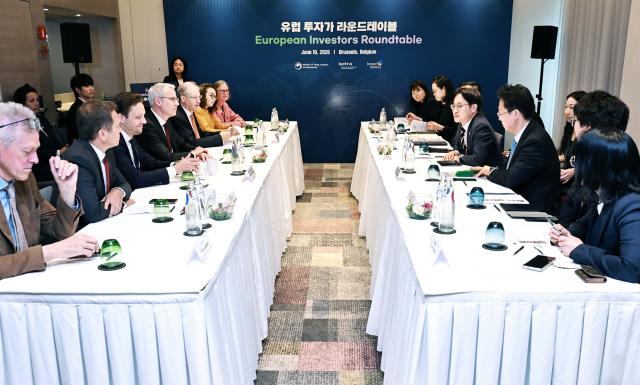
On June 11, relevant ministries reported that the Ministry of Trade, Industry and Energy and the Ministry of Climate, Energy and Environment established new cooperation channels in trade, investment, and energy during the trip.
The Ministry of Trade has laid the institutional groundwork for digital economic cooperation. South Korea and the EU officially signed the Digital Trade Agreement (DTA) under the presence of leaders. The DTA is South Korea's second bilateral digital trade agreement, following Singapore, and the first with one of its top five trading partners. With norms established for data movement, e-commerce, and digital services, South Korean companies are expected to find it easier to enter the European market.
Cooperation in supply chains and advanced industries has also been strengthened. During an investment reporting ceremony in Europe, four European companies, with Minister Kim Jeong-kwan in attendance, reported a total of $165 million in foreign direct investments. Companies in future industries, such as quantum computing, semiconductor equipment, and advanced materials, are expected to enhance supply chain cooperation with South Korea, aligning with the government's strategy to attract advanced manufacturing supply chains domestically.
Both sides launched the 'Korea-EU Competitiveness Partnership,' encompassing cooperation in trade, investment, supply chains, and advanced technologies, and agreed to establish high-level economic dialogues. This is expected to expand the existing cooperation framework, which has primarily focused on free trade agreements (FTAs), into the realms of digital trade and economic security.
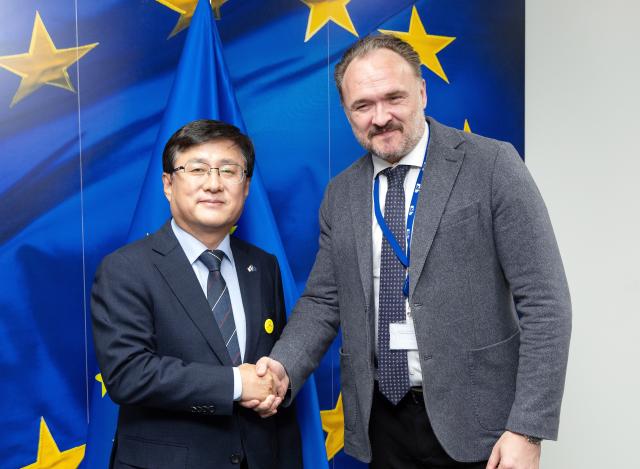
Additionally, the Ministry of Climate has broadened the scope of energy cooperation. Minister Kim Sung-hwan met with EU Energy Commissioner Kadri Simson and agreed to establish a vice-ministerial 'Korea-EU Energy Dialogue.'
The two sides will regularly discuss energy transition policies, including renewable energy, energy storage systems (ESS), power grids, and electrification in buildings and transportation, while maintaining close communication on energy security issues, such as the situation in the Middle East.
In light of the increased volatility in the global energy market due to instability in the Middle East, both sides view the expansion of renewable energy and the enhancement of power grids as key measures to strengthen energy security and have agreed to increase cooperation.
Minister Kim Sung-hwan also held the 'Korea-EU Energy Transition Win-Win Cooperation Forum' in Brussels, where he introduced South Korea's power grid technology, ESS, and virtual power plants (VPP) to European companies. Korea Electric Power Corporation signed a memorandum of understanding (MOU) with Belgium's Jan De Nul and the Netherlands' Boskalis to collaborate in the high-voltage direct current (HVDC) sector, paving the way for entry into the European power grid market.
As a result of this visit, Korea-EU cooperation has expanded beyond traditional trade relations to encompass digital trade, advanced industry supply chains, and energy transition. The establishment of high-level economic dialogues by the Ministry of Trade and the energy dialogue channel by the Ministry of Climate is expected to further strengthen cooperation between the two governments.
* This article has been translated by AI.
Copyright ⓒ Aju Press All rights reserved.