
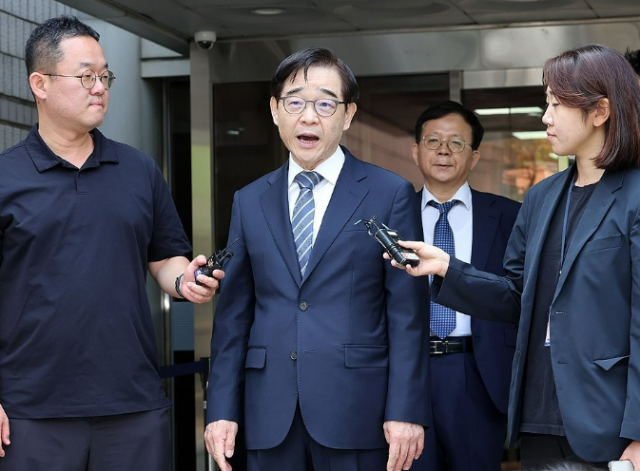
Kwon Soon-il, a former Supreme Court Justice, received a dismissal of charges in a first trial regarding allegations of providing legal advice while not registered as a lawyer. The court concluded the case without determining whether Kwon violated attorney law, citing illegal procedures in the prosecutor's investigation initiation and indictment process.
On June 11, the Seoul Central District Court's Criminal Division 21, presided over by Judge Kim Dae-kyu, ruled to dismiss the charges against Kwon, who was indicted for violating attorney law. A dismissal occurs when the court finds that the indictment process violates legal provisions, thus concluding the case without examining the facts.
The court determined that the prosecution had initiated an investigation into a case that did not legally permit direct investigation at the time, and that the transfer of the case between police and prosecutors was also improper.
Kwon was indicted in August 2024 for allegedly performing legal work as an advisor to Hwacheon Daeyu, a company linked to private developer Kim Man-bae, without being registered with the Korean Bar Association from January to August 2021.
Prosecutors argued that during this period, Kwon analyzed civil appeals and administrative lawsuits related to Hwacheon Daeyu and provided legal documents and strategies, thus performing attorney duties. According to the prosecution, Kwon received 150 million won (approximately $130,000) in advisory fees.
Hwacheon Daeyu has faced allegations of favoritism in the Daejang-dong development project. As part of the investigation into corruption related to this project, prosecutors also examined Kwon's advisory role at Hwacheon Daeyu.
The attorney law prohibits individuals from handling legal matters or providing legal advice for compensation without being registered with the Bar Association. In April, during the closing arguments, prosecutors sought a one-year prison sentence for Kwon, stating that the violation of attorney law by a former Supreme Court Justice was a serious matter.
However, the court focused on the legality of the investigation procedures rather than the substance of the allegations.
The court ruled that Kwon's alleged violation of attorney law did not constitute a crime that allowed for the initiation of a direct investigation by prosecutors under the Prosecutor's Office Act, which permits direct investigations only for certain serious crimes, such as corruption and economic crimes, and does not include violations of attorney law.
The court noted, "For a prosecutor's investigation initiation rights to be recognized, the crime must be one that the prosecutor has cognizance of; however, the alleged violation of attorney law in this case was merely included in a complaint and not recognized by the prosecutor."
Prosecutors had received a complaint from a civic group in September 2021 and investigated Kwon twice as a suspect. The case was then transferred to the Gyeongnam Southern Police Agency in January 2022, with prosecutors reportedly believing that the allegations did not fall under the scope of direct investigation at that time.
The police returned the case to prosecutors in September 2023, and after further investigation, Kwon was indicted. The charges related to the Public Officials Ethics Act were dismissed due to insufficient evidence. During the trial, prosecutors argued that since Kwon's actions were related to the Daejang-dong case, the investigation rights should be recognized, but this was not accepted by the court.
The court also questioned the legality of the police's re-transfer of the case, stating that transferring the case to prosecutors merely because it needed to be reviewed in conjunction with other Daejang-dong cases did not meet the legal criteria for necessary transfer.
The court emphasized, "Considering the intent of the investigation rights adjustment between the police and prosecutors, circumventing the prosecutor's investigation initiation rights is not permissible," and concluded that the prosecutor's investigation was illegal due to the lack of proper initiation and closure of the investigation by the police.
The court ruled that the indictment based on this illegal investigation was also unlawful and void. However, it did not determine whether Kwon actually violated attorney law. Questions regarding whether Kwon's advisory role at Hwacheon Daeyu constituted legal work under attorney law and whether the 150 million won received was considered attorney fees remain unresolved without a substantive ruling.
This ruling marks the first court decision regarding Kwon's advisory role at Hwacheon Daeyu, with the court dismissing the indictment based on issues related to the prosecutor's investigation rights rather than addressing the violation of attorney law.
After the ruling, Kwon expressed gratitude to the court for its courageous declaration of the law, stating, "The distortion of the law for political purposes and the creation of crimes should no longer be tolerated."
* This article has been translated by AI.
Copyright ⓒ Aju Press All rights reserved.