
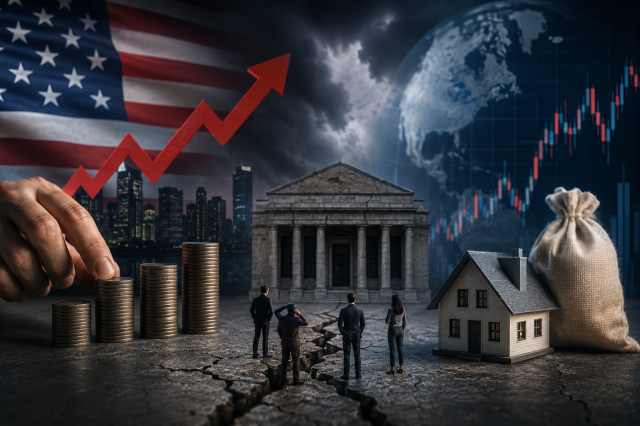
[Photo: Image generated by ChatGPT]
The U.S. Consumer Price Index (CPI) has surged to its highest level in three years, raising global concerns about prolonged tightening. While fears are growing that inflation shocks similar to those seen in 2022 could reoccur, experts warn that the current financial resilience of households and small businesses has weakened, making any such shocks potentially more impactful.
According to the U.S. Department of Labor, the CPI for May rose 4.2% compared to the same month last year, marking the highest increase since April 2023. Ahead of the Federal Open Market Committee (FOMC) meeting scheduled for June 16-17, market expectations for a pause in interest rate hikes are diminishing, leading to a greater focus on the possibility of extended tightening.
This situation is reminiscent of the tightening phase in the second half of 2022, when inflation from the U.S. rattled domestic financial markets. The external environment facing the Bank of Korea, including high exchange rates, rising import prices due to oil price increases, and concerns over capital outflows due to widening interest rate differentials between South Korea and the U.S., mirrors the conditions of that period.
The financial market has already begun to react. As of the previous day, the mixed-rate (fixed) mortgage rates for the five major banks (KB Kookmin, Shinhan, Hana, Woori, and NH Nonghyup) ranged from 4.51% to 7.50%. This marks the first time since November 2022 that the upper limit of fixed mortgage rates has exceeded 7.5%. Concerns over rising prices due to the prolonged Middle Eastern conflict and the possibility of additional rate hikes by the Bank of Korea have contributed to the increase in market rates.
However, experts caution against directly comparing the current situation to that of 2022. At that time, both monetary and fiscal policies were tightened simultaneously to combat inflation. In contrast, the current environment features an expansionary fiscal policy and an increase in the money supply, indicating a fundamentally different policy landscape.
Kim Jeong-sik, an emeritus professor of economics at Yonsei University, stated, "In 2022, tightening policies were implemented to control inflation through interest rate hikes and fiscal cuts, but now we are seeing fiscal expansion and an increase in the money supply. From a policy perspective, the situation is completely opposite to that of 2022."
Despite this, analyses suggest that financial vulnerability in the South Korean economy has actually increased. Unlike in 2022, when household savings accumulated during the COVID-19 pandemic helped absorb shocks, the financial capacity of households and small businesses has largely been depleted.
The inflationary conditions also differ from those of 2022. The consumer price inflation rate was in the 2% range until April, lower than the high inflation phase of 2022. However, the cumulative price increases over recent years have weakened households' real purchasing power. While the pace of inflation has slowed, the burden of living expenses has not diminished.
Bank of Korea Governor Rhee Chang-yong noted during a recent press conference that while the core inflation rate was 2.2% in April, the living cost inflation rate was higher at 2.9%. He emphasized that living costs have a direct impact on inflation expectations, indicating persistent upward pressure on prices.
Particularly, with an increase in essential loans such as mortgages and overdraft accounts, any further rate hikes could exacerbate the financial burden on households and small businesses. Coupled with rising stock and real estate prices and concerns over the financial health of institutions, the risks to financial stability are also increasing.
Professor Kim added, "Compared to 2022, the risks to financial stability have grown, but the environment does not allow for a strong tightening drive like before. Even if a similar external shock occurs, its impact on the market could be even greater."
* This article has been translated by AI.
Copyright ⓒ Aju Press All rights reserved.