
The Broadcasting and Communications Commission (BCC) is preparing to implement a "Media Basic Society" initiative as part of its budget planning for the upcoming year. The proposal includes a media voucher system aimed at supporting online video service (OTT) fees for low-income households, with the goal of expanding access to content and addressing the digital service gap.
According to the BCC on June 11, the commission is reviewing policies to establish a Media Basic Society as a key objective for next year's budget. With a consensus among members, led by Chairman Kim Jong-cheol, the focus is on enhancing content access for vulnerable populations and reducing disparities in digital service usage.
A BCC official stated, "We are preparing a media voucher system that would support OTT fees and paid broadcasting costs as a long-term project. However, discussions with the Ministry of Economy and Finance and other financial authorities are still needed."
The push for this policy comes in response to changing content consumption patterns. While OTT services have become a primary source for content, significant disparities in usage based on income and region persist.
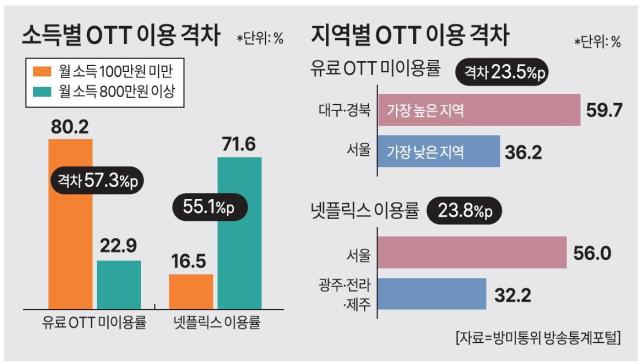
Data from the BCC's broadcasting statistics portal indicates that 80.2% of households earning less than 1 million won per month do not use paid OTT services. In contrast, only 22.9% of households earning over 8 million won are non-users, revealing a 57.3 percentage point gap between the two groups.
Usage rates for Netflix, the most popular OTT service in Korea, also vary significantly by income. Only 16.5% of households earning under 1 million won use Netflix, compared to 71.6% of those earning over 8 million won.
Regional disparities are also evident. Netflix usage is highest in Seoul at 56%, while it is only 32.2% in Gwangju, Jeolla, and Jeju. The highest non-usage rate for paid OTT services is found in Daegu and Gyeongbuk at 59.7%, while Seoul's rate is 36.2%.
The BCC is examining policies to mitigate these access gaps. However, opinions differ on whether the proposed subsidies will enhance the competitiveness of the domestic media industry. The paid broadcasting sector has expressed concerns that the voucher system could lead to increased use of global OTT services. Since users are likely to apply vouchers to well-known platforms like Netflix, the benefits for nurturing the domestic media ecosystem may be limited.
There are also calls to clarify the policy objectives of the Media Basic Society. An industry insider noted, "It is essential to define whether the media voucher is a support policy for vulnerable groups, an access expansion policy, or a domestic media industry development policy, as the support methods should vary accordingly."
Experts emphasize the need for a cautious approach to using government funds to support OTT usage. Kim Yong-hee, a professor at Sun Moon University, stated, "While the intention to expand content access for vulnerable groups is commendable, using national resources to support specific platforms could lead to market distortion. There needs to be ample discussion on the scope and intensity of market intervention."
He added, "Supporting OTT usage could ultimately imply incorporating OTT into policy and regulation frameworks, suggesting that discussions on deregulation and market restructuring should precede simple fee support measures."
* This article has been translated by AI.
Copyright ⓒ Aju Press All rights reserved.