
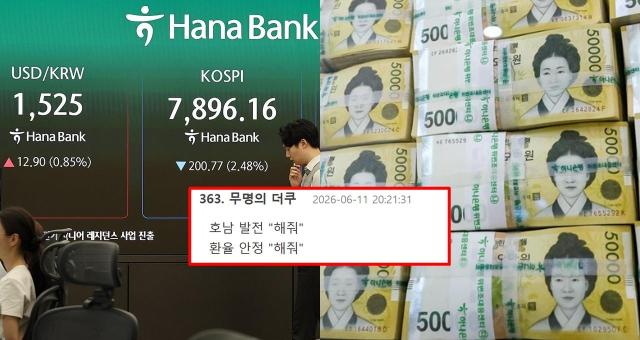
The South Korean government has requested cooperation from major exporters, including Samsung Electronics and SK Hynix, to stabilize the foreign exchange market as the won-dollar exchange rate has remained above 1,500 won for 17 consecutive trading days. This news has drawn criticism online, with many users arguing that the government is overly reliant on corporations.
On June 11, Heo Chang, the Second Vice Minister of the Ministry of Economy and Finance, and Moon Shin-hak, the Vice Minister of Trade, Industry and Energy, held a meeting at the Government Seoul Complex with representatives from key exporting companies such as Samsung Electronics, SK Hynix, Hyundai Motor, Kia, HD Korea Shipbuilding & Offshore Engineering, Samsung Heavy Industries, and Hanwha Ocean to assess the current foreign exchange market situation.
During the meeting, the government discussed measures to stabilize the foreign exchange market, including early currency exchange for export proceeds and increasing the inflow of overseas retained earnings into the domestic market.
Heo emphasized the importance of exporters' roles in improving supply and demand in the foreign exchange market and reducing volatility. Moon also highlighted the need for active corporate involvement to minimize the negative impacts of high exchange rates.
The government has identified foreign capital outflows, certain speculative trades, and market disruptions as factors contributing to the recent depreciation of the won. Additionally, it noted that exporters holding onto dollars for extended periods has reduced the supply of dollars in the foreign exchange market, further weakening the won.
However, the news has sparked backlash online, with critics accusing the government of shifting the burden of currency defense onto large corporations.
Particularly in conservative circles, comments included, "They asked for profit sharing, and now they want us to handle currency exchange too," and, "After demonizing large corporations, they turn to Samsung and Hynix when times get tough. Is it the responsibility of companies to solve the exchange rate issue? This is sheer incompetence. What kind of country is this?"
One user pointed out, "When the semiconductor market was struggling, the government criticized companies, but now they are trying to take credit for the recovery while pressuring them to sell dollars. I don't understand this double standard."
Another user remarked, "Asking companies to convert dollars to won in a high exchange rate situation essentially means asking them to incur losses. It seems like the government is offloading its responsibilities onto businesses."
Unusually, similar sentiments emerged from progressive communities as well. Users expressed, "It seems like they expect companies to solve all problems," and, "Is it appropriate for the government to keep asking private companies for help? Shouldn't these issues be addressed through monetary policy? They keep demanding companies sell dollars, buy bonds, and invest."
Some users criticized the contradiction of increasing regulations on businesses while simultaneously seeking their cooperation when needed, questioning whether the government is overly dependent on Samsung and Hynix for economic management.
* This article has been translated by AI.
Copyright ⓒ Aju Press All rights reserved.