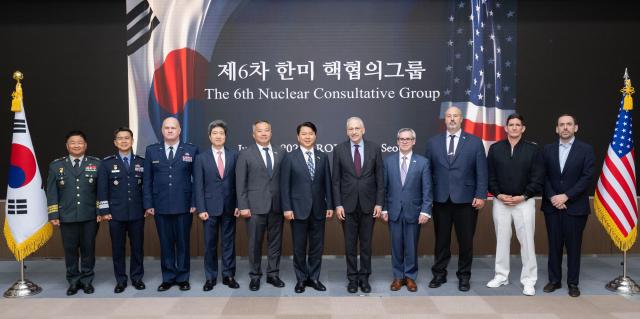
The two allies held the sixth session of the Nuclear Consultative Group, or NCG, a bilateral body launched in 2023 to strengthen U.S. extended deterrence against North Korea’s nuclear threats. The meeting was co-chaired by Kim Hong-cheol, South Korea’s deputy minister for national defense policy, and Robert Soofer, U.S. deputy assistant secretary for nuclear deterrence and response to weapons of mass destruction.
“South Korea and the United States reaffirmed their shared goal of the denuclearization of North Korea,” a joint statement said. “The United States reaffirmed its commitment to provide extended deterrence to South Korea by using the full range of U.S. capabilities, including nuclear capabilities.”
The explicit reference to North Korea’s denuclearization drew attention, as recent regional diplomacy has raised questions over whether the goal is losing traction. China did not mention North Korea’s denuclearization during a recent summit with Pyongyang, while the joint statement issued after the previous NCG session in Washington in December did not mention North Korea or denuclearization.
A Defense Ministry official said the two allies “reaffirmed their commitment to the complete denuclearization of North Korea and peace and stability on the Korean Peninsula.”
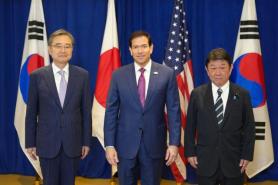
The U.S. also included similar language in a statement after its Extended Deterrence Dialogue with Japan held earlier this week, saying the two sides reaffirmed their commitment to the complete denuclearization of North Korea.
During Thursday’s meeting, the two sides also reviewed progress in developing conventional-nuclear integration, or CNI, a concept under which South Korea’s advanced conventional forces would support U.S.-led nuclear operations in response to North Korean nuclear threats.
The NCG delegations also visited a related South Korean military unit to review Seoul’s advanced conventional capabilities, according to officials.
The effort to further integrate U.S. nuclear capabilities with South Korea’s conventional forces is seen as important for maintaining the credibility of Washington’s nuclear umbrella, especially as Seoul and Washington continue discussions on the future transfer of wartime operational control from the U.S. to South Korea.

Copyright ⓒ Aju Press All rights reserved.