
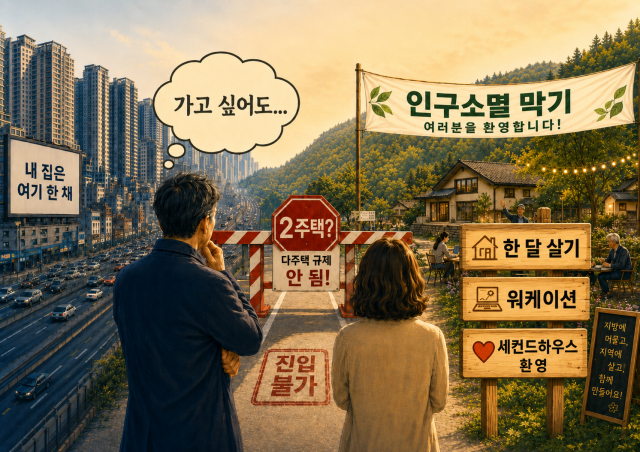
The real estate market is difficult to navigate, and so is home ownership. Government policies are equally challenging. This is where the complicated view of real estate begins.
In terms of area, one region in South Korea rivals Seoul. However, its population has been steadily declining, now teetering around 50,000. The proportion of residents aged 65 and older has surpassed 40%, while the youth demographic is below 10%. Although the administrative boundaries remain unchanged, the population within is aging and diminishing rapidly.
The region's challenge is no longer development; it is about people. Local officials are brainstorming ways to create tourism content and increase both the resident and visitor populations. Discussions often include suggestions to renovate vacant homes for use as second houses. Social media platforms popular among younger people are filled with promotions for month-long stays, workations, and support for relocating to the area.
However, progress has been slow. Those occasionally interested in the region often ask, “If I buy a house here, I won’t be able to keep my home in Seoul, right?”
Local officials have few answers to this question, as it is not entirely incorrect.
We must first redefine 'actual residence'
During a press conference marking his first year in office, the President stated, “We must protect those who own homes for actual residence. The burden should not be too great. However, if it has become almost a luxury, we should impose a holding burden similar to that of advanced Western countries. Owning multiple homes is not a problem; we do not prohibit it.”
The essence of this statement is not about how many homes one owns, but whether a home is used for actual residence or held as an asset for wealth accumulation. The direction is correct, but it raises an important question: What constitutes actual residence?
In South Korean real estate policy, 'actual residence' has long been treated as a moral concept. The narrative has solidified around protecting single-home residents while viewing multi-home owners with suspicion. However, the reality of residence is far more complex.
Is it considered actual residence if one changes their registered address? Does spending weekends in the countryside count as actual residence? If someone buys a small house in the countryside to care for their parents, is that an investment? Is a lifestyle split between Seoul and the countryside after retirement considered residence or ownership? Month-long stays are part of the resident population policy, yet buying a home in the same area subjects one to multi-home regulations.
Policies have reduced complex lives to a mere number of homes. This is a convenient standard for administration, but it is too crude to explain reality. A home is a space before it is a number. For some, it is an investment, while for others, it is a place to stay near family, or a second living space after retirement.
The number of homes does not explain everything
Tax policies based on the number of homes have conveyed a strong message for some time: discourage multi-home ownership while protecting single-home ownership. The problem is that the outcomes do not always align with policy intentions.
When disadvantages are tied to the number of homes during acquisition, ownership, and transfer stages, rational individuals tend to choose concentration over diversification. It is safer to invest in a single property in a core area of the metropolitan region than to own multiple small homes in provincial cities. The so-called 'smart single home' is less a model of actual residence and more a reflection of the safest concentration permitted by tax policy. Core properties are locked up, private rentals are declining, and the pathways for middle-class individuals planning retirement with multiple small homes in the countryside have narrowed.
The term 'multi-home' also encompasses too much. It includes gap investments aimed at short-term profits, long-term rental businesses, small homes for parental care, second houses after retirement, and purchases of vacant homes in areas facing population decline. Speculation and residency, investment and habitation are all lumped together. Policies have chosen to count numbers rather than inquire about the differences.
Of course, this does not mean that the number of homes is entirely meaningless. It has been the easiest and quickest criterion for filtering speculative demand. However, an easy standard is not always a good one. With population decline, aging, parental care, and dual-residency lifestyles becoming realities, simply counting one or two homes is insufficient to distinguish between residency and speculation.
Tax loopholes can always become conduits for speculative demand. There is a risk that capital from the metropolitan area could sweep up low-cost housing in the countryside, driving up living costs for local residents. Therefore, what is needed is not a blanket repeal but a more nuanced distinction. Discussions must begin on this premise.
Regions attract people, but tax policies focus on counting homes
The Ministry of the Interior and Safety has designated 89 areas facing population decline and 18 areas of interest, making the securing of resident and visitor populations a national priority. Each region promotes month-long stays, workations, relocation support, and the remodeling of vacant homes. They are striving to find even one more person to stay longer.
The numbers already sound alarm bells. The number of unsold homes after completion rose from around 7,000 at the end of 2021 to 28,641 by the end of 2025. Of these, approximately 85%—or 24,398 homes—are located in provincial areas. New homes are piling up in various regions, yet demand is slow to respond. This is not simply due to a lack of appeal; the structure that raises suspicions about purchases and could lead to tax disadvantages also pushes demand away.
For people to stay, space is necessary. Relying solely on lodging facilities will not lead to a stable resident population. To repeatedly visit, consume locally, and build relationships with neighbors, a base is essential. That base often turns out to be housing.
The government is not unaware of this contradiction. The 2026 economic growth strategy includes a plan to exclude the number of homes from the calculation of capital gains tax and comprehensive real estate tax when acquiring homes in population decline areas. The direction is correct, but it is still only a partial solution. The first question for those looking to buy a home in the countryside is different: “Is it okay to buy now? Will this house make me a multi-home owner? Will it disadvantage me when I sell or move my home in Seoul later?” If the system cannot clearly answer these questions, demand will not shift.
The criteria for determining actual residence remain vague. How many days of annual stay constitute residence? How should dual-residency lifestyles for parental care or post-retirement be viewed? How can we differentiate between long-term rentals and short-term speculative demand? Excluding the number of homes from tax calculations and recognizing provincial base housing as a new form of residence are two different issues.
We should ask 'how will it be used?' rather than 'how many homes do you have?'
What needs to be examined is not just the number of homes but the purpose and usage of those homes. We must consider the region, the price, the actual residency status, the duration of ownership, and the rental utilization methods. Bundling homes priced below a certain threshold in population decline areas into a uniform multi-home framework is a sign of lazy policy design.
Even a single home can be problematic if it is not occupied. Conversely, if two homes are actually lived in and contribute to local consumption and relationships, they require a different label.
The term 'actual residence with two homes' may still sound unfamiliar. However, considering the era of population decline, aging, parental care, and dual-residency lifestyles, it is no longer an odd phrase. Life no longer stays in one place. Yet, tax policies remain trapped within the confines of a single number.
Returning to the local government official, the individual who was captivated by the region's scenery and community posed a final question: “If I buy a house here, I won’t be able to keep my home in Seoul, right?”
Answering this question requires more than just a minor adjustment to tax regulations. We must redefine what actual residence means. It is not about how many homes one has, but rather what one does with those homes. If the government is concerned about non-resident single-home ownership, it must also address the concept of actual residence with two homes.
* This article has been translated by AI.
Copyright ⓒ Aju Press All rights reserved.