This is the tenth installment of AJP's Spiritual Asia series exploring the religious traditions, philosophical ideas and moral foundations that have shaped Asia's civilizations. This chapter turns to Zoroastrianism, one of the world's oldest living faiths, and examines how its teachings on truth, free will and moral responsibility continue to resonate in an age increasingly shaped by artificial intelligence.
The Buddhist Legacy Left by Shakyamuni and Great Monks
The greatness of a religion is not evaluated solely by the depth of its doctrines. No matter how excellent its scriptures and philosophy may be, if it does not live and breathe within human life, history does not remember it for long. Conversely, if one person's life changes the destinies of countless others, and that spirit is passed down to future generations across centuries, it becomes a living religion. In that regard, Buddhism was one of the most successful spiritual revolutions in human history. This is because Buddhism is not merely a religion that left behind theories of enlightenment, but one that left behind people who put enlightenment into practice in their lives. The enlightenment of a single practitioner, which began in a small kingdom in northern India 2,500 years ago, influences the spiritual world of billions of people globally today. The history of Buddhism is, in essence, the history of great individuals, and a history of hope demonstrating that humanity can change itself.
The starting point of Buddhism is, without a doubt, Shakyamuni. He was born a prince. By the standards of the time, he was in a position to enjoy all the wealth and glory of the world. However, fundamental questions surrounding human life did not let him go, even within the high walls of the royal palace. Facing the inescapable realities of aging, illness, and death, he left the palace at the age of twenty-nine to find the answer to why humans suffer. Leaving behind his wife Yasodhara and young son Rahula, his departure from home was not a simple religious decision, but a great adventure toward the truth of human existence. He experienced extreme asceticism for six years. Records even say he practiced while eating only a single grain of rice and a single sesame seed a day. However, he eventually realized that extreme asceticism itself does not guarantee the truth. And finally, after meditating under the Bodhi tree, he achieved enlightenment. The greatness that Buddhism speaks of lies precisely here: enlightenment was not a revelation handed down to humans by a god, but a state reached through human self-reflection and ascetic practice.
After attaining enlightenment, Shakyamuni returned to the world. He did not become a king, nor did he try to become the leader of a cult. Instead, he walked barefoot across India for 45 years, meeting people. He preached to kings and preached to beggars. He gave teachings to nobles and gave teachings to the lowest classes. The strict caste system that dominated Indian society at the time was unimportant in his eyes. The idea that a human being should be evaluated by their practice and character rather than their birth was a revolutionary thought for its time. Thus, it can be said that before Buddhism was a religion, it was a declaration of human equality.
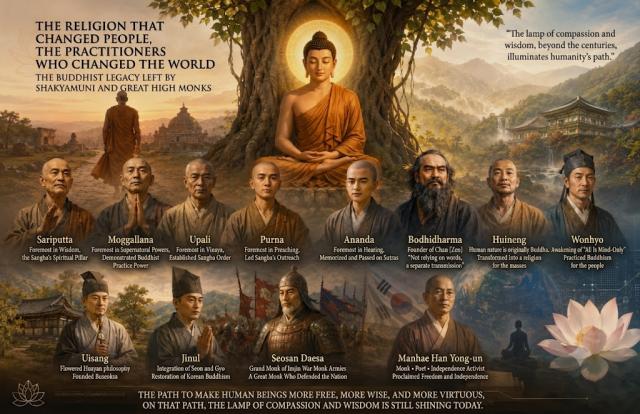
Shakyamuni's greatness is also found in another aspect: he nurtured outstanding disciples. The Buddhist order was not an organization created by a single genius, but a community built together by practitioners with diverse talents. Sariputta, known as the foremost in wisdom, served as the spiritual pillar of the order with his brilliant logic and insight. Moggallana, foremost in supernatural powers, demonstrated the mystique and ascetic prowess of Buddhism to the masses. Upali, foremost in observing the precepts, established the order of the sangha, while Punna, foremost in preaching, led the order's missionary activities. However, the most important figure above all was Ananda, the foremost in hearing and retaining teachings. He attended to Shakyamuni by his side throughout his life and memorized his master's words. The fact that a significant portion of early Buddhist scriptures today begins with the phrase "Thus have I heard" originates from Ananda's memory. If it were not for Ananda, it would have been difficult for us to encounter Shakyamuni's teachings as vividly as we do today.
After Shakyamuni entered Nirvana, Buddhism began to form a massive civilizational sphere beyond India. Among the figures who emerged in this process, the most symbolic is Bodhidharma. He is known as the figure who traveled from India to China and laid the foundation for Zen Buddhism. According to legend, he practiced seated meditation facing a wall at the Shaolin Temple for nine years. What is important is not the number. It is the spirit of thorough self-reflection he demonstrated. Bodhidharma taught that looking into one's own mind is more important than reading many scriptures. His teachings of "not relying on words and letters" and "a special transmission outside the teachings" steered a religion that had become obsessed with text and knowledge back to the path of living practice.
The figure who completed Chinese Buddhism was the Sixth Patriarch, Huineng. He was originally a poor woodcutter. He had not even properly learned to read or write. Yet, he realized the truth that human nature is originally Buddha. The emergence of Huineng holds immense significance in religious history. This is because it marked the turning point where Buddhism transformed from a religion of a few intellectuals into a religion for ordinary commoners. His teachings subsequently had a decisive influence on the Zen Buddhist traditions of China, Korea, and Japan.
In the history of Korean Buddhism, Wonhyo cannot be left out. Wonhyo is one of the high monks most beloved by Koreans. While on his way to study in the Tang Dynasty, he drank water in a cave because he was thirsty. The water he thought was cool, sweet spring water at night turned out, upon seeing it in the morning, to be stagnant water pooled inside a human skull. In that moment, he achieved a profound enlightenment: the realization that it is not objects, but the mind, that determines the world. This is the so-called enlightenment that "everything is created by the mind alone." Afterward, Wonhyo abandoned his studies in the Tang Dynasty and went among the common people. He practiced a Buddhism for the people, not just for aristocrats and monks. The life he lived became the starting point of the most humanistic tradition within Korean Buddhism.
Uisang was the figure who brought Hwaeom philosophy into full bloom. Buseoksa Temple, which he founded, still remains a symbol of Korean spiritual culture today. Jinul of the Goryeo Dynasty sought to integrate the conflict between Zen and doctrinal schools. Seosan Daesa of the Joseon Dynasty led a monk army to defend the country during the national crisis of the Imjin War. It is even evaluated that without him, the destiny of Joseon would have been vastly different. This demonstrates that Buddhism was not a religion that turned a blind eye to reality, but one that acted for the community when necessary.
Entering the modern era, Buddhism encountered another giant: Manhae Han Yong-un. He was a monk, a poet, and an independence activist. He was a rare intellectual who connected the Buddhist spirit of compassion with the national liberation movement. As one of the 33 national representatives during the March 1st Movement, he cried out for national dignity and freedom even under the oppression of Japanese imperialism. His poetry collection "The Silence of the Beloved" was not merely a collection of love poems, but an expression of a deep yearning for his homeland and freedom. He was a representative figure who showed that Buddhism could possess a spirit of active engagement with reality.
Looking back, the history of Buddhism has not been a history of scriptures, but a history of people. Shakyamuni showed the hope that human beings can change themselves. Sariputta and Ananda systematized those teachings. Bodhidharma and Huineng opened the path of ascetic practice. Wonhyo and Uisang brought Korean Buddhist culture to full bloom. Jinul and Seosan Daesa demonstrated a Buddhism that takes action amidst community crises. Manhae Han Yong-un reinterpreted Buddhism within the zeitgeist of freedom and independence.
This is why Buddhism still holds meaning today, even in an era where artificial intelligence is rapidly catching up to human intellectual capabilities. AI can calculate, but it cannot feel compassion. AI can store information, but it cannot experience enlightenment. AI can execute logic, but it cannot question the meaning of human existence. Ultimately, what makes humans human is not technology, but the spirit, and Buddhism has been exploring the very issue of that spirit for 2,500 years.
Wrapping up the third installment of the Buddhism section in the Spiritual Asia series, I reflect once more. Hinduism explored the origins of the universe, Daejonggyo explored the relationship between the nation and the heavens, and Buddhism explored the deepest depths of the human mind. However, the ultimate destination these three religions headed toward was not different. It was the path to making humans freer, wiser, and more virtuous beings. On that path, the lanterns of compassion and wisdom lit by Shakyamuni and countless high monks will continue to illuminate the road ahead for human civilization for a long time to come. That is the greatest legacy Buddhism has left to the world beyond Asia, and it is likely the reason why it remains alive today, 2,500 years later.
Copyright ⓒ Aju Press All rights reserved.