
As domestic manufacturing faces challenges from intensified price competition from China, a labor shortage due to an aging workforce, and a global supply chain reshuffle, AI is paving the way for solutions. The transition to manufacturing AI (M.AX) is becoming a necessity rather than an option.
During a meeting on June 12 at HD Hyundai Heavy Industries' medium-sized shipbuilding division in Ulsan, Yoon noted that industrial robots were continuously welding and producing or recycling lugs, which are essential components in ship manufacturing.
Lugs connect blocks to lifting equipment when cranes lift or move ship blocks. They are produced in various specifications but are used in large quantities throughout the shipbuilding process, necessitating a production system that can supply diverse lugs promptly. Additionally, since lugs can be reused two to three times, a recycling and management system is essential.
HD Hyundai Heavy Industries has established a lug autonomous manufacturing system based on eight industrial robots and two autonomous mobile robots (AMRs). This system has transitioned from a manual welding-based production method to an unmanned production system, enhancing the continuity and stability of the production flow, according to Yoon.
Production efficiency has also improved. Since implementing the lug autonomous manufacturing system, production has increased by 87.5%. The automation equipment performs repetitive tasks reliably, boosting production efficiency and allowing for flexible supply of various lugs. Variability due to worker skill levels has decreased, reducing the physical strain on workers and minimizing the risk of industrial accidents.
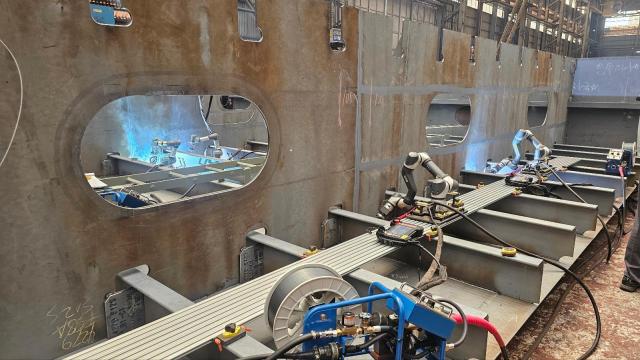
The use of collaborative robots is also increasing on-site. In the second shipbuilding plant, welding collaborative robots are utilized during the assembly process of flat blocks. Previously, repetitive welding tasks in confined spaces posed significant risks and discomfort for workers, increasing the likelihood of musculoskeletal disorders.
The collaborative robots, which incorporate the expertise of skilled workers, are performing the work of two experienced operators with 5 to 10 years of experience each, resulting in a productivity increase of about 70%, according to HD Hyundai Heavy Industries.
Looking ahead, the challenge lies in developing non-standard AI technologies. Yoon stated, "Currently, we can handle standard parts to some extent, but non-standard parts vary by design and product. We are developing humanoids that can be used in the shipbuilding dock, utilizing AI not only for components inside the ship but also externally."
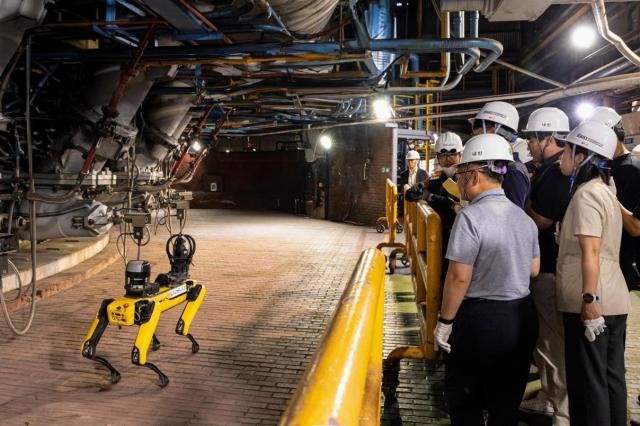
A notable example is the use of Boston Dynamics' Spot robot to inspect wind boxes in the second blast furnace at the Pohang Steelworks. Inspecting the external temperature and gas leaks of the 30 wind boxes is crucial, but periodic checks have been challenging due to the limited number of workers managing the entire furnace. The extreme heat exceeding 1,100 degrees poses risks of burns and gas exposure for workers.
To address this, the company is deploying robotic dogs to inspect the wind boxes based on accumulated data. This allows for real-time monitoring through anomaly detection capabilities derived from data analysis. The continuously gathered data has also enabled the implementation of monitoring functions based on digital twin technology.
AI is expected to be utilized for inspecting rollers on belt conveyors and manual steelwork. By detecting anomalies based on voice data from the belt conveyor, robots can be deployed for replacements. The plan is to minimize the involvement of workers in high-risk areas by having humanoid robots perform tasks near molten metal.
The technologies developed through this initiative are expected to be applicable in similar industries in the future. Choi Yong-jun, a researcher at POSCO, stated, "After enhancing the diagnostic performance of key equipment, we will expand robot demonstrations and plan to create an integrated platform for predictive maintenance packages to facilitate technology transfer."
* This article has been translated by AI.
Copyright ⓒ Aju Press All rights reserved.