
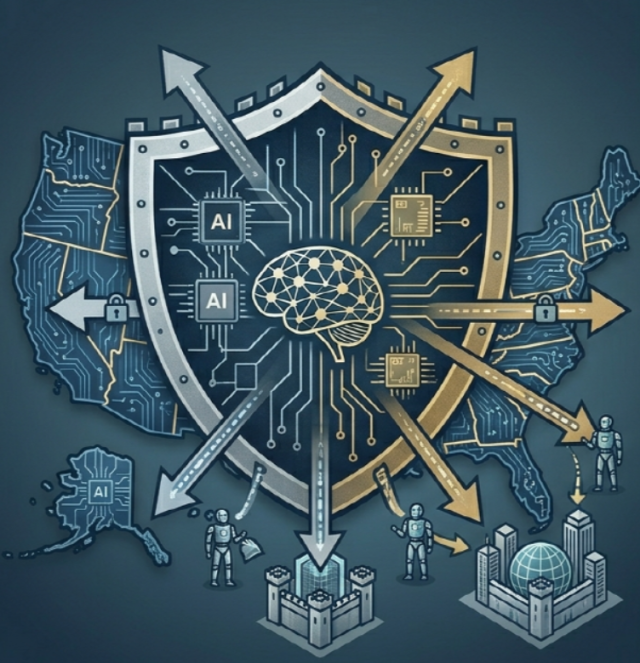
The U.S. government has issued export controls on Anthropic's latest artificial intelligence (AI) models, marking the first time access to large language models (LLMs) has been restricted. This move signals that AI has officially been classified as a national strategic asset, alongside semiconductors and satellites. The importance of sovereign AI has been underscored in South Korea as a result of this development.
According to the IT industry on June 14, the U.S. government has activated an export control order that blocks access to Anthropic's latest models, Fable 5 and Mythos 5, for all foreign nationals except U.S. citizens.
Anthropic received the order at 5:21 PM local time on June 13, and due to the inability to identify foreign customers, it ultimately blocked access for all users worldwide. This restriction also affects foreign employees working at Anthropic's U.S. office. Fable 5 was taken offline just three days after its launch.
The government justified the order by stating that a technique known as 'jailbreaking' had been discovered, which could potentially exploit the cybersecurity capabilities of the Mythos model. Mythos is known for its exceptional ability to detect previously unknown software vulnerabilities and has been utilized by U.S. intelligence agencies and selected partners for system reinforcement. This ban has directly impacted companies involved in the domestic Project Glasswing.
Anthropic quickly rebutted the government's claims. In an official statement, the company said, "After reviewing the jailbreak cases cited by the government, we found that such capabilities are already routinely utilized in other models, including OpenAI's GPT-5.5. We do not believe that a narrow range of potential jailbreak possibilities justifies the recall of a commercial model distributed to millions of users." Anthropic criticized the order for not following a "transparent, fair, and legally sound process based on technical facts" while complying with it.
Experts note that this action signals a shift in the AI landscape beyond corporate disputes.
Park Han-woo, a professor at Yeungnam University’s Department of Media Communication, stated, "This should not be viewed merely as an incident limiting access to a specific AI model abroad, but rather as a symbolic case showing that AI is being transformed into a national security asset. It is significant that, while semiconductors, satellites, and quantum technologies have been managed as strategic technologies, cutting-edge AI models themselves are now subject to export controls." He added, "This situation may intertwine issues of AI safety, national security, industrial policy, and corporate competitive strategies."
Warnings have also emerged that this measure could backfire on the U.S. AI ecosystem in the long run. Kim Nam-guk, a professor at Ulsan University and Seoul Asan Medical Center, remarked, "Marginalized countries will likely form strong alliances to survive, and the global AI industry may shift from a bipolar system dominated by the U.S. and China to a new equilibrium, possibly a tripolar system." He cited the precedent of U.S. export restrictions on Nvidia semiconductors accelerating China's development of its own GPUs, suggesting that this could paradoxically weaken the U.S.-centered AI ecosystem.
In South Korea, this incident is expected to reignite discussions on sovereign AI, which refers to AI developed and operated independently by a country without reliance on foreign technology. Given that this is the first instance of LLM export controls, institutions and companies dependent on U.S.-based AI have directly experienced the reality that their services could be blocked at any time.
Former Chief AI Advisor to the Blue House, Ha Jung-woo, emphasized on his social media, "National AI competitiveness is crucial. This highlights the importance of sovereign AI. The most powerful AI at any given time could become subject to export controls, signaling the end of the 'We Are the World' era."
* This article has been translated by AI.
Copyright ⓒ Aju Press All rights reserved.