
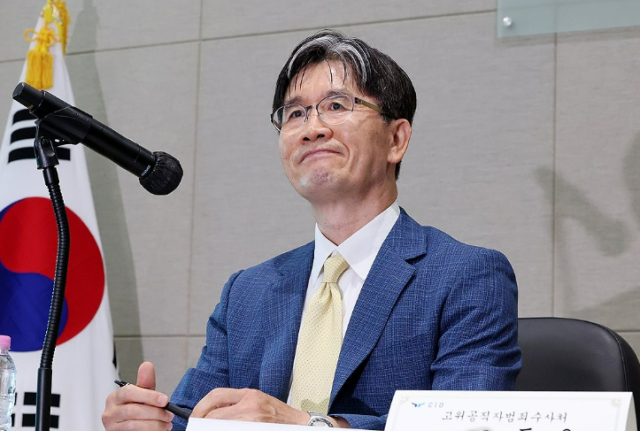
O Dong-won, the Director of the Corruption Investigation Office, reiterated the urgent need for amendments to the Corruption Investigation Office Act. He expressed concerns that limitations on investigation powers, along with a lack of personnel and organizational resources, could lead to delays in investigations.
During a press conference on June 15 marking his two-year anniversary, O stated, "To continue the thorough investigations that the public desires, amending the current Corruption Investigation Office Act is essential." He emphasized that the office is at a critical juncture, moving beyond mere establishment to becoming a key institution for judicial justice in South Korea. "This legal amendment is not about expanding the agency's powers but is a desperate plea to sharpen the blade against the deep-rooted evils in our society," he added.
In the Q&A session, O elaborated on the necessity for legal revisions. He noted, "The Corruption Investigation Office is too small to effectively monitor abuses of power and eradicate corruption among high-ranking officials."
He pointed out that there are many provisions that hinder investigations, citing limitations on investigation powers as a significant issue. O explained, "While special prosecution laws and general laws recognize investigation powers for related crimes, the Corruption Investigation Office Act restricts investigations unless they pertain to cases involving high-ranking officials. In bribery cases, we need to investigate how a company misappropriated funds to offer bribes, but these limitations obstruct our inquiries."
O stressed the need for legal and institutional support to enable the Corruption Investigation Office to exercise its original investigative authority effectively. He stated, "We must correct the limitations on our powers to ensure the office can function properly and exercise its investigative capabilities."
He also highlighted gaps in supplementary investigation procedures between the prosecutors and the Corruption Investigation Office. Referring to bribery cases involving senior officials, O remarked, "There is a legislative gap regarding who can conduct supplementary investigations between the prosecutors and the Corruption Investigation Office."
O suggested that criminal procedures must be clearly defined by law, warning that conducting investigations without clear procedures could lead to violations of due process. He proposed the need for specific regulations allowing prosecutors to conduct supplementary investigations directly or for Corruption Investigation Office prosecutors to request supplementary investigations.
He noted, "There have been some issues regarding cooperation between prosecutors and Corruption Investigation Office investigators, leading to delays in cases. Prompt legislative action is necessary."
O also addressed the handling of cases involving the distortion of law. He stated that cases solely involving the distortion of law would generally be referred to the National Investigation Headquarters. However, he clarified that cases involving both distortion of law and abuse of power could fall under the jurisdiction of the Corruption Investigation Office.
Regarding the case involving Supreme Court Chief Justice Cho Hee-dae, O said, "We fundamentally view the distortion of law as the main issue, while job abandonment is a preliminary charge. We recently referred the case to the National Investigation Headquarters, believing a unified resolution is necessary."
O expressed concern about the potential chilling effect on judicial personnel due to the excessive filing of distortion of law charges. He stated, "We need to prevent the misuse of distortion of law charges that could intimidate judicial personnel. After giving the parties a chance to submit materials, if they fail to do so, we should swiftly conclude the investigation to foster an environment where they can work with confidence."
On the restructuring of the criminal justice system, including the establishment of the Serious Crimes Investigation Agency and the Prosecutor's Office, O emphasized the independent role of the Corruption Investigation Office. He stated, "Even with the establishment of the Serious Crimes Investigation Agency and the Prosecutor's Office, the original purpose of the Corruption Investigation Office as an agency investigating high-ranking officials' crimes remains intact."
He added, "The Corruption Investigation Office has the authority to prosecute judges, prosecutors, and police officials of the rank of superintendent and above. Regardless of any restructuring of the prosecution and investigative agencies, the duty to monitor abuses of power while maintaining political neutrality remains unchanged."
When asked whether the Corruption Investigation Office, which holds both investigative and prosecutorial powers, poses a risk of power abuse similar to the prosecutors, O responded, "The Corruption Investigation Office only investigates crimes committed by high-ranking officials and targets specific offenses. There has not been a particular issue of power abuse."
He also affirmed, "The Corruption Investigation Office is an institution that operates under the principle of political neutrality, and we will fulfill our role in line with our founding purpose to check the powers that be."
O highlighted key achievements over the past year, including the investigation of the December 3 insurrection case, the prosecution of a bribery case involving a Jeonju District Court judge, and significant sentences in bribery cases involving senior police officials.
He remarked, "The past year has been a whirlwind since we completed the investigation into the December 3 insurrection case, a significant milestone in our constitutional history. Based on the momentum from this monumental event, we achieved notable results, including the prosecution of the bribery case involving a Jeonju District Court judge and substantial sentences in the bribery case involving senior police officials."
Regarding the insurrection investigation, O reflected, "I believe the necessity of the Corruption Investigation Office as an essential organization within our government has been proven."
He also mentioned that the legitimacy of the Corruption Investigation Office's investigative powers and arrest warrants was upheld in the first trial of former President Yoon Suk-yeol. O stated, "Although there were challenges regarding our investigative powers, jurisdiction, and the legality of arrest warrants, the court recognized their legitimacy. I take pride in the fact that the Corruption Investigation Office has acted as a legitimate investigative agency without losing its way."
Regarding allegations of violations of voting rights in the June 3 local elections, O said, "We are monitoring the Joint Investigation Headquarters' investigation, and the Corruption Investigation Office has also received the case. Since political officials from the National Election Commission are subjects of our investigation, we are examining the potential for criminal charges."
He added, "We are focusing on whether actions were taken according to guidelines and whether there are any issues related to those guidelines."
* This article has been translated by AI.
Copyright ⓒ Aju Press All rights reserved.