
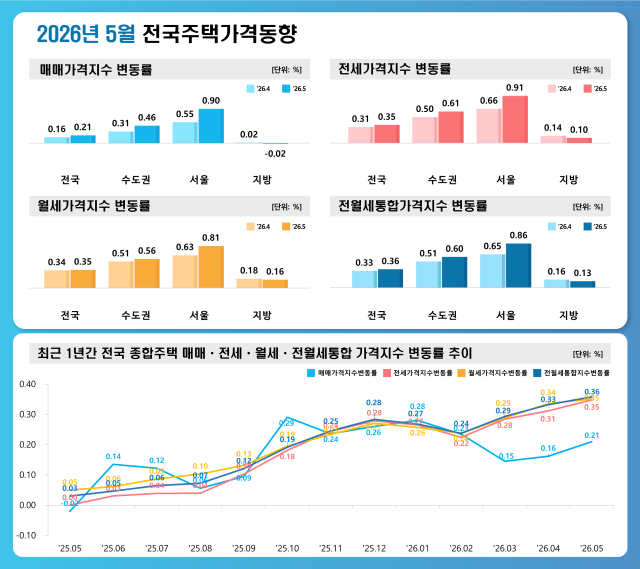
According to the Korea Real Estate Agency's report on national housing price trends for May 2026, the average housing sale price across the country increased by 0.21% compared to the previous month. The metropolitan area saw a 0.46% rise, with Seoul's prices climbing 0.90%, while regional markets experienced a slight decline of 0.02%.
The increase in Seoul's housing prices is primarily concentrated in desirable areas such as redevelopment zones, transit-accessible locations, and large complexes. The growth rate for Seoul's housing prices expanded from 0.55% in April to 0.90% in May.
By district, Seongbuk-gu recorded the highest increase at 1.36%, followed by Songpa-gu (1.19%), Gwangjin-gu (1.18%), Seongdong-gu (1.07%), Seodaemun-gu (1.06%), and Nowon-gu (1.05%), all showing around 1% growth.
In contrast, the regional housing market remains stagnant. Gwangju saw a decrease of 0.52%, and Jeju's prices fell by 0.17%, while the five major metropolitan cities overall dropped by 0.09%. Only a few areas, such as Ulsan (0.33%) and Jeonbuk (0.21%), showed any signs of growth.
The rental market also reflects a strong trend centered around Seoul and the metropolitan area. National rental prices rose by 0.35%, with the metropolitan area increasing by 0.61% and Seoul's rental prices climbing by 0.91%. Notably, the growth rate for rental prices in Seoul has reached levels comparable to that of sale prices. The Real Estate Agency noted that demand for rentals continues to flow into areas with excellent living conditions, such as large complexes and transit-accessible locations.
In the Seoul rental market, Songpa-gu experienced the highest increase at 1.62%, followed by Seongdong-gu (1.44%), Nowon-gu (1.40%), Seongbuk-gu (1.30%), and Dobong-gu (1.13%).
The upward trend in monthly rents also persists, with national monthly rental prices rising by 0.35% and Seoul's by 0.81%. In Seoul, demand for monthly rentals is concentrated in areas like Songpa-gu (1.30%), Nowon-gu (1.40%), and Seongdong-gu (1.27%).
The Korea Real Estate Agency stated, "Demand is concentrated in new and redevelopment projects in Seoul and the metropolitan area. While some regions are showing a wait-and-see attitude, the overall trend remains upward. The rental market is also experiencing increased demand in transit-accessible and newly built areas, leading to continued rising transactions."
Industry experts believe that the simultaneous rise in Seoul's housing prices and rental challenges will likely sustain the polarization between the metropolitan area and regional markets, as well as between new and existing properties. The similar growth rates for sale prices (0.90%) and rental prices (0.91%) in Seoul are interpreted as a signal of ongoing demand from actual buyers.
* This article has been translated by AI.
Copyright ⓒ Aju Press All rights reserved.