
The real estate market is difficult to navigate, and homeownership is challenging.
In June 2017, the Moon Jae-in administration launched efforts to control housing prices. The government designated all of Seoul as a speculative zone under the 8·2 measures, imposed higher capital gains taxes on multiple homeowners, and announced plans for a reconstruction excess profit recovery system. It also significantly reduced loan limits to curb leverage, with the official rationale being to protect genuine demand and suppress short-term speculative demand.However, just four months later, the government offered incentives for multiple homeowners to register rental properties. This created a conflicting situation where homeowners were pressured to sell but were simultaneously given a legal avenue to avoid doing so. The design of the incentives was contradictory.
Subsequent measures became more detailed under the label of “targeted prescriptions.” The 9·13 measures increased comprehensive real estate taxes, tightened loans for multiple homeowners, and imposed regulations on loans for rental businesses. The 12·16 measures prohibited mortgage loans for apartments priced over 150 million won and further lowered the loan-to-value ratio for amounts exceeding 90 million won. The regulatory landscape continued to expand, encompassing taxes, loans, subscriptions, reconstruction, resale, and rental business management.
Despite these efforts, the median sale price of apartments in Seoul surged from 606 million won to 920 million won within three years of the Moon administration's inception. The cumulative increase in the actual transaction price index exceeded 45% over the same period. Throughout this time, the Minister of Land, Infrastructure and Transport remained unchanged, with Kim Hyun-mi serving as the longest-serving minister in the department's history.
These records did not signify success but rather a chain of failures.
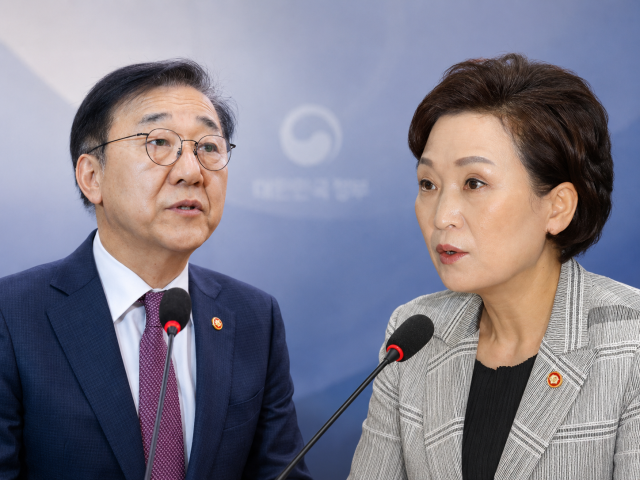
The long tenure of Kim Hyun-mi as Minister of Land, Infrastructure and Transport.
The reason for revisiting Kim Hyun-mi’s name is not to judge the past but to reflect on the failures of her administration as the new government embarks on a path of stringent real estate regulations. Is Kim Yoon-deok, the current Minister of Land, Infrastructure and Transport, free from the pitfalls that ensnared Kim Hyun-mi? Can he fulfill the tasks at hand until the end?
The issue with Kim Hyun-mi’s administration was not a lack of measures; rather, there was an abundance of them. The problem lay in the inability to correct the diagnosis. The Ministry of Land, Infrastructure and Transport's assessment was relatively clear: chronic housing shortages had been largely resolved, housing supply rates had increased, and the number of housing units entering the market in Seoul and the metropolitan area was not below historical averages. They attributed rising housing prices to speculative demand, multiple homeownership, gap investments, liquidity, and expectations of capital gains rather than supply shortages.
Based on this assessment, the policy direction became entrenched in regulation. The approach involved tightening taxes, restricting loans, raising barriers for reconstruction, and limiting transactions. While there were supply measures, such as plans for 300,000 units in the metropolitan area, new towns, utilizing idle land in Seoul, and repurposing public facilities, these were more about partial supply in outer public housing areas rather than large-scale urban supply to meet core demand in Seoul.
Market signals indicated otherwise. Demand for core areas in Seoul did not diminish, and the scarcity of new apartments in preferred locations increased. As regulations increased, listings became scarce, and demand shifted toward safer assets. Nevertheless, the government did not acknowledge the supply shortage for some time. In July 2020, Kim Hyun-mi stated she did not believe there was a housing supply shortage, explaining that the issue was not the quantity itself but the system for properly supplying it to genuine demand. It was only in November of the same year that she made comments acknowledging a decrease in apartment supply.
There had already been several opportunities for a change in leadership. Despite numerous measures, prices continued to rise, listings became scarce, and the debate over supply shortages gained prominence. Opportunities arose when her successor was nominated in 2019 but failed to take office, after the ruling party's landslide victory in the 2020 general elections, and when discussions about a supply shift emerged in the summer of 2020. However, Kim Hyun-mi remained in her position. Her retention was not a decision but a default; in a structure where doing nothing resulted in retention, changing leadership required justifications, candidates, and timing, all of which came with costs.
If the diagnosis is incorrect, it must be corrected. However, to correct the diagnosis, one must first acknowledge that it is wrong. Acknowledgment implies dismissal, and dismissal signifies the formal recognition of failure. As long as this equation holds, a change in ministers becomes a means of policy modification rather than a declaration of governmental failure. The Moon administration became a prisoner of this equation.
Ultimately, a change occurred only at the end of December 2020, with just over a year left in the administration's term. The new Minister, Byun Chang-heum, introduced a supply plan for 836,000 units just five weeks after taking office. While the numbers were significant, the timing was late. However, LH, the key executing agency for the supply plan, soon became embroiled in pre-speculation allegations regarding the Gwangmyeong and Siheung new towns. The administration lacked both time to recover and political capital. The delayed transition faltered not due to directional issues but due to timing.
One cannot attribute Kim Hyun-mi’s failures to Byun Chang-heum. The Byun administration was more a result of the delayed transition. The Kim Hyun-mi administration should have recognized the diagnosis of supply shortages earlier and adjusted the regulatory framework more swiftly. A change in leadership could have been a method for that adjustment. However, the change was perceived as an acknowledgment of failure, and thus it was postponed. In the meantime, the market had moved further away.
The new government's approach to real estate regulation and its implications.
Five years have passed since then, and the Yoon Suk-yeol administration has begun.
The starting point is eerily similar. The guiding principle is “eradication of real estate windfall profits and transition to a productive economic structure.” The 10·15 measures have designated all of Seoul and 12 areas in Gyeonggi Province as regulated zones and land transaction permission areas, and in May of this year, the government resumed higher capital gains taxes. This design aims to tighten the exit routes for multiple homeowners.
However, the market is moving in unexpected directions. In a climate of reduced transactions, a few listings are being sold at high prices, a paradox that has become familiar since the introduction of regulations. In the year following the Yoon administration's launch, apartment prices in Seoul recorded double-digit increases according to real estate data, surpassing the initial year’s rise during the Moon administration.
The rental market is also showing signs of strain. Regulations on multiple homeowners are reducing rental supply, leading to rental instability, which in turn drives demand for purchases. This chain of events is not unfamiliar, having been witnessed after the implementation of the two rental laws in 2020. The years 2026 and 2027 are expected to see a further decrease in housing supply due to a construction cliff. Pressure in the rental market is likely to continue building for the foreseeable future.
Recently, speculation about a cabinet reshuffle has emerged. Following the defeat in the Seoul mayoral election, discussions about a comprehensive revision of real estate policy have coincided with rumors of a change in the Minister of Land, Infrastructure and Transport. Kim Yoon-deok has been in office for less than a year, which is typically considered too early for a change. However, it is difficult to avoid accountability regarding the scarcity of listings, overheating, and rental supply instability in the Seoul real estate market.
President Yoon Suk-yeol did not rule out the possibility of a cabinet reshuffle during his press conference marking his first year in office. However, he did not specify which departments would be reviewed in detail. While he did not directly mention Kim Yoon-deok's retention, his comments did not strongly support immediate replacement either.
Kim Yoon-deok appears to be aware of this accountability. On the night of June 4, the day after the local elections, he announced on Facebook that he had discussed housing supply plans with the Korea Housing Association, stating, “The government’s commitment to housing supply is resolute and firm.” He emphasized the importance of communicating with supply sites until the goals of the 9·7 housing supply measures are achieved, promising to address any obstacles swiftly.
In a context where real estate is cited as a contributing factor to the defeat in the Seoul mayoral election, the Minister of Land, Infrastructure and Transport has reaffirmed his commitment to supply. The minister is inevitably accountable for housing and rental prices.
Yoon-deok Kim's other test: balanced development.
Moreover, the significance of Kim Yoon-deok as a minister extends beyond managing the real estate market. As the first Minister of Land, Infrastructure and Transport from Jeollabuk-do, he views balanced development and the reorganization of land use as issues of greater importance than mere departmental concerns. The second phase of the relocation of public institutions and the fifth national railway network construction plan are prime examples. Easing the concentration in the metropolitan area and reestablishing regional hubs are central to the new government's land policy.
These tasks have already entered the national agenda, transcending personal interests. The importance of balanced development and the relocation of public institutions was publicly addressed in presidential briefings, and the Ministry of Land, Infrastructure and Transport has prioritized the second phase of public institution relocation as a key issue for balanced growth. Kim Yoon-deok has also indicated that he will outline a timeline by September, making it clear that these issues can no longer be postponed as long-term projects.
Relocating public institutions is a matter where regional interests clash directly. It carries significant implications if proposed just before a general election, and delaying it too long makes subsequent procedures difficult. With the general election scheduled for April 2028, it is essential to establish a framework within this year. The fifth national railway network construction plan has also been delayed due to complaints from across the country. The moment one line is included or excluded, local political circles and local governments will react simultaneously.
Here, the decisive differences between Kim Hyun-mi and Kim Yoon-deok become evident.
Kim Hyun-mi was bound to the singular task of real estate. As that task failed, changing ministers became increasingly difficult. Changing the minister would mean acknowledging failure, while not changing would result in the accumulation of failures. In a structure where errors could not be corrected, transitions could not be executed, and failures could not be acknowledged, the more measures there were, the greater the failures became.
Kim Yoon-deok, however, is in a different position. This does not mean his task is easier. His responsibilities are twofold. One is to manage the instability of housing and rental prices. If the tightening of regulations leads to increased rental instability and scarcity of listings, Kim Yoon-deok will also face accountability. The other is to transform balanced development and statutory plans into tangible outcomes. This task will inevitably be evaluated as a measure of Kim Yoon-deok’s success.
Ultimately, the case of Kim Hyun-mi illustrates one key point: a minister's evaluation hinges not on how long they endure but on whether they fulfill their assigned responsibilities in a timely manner. Managing real estate instability while closing the timeline for balanced development is the challenge that Kim Yoon-deok must prove he can meet.
* This article has been translated by AI.
Copyright ⓒ Aju Press All rights reserved.