
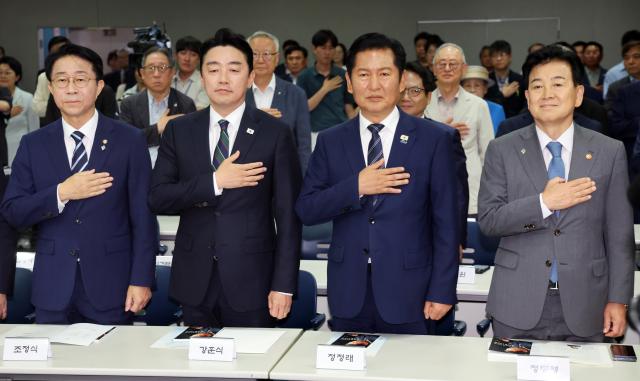
On June 15, President Lee Jae-myung, National Assembly Speaker Cho Jeong-sik, and Democratic Party leader Jung Cheong-rae expressed their commitment to establishing a peace regime on the Korean Peninsula during the 26th anniversary of the June 15th North-South Joint Declaration. However, they voiced opposition to the concept of absorptive unification, which refers to the South Korean government's acquisition of North Korean territory through force without military conflict.
While on a diplomatic tour in Europe, President Lee conveyed through his Chief of Staff Kang Hoon-sik at the ceremony held at Yonsei University's Kim Dae-jung Library, "The June 15th Joint Declaration is the starting point for peace and coexistence on the Korean Peninsula. The government will not cease efforts for peace and coexistence. We will do our utmost to facilitate dialogue, just as we did 26 years ago."
The day before, during a special mass at St. Peter's Basilica in the Vatican, President Lee remarked, "The North and South, which once spoke of peace and prosperity together, have reverted to a period of disconnection. Since taking office last year, the South Korean government has pursued proactive measures to ease tensions, including halting leaflet distribution and loudspeaker broadcasts toward the North. We have made it clear that we do not seek absorptive unification or unilateral regime competition."
Prime Minister Kim Min-seok was scheduled to attend the event but was unable to participate in the main ceremony due to scheduling conflicts. However, he made an appearance at the venue to greet those involved in the June 15th Joint Declaration.
Speaker Cho stated, "It seems that our inter-Korean relations have returned to where they were 26 years ago. I will do my utmost to bring warmth to the frozen inter-Korean relations in the National Assembly."
Leader Jung expressed confidence in President Lee, saying, "We have President Lee, who carries on the legacy of the late President Kim Dae-jung. I believe he embodies the spirit of Kim Dae-jung as a peacemaker."
Kwon No-gap, chairman of the Kim Dae-jung Foundation, noted, "26 years ago, President Kim opened the path to peace on the Korean Peninsula with the 'Sunshine Policy' of reconciliation and cooperation. Today, despite North Korea's constitutional amendment to remove unification policies and define the North and South as 'hostile states,' we can still coexist peacefully."
He emphasized, "Peace through force is not a path to human dignity and happiness but to destruction. We must never pursue peace through force. Even if it seems practically impossible, we must reaffirm that the values and possibilities of reconciliation and cooperation from June 15th are the most realistic choice for peace through dialogue."
The June 15th Joint Declaration, signed on June 15, 2000, marked a significant turning point in inter-Korean relations, as it was the first time the leaders of the divided Koreas, then-President Kim Dae-jung and the late North Korean leader Kim Jong-il, met and issued a declaration.
* This article has been translated by AI.
Copyright ⓒ Aju Press All rights reserved.