
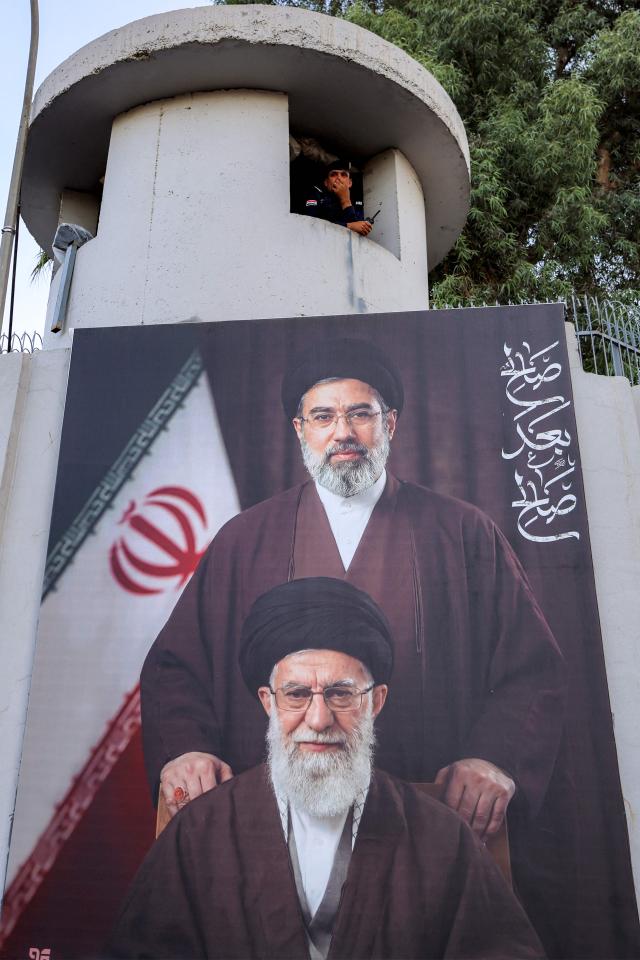
Part One: You Can't Bomb a Civilization
The war lasted 106 days. The official tally will show American hardware, American satellites, and American precision guided everything. It will show a nuclear program set back, missile stockpiles reduced, Revolutionary Guard installations turned to rubble.
By the metrics that Washington tends to use — sorties flown, targets destroyed, casualties inflicted — the United States performed exactly as advertised. And yet.
There is a version of victory that looks, upon close inspection, like something else entirely.
Rome had versions of those too, against Persia. Trajan took Mesopotamia in 116 AD. He just couldn't hold it. Neither could anyone who came after him. The Persians had a habit of still being there when the conquerors got tired and went home. They are still there now.
That is the thing Washington never quite absorbed: Iran is not a problem to be solved. It is a civilization to be reckoned with — and there is a difference, enormous and consequential, between the two.
American strategic culture is congenitally allergic to this distinction. We see states. We see regimes. We see threat assessments and capability matrices and rogue actors.
What we rarely see, because our entire intellectual framework for power was built in a country that is 250 years old, is the weight of deep time. Iran has been Iranian — recognizably, stubbornly, irreducibly Iranian — for five thousand years.
It has absorbed Alexander the Great. It absorbed the Arab conquest. It absorbed the Mongols. It absorbed the British and the Russians playing their Great Game across its territory. It absorbed Saddam Hussein's eight-year war of attrition, backed, let us not forget, by Washington.
It absorbed forty years of sanctions designed, in the frank words of more than one American official, to bring the regime to its knees. The knees remain unbent.
The founding figure here is Cyrus the Great — not Khomeini, not the Supreme Leader, not the IRGC generals who appear in Pentagon briefings.
Cyrus, who in the sixth century BC built an empire not through subjugation but through something radical for the ancient world: tolerance. He let conquered peoples keep their gods, their customs, their identities. He freed the Jewish exiles from Babylon and funded the rebuilding of the Temple in Jerusalem.
He is, uniquely, the only non-Jewish figure in the Hebrew Bible to be called a messiah. To Iranians, he is what Washington is to Americans — the founding father, the measure of national greatness, the standard against which everything since is judged.
America went to war with the heirs of Cyrus and apparently did not notice.
The mistake is almost too large to enumerate. Washington looked at Iran and saw 1979: the hostage crisis, the chants, the Revolutionary Guard, the theocracy, the axis of evil. All real. All relevant. All, critically, insufficient.
Iran is not reducible to its Islamic Republic any more than the United States is reducible to the Trump administration.
The Islamic Republic is the current management of a civilization that has been operating under various managements for five millennia. Civilizations outlast their governments. This should not be a surprising observation.
But American strategic planning — hooked on electoral cycles, quarterly defense budgets, and the institutional memory of a nation that has never lost a war on its own soil — runs on a fundamentally different clock. We think in years. Occasionally, in decades. Iran thinks in centuries. That gap in temporal imagination is not a minor operational variable.
It is, as we have now seen, a decisive one.
The Persians never beat Rome in the field, not consistently. But they survived Rome. They survived everyone. And in the collective memory of every Iranian who has ever been told, by some external power, that this time you will submit — that memory does not argue. It simply waits.
*The author is a senior columnist for AJP with deep knowledge in religion, geopolitics, and civilizational history.
Copyright ⓒ Aju Press All rights reserved.
