
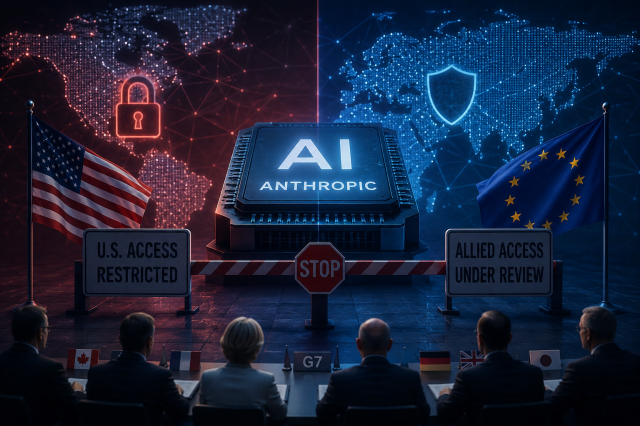
The U.S. government has imposed restrictions on the overseas use of Anthropic's advanced artificial intelligence (AI) models, prompting discussions among allies about reducing dependence on American technology. As the U.S. promotes AI exports while simultaneously restricting the use of specific models for security reasons, calls for 'tech sovereignty' are gaining traction in Europe.
On June 16, Bloomberg, Reuters, and Axios reported that U.S. authorities recently issued export control guidelines for Anthropic's latest AI models, 'Fable5' and 'Mythos5.' These guidelines require prior approval for providing the models overseas, leading Anthropic to suspend services for both models.
The U.S. cited national security concerns, noting the potential for safety mechanisms in Fable5 to be circumvented. Anthropic has pushed back against the restrictions, arguing that their scope is excessive. The company warned that if these standards are applied across the industry, the deployment of new models by all leading AI firms could effectively come to a halt.
This move contradicts the U.S. strategy of expanding AI exports. The Trump administration issued an executive order last year to support the overseas dissemination of American AI. The Department of Commerce has also been promoting related export programs. However, as concerns grow that the use of advanced models could be restricted at any time, uncertainty among foreign clients and allies is also increasing.
The issue of advanced model usage was a key topic at the recent G7 summit in Évian, France. Representatives from major countries discussed 'trusted partner' initiatives aimed at ensuring that some allied nations can access the latest models from U.S. companies. This is seen as a response to the Anthropic situation, with efforts to secure usage rights for allied nations.
In Europe, there are ongoing efforts to reduce reliance on U.S. core capabilities. The French General Directorate for Internal Security (DGSI) has decided to replace the data analysis tools of the American firm Palantir with products from the domestic company, ChapVision. The transition may take several years due to existing contracts.
France is also accelerating its efforts to develop related industries, planning to invest an additional €655 million (approximately $1.15 billion) in AI development and public service applications. The government intends to introduce tools based on the models of the domestic company Mistral AI in the administrative sector. French Prime Minister Sébastien Le Cornu stated, "We cannot accept a new strategic dependence in the digital field; France must have its own tools."
Similar trends are emerging in the UK and Germany, where there is a reevaluation of contracts with Palantir. The UK's National Health Service (NHS) is reviewing its large-scale data processing contract with Palantir, while German military authorities have reportedly indicated they will no longer use the product.
This trend does not stem from distrust in the capabilities of U.S. AI companies but rather reflects concerns about the risks of relying on specific countries and firms for government and security systems. The U.S. is attempting to control advanced models for security reasons, while allied nations view these measures as potential vulnerabilities in their own administrative and security frameworks. Following semiconductors and cloud technology, AI models and data analysis tools have emerged as key areas in the competition for tech sovereignty.
* This article has been translated by AI.
Copyright ⓒ Aju Press All rights reserved.