
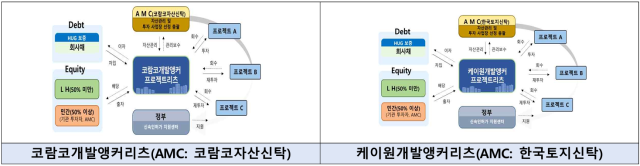
The South Korean government is set to activate a 1 trillion won ($760 million) PF Development Anchor REITs program. This initiative aims to inject public funds into promising development projects that are struggling to secure initial financing due to a downturn in the real estate project financing (PF) market, thereby encouraging private investment.
The Ministry of Land, Infrastructure and Transport announced on June 17 that it will begin accepting applications for the 1 trillion won PF Development Anchor REITs investment program starting June 18.
The PF Development Anchor REITs structure involves using public funds as a catalyst to attract private investment. With the recent tightening of the real estate PF market, even viable development projects face challenges in securing initial funding. This program allows public entities to participate as investors to support project advancement.
The REITs will be funded through 200 billion won from public sources and approximately 320 billion won from private investments, along with company bonds backed by the Korea Housing and Urban Guarantee Corporation (HUG), totaling 1 trillion won. Last November, Korea Land Trust and Coramco Asset Trust were selected as asset management companies (AMCs), and the REITs were officially established in December. In May, HUG introduced a new company bond guarantee product, and the establishment report for the Development Anchor REITs has been accepted, initiating the selection process for investment projects.
The Development Anchor REITs will operate for five years. It will invest in bridge loan projects during the land acquisition phase for a period of 18 months, after which the recovered funds will be reinvested. The investment amount for each project will be capped at 50% of the land acquisition cost, with a maximum of 100 billion won.
Investment rates will be determined through agreements between project operators and AMCs, taking into account the risk level of individual projects and market conditions. However, the rates are expected to be lower than market rates, set at 250 to 300 basis points above the AAA-rated three-year corporate bond rate.
Developers seeking investment can apply for the program through the Coramco Asset Trust and Korea Land Trust websites starting June 18. Submitted projects will be evaluated based on stability and public interest before investment decisions are made. The selection process will include a review by an investment committee involving the Korea Land and Housing Corporation (LH).
Investment projects will be assessed based on criteria such as land valuation, development plan feasibility, land acquisition rates, permitting potential, and equity ratios. Key stability criteria include 100% land rights acquisition and an equity ratio of over 20% relative to land costs. Projects led by the government or local governments, AI data centers with significant industrial impact, and those contributing to housing stability will receive priority.
The Ministry believes this REITs initiative will help restart development projects that have stalled due to funding issues. It is particularly aimed at providing liquidity for housing supply projects in the metropolitan area and key regional development initiatives, thereby promoting housing supply and revitalizing local economies.
Kim Young-guk, head of the Housing and Land Office at the Ministry of Land, Infrastructure and Transport, stated, "The launch of this Development Anchor REITs will invigorate promising development projects facing funding challenges, especially housing supply projects in the metropolitan area and key regional initiatives."
Meanwhile, industry insiders note that with high interest rates and stricter PF risk management, the barriers to financing for private development projects have increased. They view the Development Anchor REITs as a litmus test for the normalization of projects that are viable but struggling to secure initial liquidity.
* This article has been translated by AI.
Copyright ⓒ Aju Press All rights reserved.