
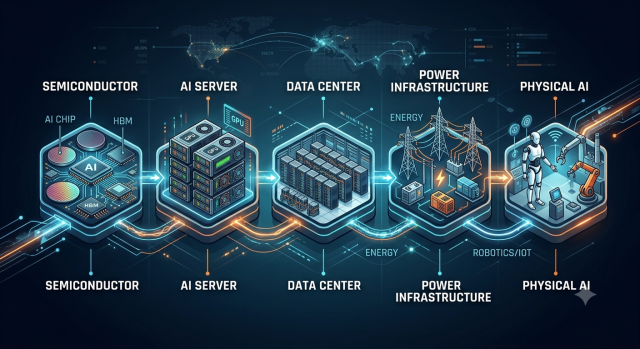
Artificial intelligence (AI) investment beneficiaries are no longer limited to semiconductor companies. The investment cycle triggered by the spread of generative AI is rapidly expanding beyond semiconductor and equipment manufacturers to encompass data centers, power infrastructure, and industrial robots across the entire value chain. As AI becomes more sophisticated, funds and investments are shifting to areas where new bottlenecks are emerging.
According to the Korea Exchange on June 17, as of the previous day's closing price, Sanil Electric has surged 95.23% this year, HD Hyundai Electric by 43.93%, Hyosung Heavy Industries by 118.53%, LS Electric by 179.89%, and Korea Electric Wire by 77.73%, all outperforming the market average. Although these companies do not directly produce AI semiconductors, they have been re-evaluated as key beneficiaries of the expanded investment in AI infrastructure.
Sanil Electric is a power equipment manufacturer specializing in transformers. The competition among big tech companies to build massive data centers, spurred by the proliferation of generative AI, has made transformers, distribution facilities, and transmission networks essential investments. This has positioned power equipment companies like Sanil Electric as key beneficiaries in the AI value chain, as a stable supply of substantial power is a prerequisite for operating GPUs in AI data centers.
The catalyst for this phenomenon is the high performance of AI. As the scale of large language models (LLMs) increases and demand for inference rises, the need for AI semiconductors such as GPUs and HBM has surged, leading to widespread shortages in advanced packaging, substrates, and materials needed to support this demand.
As competition for AI performance intensifies, new bottlenecks are emerging not only in semiconductors but also in components and materials. The MLB that connects chips and substrates within AI accelerators requires higher signal integrity and data processing speeds, leading to advancements in high-layer and miniaturization. The production of high-performance copper foil (HVLP) is also limited due to its significantly higher manufacturing difficulty compared to general products.
The AI value chain expands further at the data center stage. As the number of GPUs and servers increases, data centers capable of accommodating them become necessary, consuming far more power than typical industrial facilities. As the power density per rack of AI servers rises, the construction of power infrastructure, including transmission networks, substations, ultra-high voltage transformers, and distribution panels, becomes essential.
Global tech giants are simultaneously increasing investments in power grids alongside AI infrastructure. Alphabet has raised its capital expenditure guidance for this year to between $180 billion and $190 billion, while Meta has adjusted its guidance to $125 billion to $145 billion. Amazon plans approximately $200 billion, and Microsoft aims for about $190 billion in annual capital investments.
The power equipment market remains robust. The combined new orders from five major transformer companies (HD Hyundai Electric, Hyosung Heavy Industries, LS Electric, Sanil Electric, and Iljin Electric) reached a record 8.5 trillion won in the first quarter, with the order backlog expanding to 34.5 trillion won. Researcher Son noted, "It is important that the upward revision of capital expenditures is translating into utility contract loads and equipment orders, and new orders in 2026 are likely to exceed existing company guidance."
The AI value chain does not stop here. Once sufficient computing and power infrastructure are established, the introduction of physical AI in industrial settings, including robots, smart factories, and autonomous manufacturing, will gain momentum. While past AI investments focused on the semiconductor sector, current analysis suggests that to understand AI investment trends, one must also consider advanced materials, substrates, data centers, power grids, and industrial robots across the entire supply chain.
Park Hee-cheol, a researcher at Kyobo Securities, stated, "The high-performance demands of AI will ripple throughout the value chain, causing widespread IT ecosystem supply burdens. It is essential to pay attention to the value chain where new market opportunities arise and bottlenecks may occur due to the emergence of new technologies."
* This article has been translated by AI.
Copyright ⓒ Aju Press All rights reserved.