
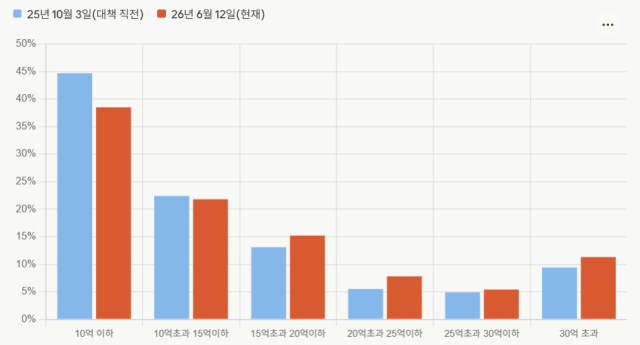
Nearly 40% of apartments in Seoul are now priced above 1.5 billion won (approximately $1.1 million). Following the implementation of stricter lending regulations in October 2022, demand initially shifted toward homes priced below this threshold. However, rising prices have led to an increase in the proportion of apartments exceeding 1.5 billion won. Analysts suggest that the '1.5 billion won barrier' is weakening, as transactions in newly built complexes in non-Gangnam areas, such as Nowon, Dongdaemun, and Seongbuk, have been recorded between 1.6 billion and 1.8 billion won.
According to data analyzed by Real Estate 114, the proportion of apartments priced over 1.5 billion won was 32.83% on October 3, 2022, just before the lending regulations took effect. As of June 12, 2026, this figure has risen to 39.70%, an increase of 6.87 percentage points. Conversely, the share of apartments priced below 1.5 billion won has decreased from 67.17% to 60.30% during the same period.
In terms of the number of units, the shift in price ranges is evident. Apartments priced below 1 billion won have decreased from 691,495 units to 565,291 units, a drop of 126,204 units. In contrast, the number of apartments priced over 1.5 billion won has increased from 507,546 units to 583,093 units, an increase of 75,547 units.
Baek Sae-rom, a senior researcher at Real Estate 114, stated, "Despite the tightening of financial regulations under the 10.15 measures, the continued rise in Seoul apartment prices has shifted the distribution of housing prices toward the higher end. The increase in the proportion of high-priced homes over 1.5 billion won is evident."
In the market, the upward trend in prices is particularly notable in newly built complexes in non-Gangnam areas, which have historically had lower price burdens. According to the Ministry of Land, Infrastructure and Transport's real transaction price disclosure system, the exclusive right to an 84-square-meter unit at Seoul Won I Park in Wolgye-dong, Nowon-gu, was sold for 181.16 million won last month. Considering that the price at the time of sale in 2024 was between 126.2 million and 141.4 million won, this represents an increase of over 40 million won before occupancy.
In April, the exclusive right to an 84-square-meter unit at I-Mun I-Park JAI in Imun-dong, Dongdaemun-gu, was sold for 183.5 million won. In addition, the exclusive right to an 84-square-meter unit at Jangwi Jaideon 4 Complex in Jangwi-dong, Seongbuk-gu, changed hands for 165 million won last month. The exclusive right to an 84-square-meter unit at Hills State Nokbeon Station in Eunpyeong-gu was sold for 150 million won last month, setting a new record, while the exclusive right to an 84-square-meter unit at Sangdo Prugio Clave New in Dongjak-gu rose from 143 million won in October 2022 to 150 million won last month.
The price increase is also strongly evident in non-Gangnam areas. According to the Korea Real Estate Agency, as of the second week of June 2026, the cumulative sales price increase rate for apartments in Seoul was highest in Seongbuk-gu at 7.02%. Dongdaemun-gu recorded a 5.50% increase, while Nowon-gu saw a 4.96% rise. This trend is interpreted as a result of increased buying interest in areas that previously had relatively lower price burdens compared to Gangnam.
Experts believe that the concentration of demand in relatively lower-priced areas following the lending regulations has contributed to the rising prices in non-Gangnam regions. Although demand initially focused on homes priced below 1.5 billion won, this has led to price increases in some complexes, pushing them back above the 1.5 billion won mark.
Nam Hyuk-woo, a researcher at Woori Bank, noted, "As demand shifts toward areas that have increased less in price compared to others, we are seeing a phenomenon where price gaps are narrowing, often referred to as 'price alignment.' The influx of buyers into regions with relatively good access to loans and smaller price increases is gradually expanding the areas experiencing price increases."
* This article has been translated by AI.
Copyright ⓒ Aju Press All rights reserved.