
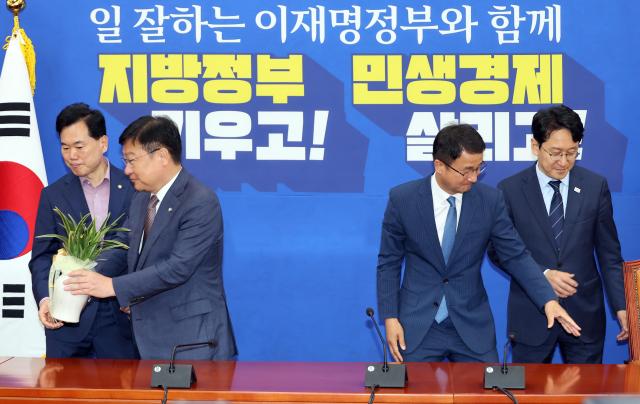
The Democratic Party has set a goal to complete the formation of committees by June 18, but as of June 17, they are facing significant challenges. However, the party has indicated that it prioritizes negotiations over the possibility of monopolizing committee positions if talks drag on.
According to political sources, recent meetings between Cheon Jun-ho, the Democratic Party's chief floor leader, and Kim Seung-soo, the People Power Party's chief floor leader, have continued in the lead-up to the June 18 plenary session. However, as of 3 p.m. on June 17, they had not yet met. While communication between the two leaders is ongoing, no confirmed schedule has been reported.
During negotiations, the two leaders reached an agreement to establish a special committee to address the recent mismanagement of ballots by the Election Commission and to pass a plan for a national investigation at the plenary session on June 18. However, they remain at an impasse regarding committee formation. Both parties have expressed a strong desire to secure the chairmanship of the Legislation and Judiciary Committee, and they have shown clear differences in their positions regarding economic-related committees, such as the Political Affairs Committee.
Tensions between the two parties over the Legislation and Judiciary Committee are escalating. Han Byeong-do, the Democratic Party's floor leader, and Jung Jeom-sik, the People Power Party's floor leader, have both publicly expressed their strong intentions regarding this committee.
The Democratic Party argues that the ruling party should take charge of the committee to support the governance of President Lee Jae-myung's administration in its second year and to ensure public welfare stability. In response, the People Power Party has accused the Democratic Party of attempting to continue legislative overreach into the second half of the term through control of the committee. They also contend that since the Democratic Party holds the speakership as the majority party, the chairmanship of the Legislation and Judiciary Committee should go to the second-largest party.
Additionally, Han warned during a recent meeting that the People Power Party could also reclaim economic-related committee positions. Conversely, the People Power Party insists that it must secure at least seven committee chairmanships.
The key position among the economic committees appears to be the chair of the Political Affairs Committee, which oversees the Fair Trade Commission and the Financial Services Commission, directly impacting major economic legislation such as amendments to the Capital Markets Act and the Commercial Act. Previously, President Lee Jae-myung criticized the opposition-controlled Political Affairs Committee, stating, "With the opposition chair, nothing can be accomplished."
Given the sharp differences between the two parties, there are concerns that the Democratic Party may monopolize the committee formation. Earlier in the current term, Democratic Party representative Jeon Cheong-rae and Han had mentioned the possibility of monopolization under the banner of a "working National Assembly." In fact, the Democratic Party previously occupied all committee chairmanships in the 21st National Assembly after negotiations with the Future United Party broke down, citing the need for a "working National Assembly" as a justification.
Nevertheless, the Democratic Party maintains that negotiations remain the priority. Lee Joo-hee, the party's spokesperson, told reporters that "it is not yet time to discuss that" and emphasized that such a card cannot be played quickly at this stage of negotiations. If the Democratic Party attempts to monopolize the committees as a last resort, it is expected to further escalate tensions between the ruling and opposition parties.
* This article has been translated by AI.
Copyright ⓒ Aju Press All rights reserved.