
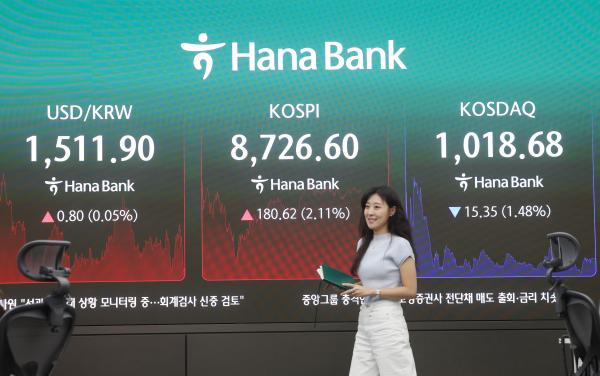
According to the Korea Exchange on June 17, the KRX Bank Index closed at 1,634.91, an increase of 145.21 points (9.75%) from the end of last month (1,489.7 on May 29). During the same period, the KOSPI index rose by 8.03%, indicating a stronger performance for the KRX Bank Index.
Shinhan Financial Group saw its stock price rise by 11.21% during this time, while Hana Financial Group increased by 10.23%, KB Financial Group by 9.75%, and Woori Financial Group by 7.65% compared to the end of May. Notably, KB Financial reached a new 52-week high of 182,700 won on June 16.
Bank stocks had been relatively sidelined during this year's stock market rally, which was largely driven by semiconductor stocks. Despite reporting record earnings in the first quarter, concerns over financial stability and policy uncertainties limited stock price increases. The concentration of investment in major semiconductor firms like Samsung Electronics and SK Hynix also played a role.
However, the recent likelihood of interest rate hikes has shifted the sentiment towards bank stocks. Generally, rising interest rates can widen the interest margin, enhancing bank profitability. LS Securities recently reported that if the benchmark interest rate increases by 0.25 percentage points, major banks could see an average increase of about 100 billion won in interest income during the first year. According to FnGuide, the projected net profit for the four major financial groups in South Korea is estimated at 19.4879 trillion won as of this date.
The active shareholder return policies in the banking sector are also contributing to rising stock prices. Major financial groups are expanding dividends and share buybacks in line with the government's value-up policy. A survey by BNK Investment & Securities predicts that the total shareholder return rate for the banking sector will rise from 46.5% this year to 49.4% by 2028, with total shareholder returns expected to reach approximately 38.6 trillion won, accounting for 21.1% of market capitalization.
Industry experts believe that the relative attractiveness of bank stocks is likely to increase in the near future. This perception stems from the ability to generate stable dividend yields in a volatile market. Additionally, the easing of penalties related to Hong Kong's H-index linked securities (ELS) has also bolstered investor sentiment.
Kim Jae-woo, a researcher at Samsung Securities, noted, "In May, loans from banks increased for both businesses and households, indicating a rise in demand for loans. The funding for these loans has primarily come from low-cost deposits, suggesting that both loan growth and recovery of net interest margins are likely to show positive trends."
However, challenges remain. Recently, household debt has surged again, prompting financial authorities to tighten regulations on household debt management. Such regulations could limit the banks' ability to aggressively increase household loans, even as interest rates rise. Additionally, concerns over rising non-performing loans and increased provisions due to economic slowdown are potential burdens for the sector.
* This article has been translated by AI.
Copyright ⓒ Aju Press All rights reserved.