
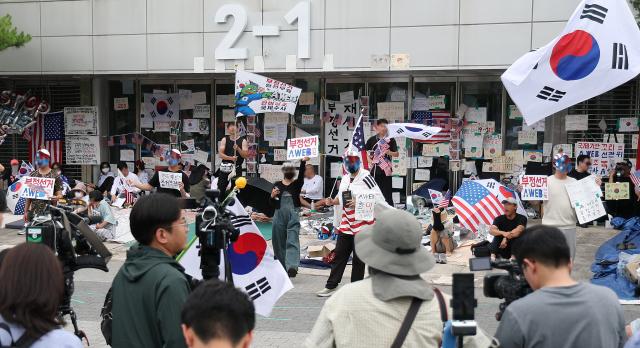
Protests continue near the Handball Stadium in Olympic Park, Songpa-gu, Seoul, on June 17. [Photo=Yonhap News]
As the ruling and opposition parties agree to investigate the infringement of voting rights during the June 3 local elections, discussions are expected to expand to election management and reform. However, the Democratic Party is likely to focus on strengthening election management capabilities, while the People Power Party may push for the abolition of early voting.
On June 17, the People Power Party appointed Yoon Sang-hyun as the chair of the National Investigation Special Committee. The day before, the parties had agreed that the committee would be led by the People Power Party, with nine members from the Democratic Party, seven from the People Power Party, one from the Justice Party, and one from the Reform Party.
In addition to issues like the shortage of voting papers, the scope of the investigation will also include election management reform, potentially broadening the discussion to improvements in early voting. The People Power Party is expected to scrutinize overall management failures, including the handling of early voting ballots and their transportation.
Jang Dong-hyuk, a representative of the People Power Party, stated on June 7, "We must eliminate early voting, which half the public distrusts. We can cut off the roots of election fraud, so I don’t understand why there is such a strong defense of early voting."
In contrast, the Democratic Party is likely to focus on reforming the system to enhance overall election management capabilities rather than questioning the early voting system itself. A discussion hosted by the Democratic Party's task force for election system reform emphasized crisis response systems rather than early voting.
Han Byeong-do, the Democratic Party's floor leader, remarked, "The National Election Commission lacks the ability to respond quickly in times of crisis. We will work towards legislation that includes legal standards for printing and distributing ballots, establishing crisis response systems, and improving the treatment of on-site personnel."
Experts have expressed differing views on the matter. Shin Yul, a professor of political science at Myongji University, told Aju Business Daily, "Early voting is causing social conflict, and there needs to be a public deliberation on its abolition to reduce social costs."
On the other hand, Park Sang-byeong, a political commentator, noted that while there is a significant chance early voting will be scrutinized by the National Investigation Committee, he warned that if discussions extend beyond election management to early voting, it could lead to political strife.
On June 17, the People Power Party appointed Yoon Sang-hyun as the chair of the National Investigation Special Committee. The day before, the parties had agreed that the committee would be led by the People Power Party, with nine members from the Democratic Party, seven from the People Power Party, one from the Justice Party, and one from the Reform Party.
In addition to issues like the shortage of voting papers, the scope of the investigation will also include election management reform, potentially broadening the discussion to improvements in early voting. The People Power Party is expected to scrutinize overall management failures, including the handling of early voting ballots and their transportation.
Jang Dong-hyuk, a representative of the People Power Party, stated on June 7, "We must eliminate early voting, which half the public distrusts. We can cut off the roots of election fraud, so I don’t understand why there is such a strong defense of early voting."
In contrast, the Democratic Party is likely to focus on reforming the system to enhance overall election management capabilities rather than questioning the early voting system itself. A discussion hosted by the Democratic Party's task force for election system reform emphasized crisis response systems rather than early voting.
Han Byeong-do, the Democratic Party's floor leader, remarked, "The National Election Commission lacks the ability to respond quickly in times of crisis. We will work towards legislation that includes legal standards for printing and distributing ballots, establishing crisis response systems, and improving the treatment of on-site personnel."
Experts have expressed differing views on the matter. Shin Yul, a professor of political science at Myongji University, told Aju Business Daily, "Early voting is causing social conflict, and there needs to be a public deliberation on its abolition to reduce social costs."
On the other hand, Park Sang-byeong, a political commentator, noted that while there is a significant chance early voting will be scrutinized by the National Investigation Committee, he warned that if discussions extend beyond election management to early voting, it could lead to political strife.
* This article has been translated by AI.
Copyright ⓒ Aju Press All rights reserved.