
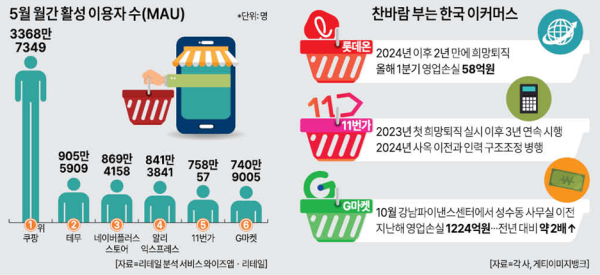
Chilly Winds Blow Through Korean E-commerce [Graphic=Ajou Economic]
As competition from Chinese e-commerce platforms like AliExpress and Temu intensifies, South Korean e-commerce companies are implementing stringent cost-cutting measures. These include relocating offices to reduce fixed costs and expanding voluntary retirement programs to include junior employees in an effort to improve profitability.
According to the retail industry on June 17, Lotte On, the e-commerce division of Lotte Shopping, is accepting applications for voluntary retirement from employees until the end of this month. This marks the first voluntary retirement program since 2024. Employees with more than three years of service, including those in their twenties, are eligible.
The terms have improved compared to two years ago. Lotte On will provide eligible employees with a lump sum payment of up to 12 months' salary. Additionally, employees with college-age children will receive 10 million won per child for educational expenses. This is an increase from the six months' salary offered during the last voluntary retirement program, indicating a strategy to attract as many applicants as possible.
Since its launch in 2020 as a unified online mall for Lotte Group's retail business, Lotte On has struggled to turn a profit. In the first quarter of this year, it reported an operating loss of 5.8 billion won, a reduction of 2.7 billion won from the previous year, but it remains in the red. A Lotte On representative stated, "In response to the rapidly changing e-commerce market, we decided to implement voluntary retirement to restructure our workforce and become a more competitive organization."
Gmarket, part of the Shinsegae Group, is also relocating its office from the Gangnam Finance Center in Seoul to the AM Plus building in Seongdong-gu, Seoul, in October. Gmarket's consolidated revenue fell by 23% to 740.5 billion won last year, while its operating loss nearly doubled to 122.4 billion won. The industry expects Gmarket to benefit from lower rental costs in Seongdong-gu compared to Gangnam.
Previously, 11st moved its office from Seoul Square in front of Seoul Station to the U-Planet Tower in Gwangmyeong in 2024. The monthly rent for the same space in U-Planet Tower is reported to be one-third of that in Seoul Square. Additionally, 11st has conducted voluntary retirements for three consecutive years since 2023, focusing on reducing fixed costs through office relocation and workforce restructuring.
The tightening measures among domestic e-commerce companies are largely driven by the rapid growth of C-commerce. Platforms like AliExpress and Temu have attracted domestic users by offering ultra-low prices, faster shipping, and a wider selection of products. Recently, even major domestic brands have begun to partner with C-commerce platforms, diminishing the perception that these products are low-quality due to their low prices.
According to retail analytics service WiseApp & Retail, Temu's monthly active users (MAU) rose by 7.6% in May to 9,055,909, making it the second most popular comprehensive mall app. AliExpress also saw a 1.3% increase to 8,413,841 users, ranking fourth. Both platforms outperformed 11st (fifth) and Gmarket (sixth) in user rankings.
Industry experts predict that the cost-cutting trend among domestic e-commerce firms will continue for the foreseeable future. With high inflation and a slowdown in consumer spending, the growth of the market has decelerated, and the price competition with C-commerce has made cost efficiency a priority over aggressive expansion. An industry insider noted, "As C-commerce users grow rapidly, domestic e-commerce companies are feeling increased pressure," adding that they are likely to focus on cost reduction and organizational efficiency for the time being.
* This article has been translated by AI.
Copyright ⓒ Aju Press All rights reserved.