
Koo Yun-cheol, Deputy Prime Minister and Minister of Finance, presented these measures during a meeting of the Special Task Force for the Management of Living Prices on June 18.
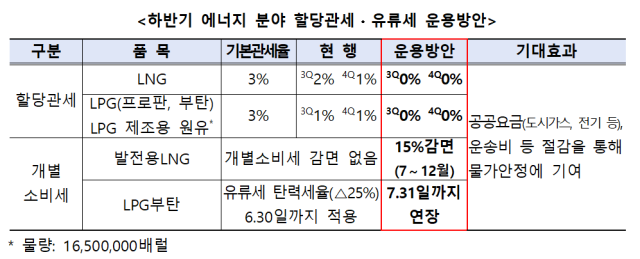
Starting this second half of the year, the government will implement a 0% tariff rate on liquefied natural gas (LNG), propane, butane, and crude oil used for the production of liquefied petroleum gas (LPG). Furthermore, the individual consumption tax on LNG for power generation will be temporarily reduced until December, and the flexible tax rate on LPG butane will be extended for one month.
The Ministry of Finance plans to assess whether the zero tariff on energy products will exert downward pressure on consumer prices through research. A ministry official explained, "Tariff quotas are applied not at the consumer level but at the import stage, where businesses receive tax reductions when purchasing. We are conducting research and have confirmed that there is downward pressure on prices; however, it may be difficult for consumers to feel this impact directly."
In the agricultural sector, the government will support tariff quotas for a total of 22 products, including three types of fruits, 17 food ingredients, and two feed ingredients. The application period for 13 products, which are set to expire, will be extended, and new tariff quotas will be applied to feed ingredients until the end of the year.
Although the application period for tariff quotas has been extended, the quantity remains unchanged due to the existing amounts not being exhausted. The Ministry of Finance decided to extend the period in consultation with the Ministry of Agriculture, Food and Rural Affairs.
A ministry official noted, "While the basic tariff on energy is low at 3%, limiting further reductions is challenging. However, we can lower agricultural product tariff quotas by up to 40%, and this time we have reduced them by about 20-30%. The impact on consumers may be influenced by distribution margins, so we plan to strengthen checks in the distribution process to prevent profit exploitation through tariff quotas."
The Ministry of Finance intends to submit amendments to the regulations on tariff quotas and the enforcement decree of the Individual Consumption Tax Act to the Cabinet meeting, aiming for implementation starting July 1. Additionally, the 17 food ingredients will be designated as key items for concentrated management of tariff quotas to ensure that the benefits of tax rate reductions are directly passed on to consumers through enhanced distribution checks.
* This article has been translated by AI.
Copyright ⓒ Aju Press All rights reserved.