This is the fourteenth installment of AJP's Spiritual Asia series exploring the religious traditions, philosophical ideas and moral foundations that have shaped Asia's civilizations. This chapter turns to Zoroastrianism, one of the world's oldest living faiths, and examines how its teachings on truth, free will and moral responsibility continue to resonate in an age increasingly shaped by artificial intelligence.
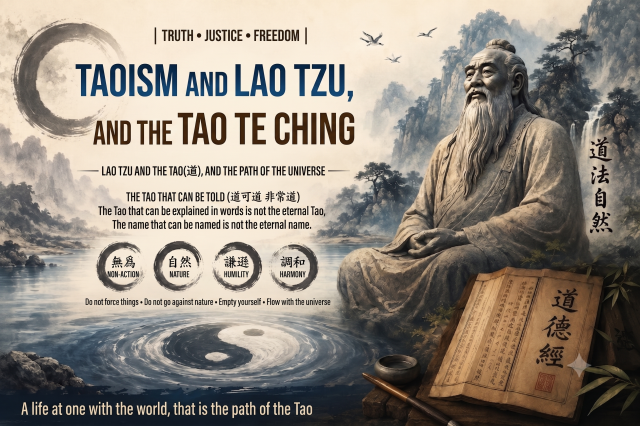
Lao-tzu, the Tao, and the Path of the Universe
In our journey exploring the spirituality of Asia, we now enter the deep spiritual world of Chinese civilization. If India's Hinduism sought the union of the universe's origin and the human soul, Buddhism explored the causes of suffering and the path to liberation, and the Korean people's Daejonggyo emphasized the spirit of Hongik Ingan (benefiting all humanity) and Jaeseihwa (ruling the world with reason), then China's Taoism opened up a unique spiritual realm that views humanity, nature, and the order of the universe as one.
Taoism is not merely a religion. It is a philosophy, a way of life, and a worldview for understanding nature and humanity. Above all, Taoism is one of the deepest roots that formed the spiritual world of the Chinese people. To understand the history and culture of China, one must understand not only the Confucianism of Confucius but also the Taoism of Lao-tzu. If Confucianism presented the principles for governing society, Taoism explored human existence and the essence of the universe. If Confucianism emphasized order and responsibility, Taoism emphasized freedom and harmony. If Confucianism sought to change the world, Taoism sought to become one with it.
Today's world is entering an era of artificial intelligence, quantum computing, space exploration, and biotechnology. Paradoxically, however, modern people are experiencing greater anxiety and confusion than in any previous era. Competition has become fiercer, the pace of life has accelerated, and humanity is increasingly alienating itself from nature. It is precisely in this era that the message left by Lao-tzu 2,500 years ago is once again drawing attention. This is because Taoism teaches that humans are not beings who conquer nature, but a part of it.
Lao-tzu, known as the founder of Taoism, is one of the most mysterious figures in the history of Eastern thought. His life is a mix of history and legend. According to Sima Qian's Records of the Grand Historian, Lao-tzu's given name was Li Er, and his courtesy name was Dan. It is said that he was an official who managed the royal archives of the Zhou Dynasty. During that time, he read countless classics and observed the rise and fall of human society. However, as the Zhou Dynasty entered its late period and political turmoil and moral corruption deepened, he decided to leave the world behind.
According to legend, Lao-tzu headed west riding a blue ox. When he arrived at the Hangu Pass, an official guarding the gate named Yinxi recognized his extraordinary nature and said:
"Before you leave, Master, please leave behind your wisdom for future generations."
Lao-tzu accepted the request and left behind a short text. That is the Tao Te Ching, considered one of the greatest philosophical texts in human history. Although it is a short book of about 5,000 characters, the impact it has had on human civilization is immeasurable. In the West, it is considered one of the most translated Eastern classics, second only to the Bible.
The Tao Te Ching consists of 81 chapters in total. There is a very interesting point here. The Chunbugyeong, a representative scripture of the Korean people, also consists of exactly 81 characters. Of course, there is no historical evidence that the two texts directly influenced each other. However, the symbolism of the number 81 in Eastern thought is noteworthy. 81 is the square of 9. In the East, 9 is the largest positive number (Yang) and symbolizes completion. Therefore, 81 is interpreted as a number representing perfect universal order and harmonious circulation.
If the Chunbugyeong begins with "One begins, but there is no beginning to One" to explain the creation of the universe and human existence, the Tao Te Ching begins with "The Tao that can be told is not the eternal Tao" to explain the origin of the universe. Both texts show a remarkable commonality in their attempt to explain the essence of the cosmos through human language.
The first sentence of the Tao Te Ching, "Tao k'o Tao, fei ch'ang Tao; Ming k'o Ming, fei ch'ang Ming," can be called the absolute essence of Eastern philosophy. It is commonly translated as, "The Tao that can be told is not the eternal Tao; the name that can be named is not the eternal name." Here, Lao-tzu points out the limitations of human language. Truth exists, but human language cannot fully capture it.
We can describe the ocean, but we cannot become the ocean itself. We can define love, but we cannot express the entirety of love itself. Similarly, it was Lao-tzu's insight that the Tao, the source of the universe, also transcends human language.
Then, what is the Tao?
Lao-tzu did not say the Tao was a god. He did not say it was matter, either. However, he saw it as the source of all gods and all matter. The Tao exists by itself and is the fundamental principle of the universe that gives birth to and nurtures all things. Chapter 42 of the Tao Te Ching explains this most concisely:
"The Tao gives birth to One, One gives birth to Two, Two gives birth to Three, Three gives birth to all things."
Read from the perspective of modern cosmology, this sentence from 2,500 years ago shows astonishing imagination. While not exactly identical to the process of the universe expanding after the Big Bang, energy creating matter, and matter giving birth to life, it holds deep meaning as a philosophical attempt to explain the principles of the universe's creation.
Another core concept Lao-tzu spoke of is Wu-wei Tzu-jan (Non-action and Naturalness). Many people misunderstand wu-wei as doing nothing. However, the wu-wei Lao-tzu spoke of is not laziness. It is not forcing things. It is not going against the natural order. It is not pursuing desires to the point of harming oneself and the world.
Today, we compete day and night for results. We pursue more money, higher status, and greater success. But Lao-tzu asks:
"Where does it end?"
Human desire has no end. The more one tries to satisfy a desire, the more new desires arise. Therefore, Lao-tzu viewed living a life that conforms to the flow of nature as the ideal life.
The entity Lao-tzu loved most was water. He considered water the teacher of the universe.
"Shang Shan Jui Shui." (The highest good is like water.)
Water flows to the lowest places. It does not boast of itself. Yet, it eventually carves rocks, creates rivers, forms valleys, and changes the world. Water is the softest but the strongest. Lao-tzu believed humans should also live like water. He taught not to try to dominate the world with strength, but to harmonize with the world through flexibility.
This thought profoundly influenced overall Chinese culture in later years. The Taoist worldview permeated Chinese landscape painting, calligraphy, garden culture, traditional medicine, martial arts, and the world of Zen. The attitude of not going against nature but living alongside it became established as a crucial characteristic of Chinese civilization.
Taoism also holds a unique significance as a political philosophy. Lao-tzu believed that the more a ruler intervenes, the more chaotic society actually becomes. Rather than a strong power that oppresses the people, he considered governance that helps the people live naturally to be the ideal. This idea continues to inspire many political scientists and management scholars today.
This is also why Lao-tzu and Taoism are receiving renewed attention in the 21st century. The world has advanced technologically, but it is becoming spiritually fatigued. Humans possess more, but live with greater anxiety. Thus, people have started asking again:
"How should we live?"
Lao-tzu already provided the answer 2,500 years ago.
Do not force things. Do not go against nature. Empty yourself. And be one with the flow of the universe.
Taoism does not tell humans to become winners. It does not tell them to be conquerors. Rather, it tells them to become beings in harmony with nature. It is not a philosophy for the weak, but a philosophy for those who survive the longest. A strong tree breaks in a storm, but a flexible bamboo withstands the wind. This is exactly what Lao-tzu taught.
Today, humanity faces massive challenges: the climate crisis, environmental issues, the AI revolution, and civilizational transition. The more we live in such an era, the deeper meaning Lao-tzu's Tao holds. It makes us realize that humans are not the masters of nature but a part of it, and that humans are not the center of the universe but just one of its members.
Understanding the spirituality of Asia is not simply studying the religions of the past. It is a process of finding wisdom for the future. The teachings of the Tao left by Lao-tzu transcend 2,500 years of time to ask us a question again today:
"Are you trying to conquer the world, or are you trying to become one with it?"
That question is the very reason why Taoism is still alive today, and it is likely one of the most precious gifts that Asian spirituality offers humanity.
Copyright ⓒ Aju Press All rights reserved.