
South Korea's economy stands at a crossroads. Low birth rates, an aging population, stagnant productivity, and declining potential growth rates threaten the nation's economic future. Deputy Prime Minister Koo Yun-cheol views this crisis not merely as a recession but as a limitation of the country's growth model. He seeks solutions in artificial intelligence (AI).
Koo defines AI not just as an industry but as a new growth engine for South Korea. Since taking office, he has promoted 15 key AI transformation projects as part of the national strategy, increasing the AI budget for 2026 to 10.1 trillion won and leading a massive initiative to supply 30 trillion won to the AI sector through a national growth fund.
His deep understanding of AI has earned him recognition among past economic ministers. Koo is a policymaker and the author of "AI Korea," who has elevated AI to a national strategy. He poses a straightforward question: "If we do not embrace AI, how will South Korea grow?"
Koo Yun-cheol is a typical finance bureaucrat. He has designed national finances through roles such as head of the Budget Office, Deputy Minister of the Ministry of Economy and Finance, and Minister of Economy. However, viewing him solely as a budget expert is only half the story.
After leaving public office, he authored "Revolution Korea" and "AI Korea," studying how AI can transform national competitiveness. Koo identifies the biggest challenge facing the South Korean economy as declining potential growth rates, with a shrinking population and stagnant productivity. He believes that the existing manufacturing model can no longer sustain growth, leading him to propose the AI transformation as a solution.
He has publicly stated, "AI is an all-in endeavor." He emphasized that creating just one or two world-class products could significantly enhance South Korea's future growth potential. This assertion is not mere rhetoric; much of his budget planning and policies are being restructured around AI.
South Korea's AI National Budget Era
A key figure demonstrating Koo's leadership is 10.1 trillion won. In the 2026 budget proposal, he increased AI-related funding from 3.3 trillion won the previous year to over 10 trillion won, marking the largest AI investment in South Korea's history.
This budget will not only support research and development but will also invest in the entire AI ecosystem, including securing 15,000 GPUs, developing AI semiconductors, physical AI, autonomous vehicles, humanoid robots, AI factories, and training AI talent.
Notably, Koo does not view AI as solely the responsibility of the Ministry of Science and Technology. Instead, he approaches it as a national effort involving finance, taxation, education, and industrial policy, similar to past initiatives to nurture the semiconductor industry. However, while semiconductors were a specific industry, AI is a universal technology that can transform all sectors.
15 Key AI Transformation Projects
Koo's flagship initiative is the 15 key AI transformation projects. He is promoting these projects across manufacturing, public sectors, and services to spread AI throughout the industry. The focus is on physical AI.
Koo sees the combination of manufacturing and AI through physical AI as a critical battleground for South Korea. This includes AI robots, AI vehicles, AI factories, AI shipyards, and AI logistics systems.
Why physical AI? The U.S. excels in software, and China has strong platform capabilities. In contrast, South Korea possesses world-class manufacturing foundations. Koo believes that by integrating AI with this strength, South Korea can become a global leader.
His strategy is not just to create AI models but to transform the entire manufacturing sector into an AI-driven industry.
AI Factory Project
Among Koo's most practical projects is the AI factory initiative. The government plans to expand the number of leading AI factories to 500 by 2030, providing up to 10 trillion won in financial and tax support.
AI factories will have AI managing the brain of the factory, optimizing everything from production planning to quality control, energy use, and equipment maintenance. Examples include POSCO's blast furnace, Hyundai's production lines, and LG Electronics' factories.
Koo believes that as AI enhances manufacturing productivity, the entire South Korean economy can return to a growth trajectory. This represents not just digitalization but a transformation on the scale of an industrial revolution.
AI and Public Innovation
Another notable aspect of Koo's approach is public sector innovation through AI. He has set a goal to implement AI in all public institutions. In fact, he introduced a new scoring system for public institution evaluations that awards 1.5 points for AI innovation.
Public institutions are significant organizations within the South Korean economy. By utilizing AI, these organizations can enhance productivity and improve the quality of services for citizens. Koo emphasizes that public transformation is essential for private sector change, a crucial point.
Many countries view AI as a private sector issue, but Koo aims to shift the entire national operation to an AI-based framework.
AI for Everyday Life
AI is also being applied to everyday life. The government has established an AI-based price monitoring system to analyze real-time prices of items such as ramen, bread, detergent, and toilet paper. AI is also being used to predict agricultural supply and demand.
Additionally, a generative AI-based platform for smart shopping is being introduced to recommend optimal purchasing options for consumers. Other initiatives include AI services for national tax consultations, agricultural information, voice phishing responses, and pre-approval diagnostics. This dual approach utilizes AI as both a means of economic growth and a tool for everyday innovation.
The core of Koo's philosophy is the democratization of technology. He emphasizes that, like King Sejong's creation of Hangul, all citizens should understand and utilize AI. His vision of "AI Hangulization" goes beyond mere translation; it aims to make AI a practical tool accessible to everyone, not just experts.
This approach is unique in national AI strategies. While the U.S. emphasizes innovation and China focuses on state control, Koo prioritizes the popularization of AI.
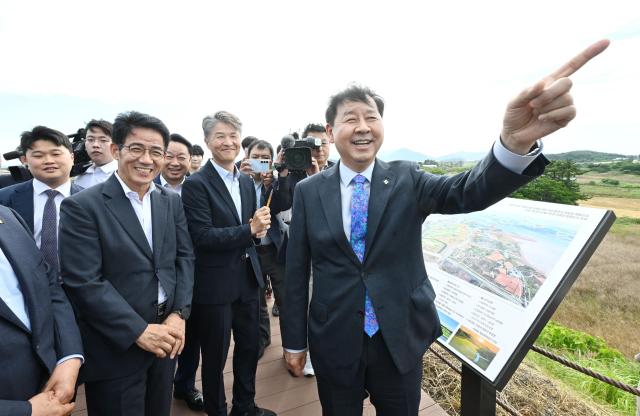
Recently, Koo visited the Gwangju AI Data Center and industrial sites in Gumi. In Gwangju, he experienced the national AI data center and autonomous driving simulator, assessing the AI semiconductor and future vehicle industries. He stressed the need to develop Gwangju as a global AI industrial hub. In Gumi, he met with robotics and physical AI companies to discuss manufacturing innovation strategies and pledged support for the localization of ultra-precision sensors and actuators. He aims to create a structure where central government policies connect with regional innovations.
The Essence of Koo Yun-cheol's Leadership
Koo Yun-cheol's leadership in AI is not about technical expertise; he is not an engineer. His strength lies in his ability to mobilize the national system.
He is focused on creating budgets, reforming tax systems, connecting finance, changing regulations, and nurturing talent. In the AI era, while engineers are important, strategists with national-level execution capabilities may be even more crucial.
Koo views AI not just as a field of economic policy but as a survival strategy for South Korea. This is why he is simultaneously advancing the 10 trillion won AI budget, the 30 trillion won AI investment fund, the 15 key AI transformation projects, public sector AI innovation, and AI initiatives for everyday life.
Koo's true challenge is to reverse the decline in potential growth rates through AI and put South Korea back on a growth trajectory. If successful, he could be remembered not just as a budget expert but as South Korea's first AI economic architect.
* This article has been translated by AI.
Copyright ⓒ Aju Press All rights reserved.