
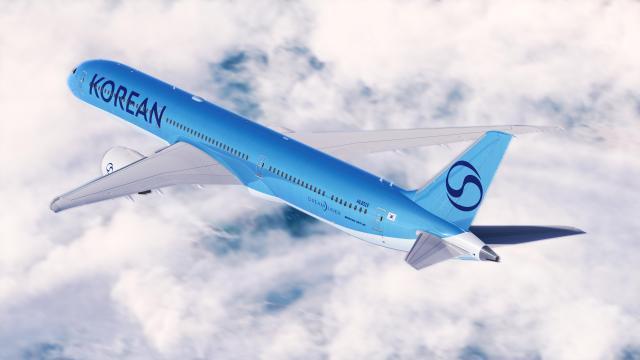
Korean Air has estimated the integration cost with Asiana Airlines at 1 trillion won and expressed confidence that it will fully recover this amount by 2028. The airline also promised to maintain a dividend policy of around 30% of its net income to minimize any impact on shareholder value. Once the merger is complete, the combined company is expected to become a mega carrier with annual revenues of 23 trillion won and a fleet of over 230 aircraft.
On June 19, Korean Air held an investor briefing at the headquarters of Korea Investment & Securities in Yeouido, Seoul, to enhance understanding of its decision to pursue the merger with Asiana Airlines. Attendees included Vice Chairman Woo Ki-hong, Vice President of Finance Ha Eun-yong, Vice President of Mergers Park Hee-don, Executive Director of Finance Oh Moon-kwon, and Managing Director of Management Strategy Choi Young-ho.
When Korean Air decided to merge with Asiana Airlines in 2020, it initially estimated the integration costs to be between 900 billion and 1 trillion won. The company stated that a re-evaluation of these costs after receiving corporate merger approval in 2024 yielded similar figures. Vice Chairman Woo Ki-hong noted, "The synergy from the merger is expected to reach about 300 billion won annually, and we anticipate that the cumulative synergy over three years will sufficiently offset the integration costs by the end of 2028 or early 2029."
Korean Air plans to enhance profitability by adjusting overlapping routes in both passenger and cargo sectors and tightening its transfer network. The strategy includes connecting Korean Air's routes in North America with Asiana Airlines to cover regions where Asiana currently does not operate. By increasing connecting flights and minimizing layover times, the airline expects to capture significant international transfer demand.
Regarding shareholder concerns about potential value erosion, the company emphasized that the impact would be "limited." For every share of Asiana Airlines common stock, 0.27 new shares of Korean Air will be issued; however, no new shares will be allocated to Korean Air's existing 63.88% stake in Asiana. The company reiterated its commitment to maintaining a dividend policy of around 30% of net income to protect shareholder value.
The company explained, "The size of the new shares issued will be only about 5% of the total, and given our solid performance, we will continue to adhere to our basic framework of distributing dividends within 30% of net income."
Korean Air aims to secure merger approval from the Ministry of Land, Infrastructure and Transport by the end of this month, followed by a shareholders' meeting for Asiana Airlines in August, with a target for full integration by December 17. Once completed, the merged entity will operate as a mega carrier with annual revenues of 23 trillion won, a fleet of over 230 aircraft, 28,000 employees, and services to more than 120 global cities.
However, the briefing did not provide specific solutions to the labor integration conflicts between the two companies. Korean Air has promised 100% job retention without forced restructuring, but there are significant tensions among pilots, cabin crew, maintenance staff, and other employees due to differing interests.
One of the most prominent issues is the "seniority" problem among pilots. Asiana Airlines pilots are demanding that their experience be fully recognized in the integrated personnel system, while Korean Air pilots are concerned about potential delays and omissions in promotions for existing staff after the merger.
Concerns regarding the integration of mileage programs are also being addressed. Korean Air is preparing a plan to integrate mileage at a 1:1 ratio for flight miles and a 1:0.82 ratio for partner miles, which is currently under review by the Fair Trade Commission.
Previously, the Fair Trade Commission rejected Korean Air's mileage integration plan twice. The third revised proposal under review includes expanded bonus seat availability, increased partner options, and extended mileage expiration periods for Asiana Airlines. Vice Chairman Woo stated, "We will work to finalize the remaining procedures and aim for a conclusion by August at the latest."
* This article has been translated by AI.
Copyright ⓒ Aju Press All rights reserved.